Razavi Khorasan province
Northeastern Iranian province centered on Mashhad.

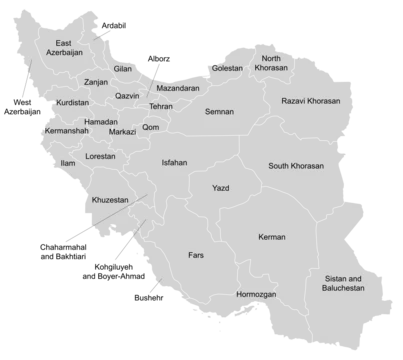
Razavi Khorasan is a province in northeastern Iran, one of the country's 31 provinces. Its capital, Mashhad, is Iran's second-largest city. The province was created in 2004 when the former Khorasan province was split into three; it was assigned to Region 5 in 2014, with Mashhad serving as the secretariat. The name "Razavi" refers to Ali al-Rida, the eighth Imam of Twelver Shia Islam, who died in Tus in 818 and is buried in Mashhad.
The broader region of Greater Khorasan has seen many dynasties and governments rise and fall. Arab, Turk, Kurdish, and Turkmen tribes repeatedly reshaped the area. Ancient Iranian geographers divided Iran into eight parts, with Greater Khorasan being the largest and most prosperous. Esfarayen was an early settlement for Aryan tribes after their arrival. The Parthian Empire was based near Merv in Khorasan for many years. Under the Sassanids, a Spahbod (Lieutenant General) called Padgošban governed the province, assisted by four margraves. During the Muslim conquest of Persia, Khorasan was split into four sections named after the cities Nishapur, Merv, Herat, and Balkh. The Rashidun Caliphate conquered it in 651, and it remained under Abbasid rule until 820, followed by the Iranian Tahirid dynasty until 873 and the Samanid dynasty in 900. Khorasan was Iran's largest province until it was divided on 29 September 2004 into Razavi Khorasan, North Khorasan, and South Khorasan, a decision approved by parliament on 18 May 2004 and by the Council of Guardians on 29 May 2004.
According to the 2006 census, the population was 5,515,980 in 1,426,187 households. By 2011, it had grown to 5,994,402 in 1,716,314 households, and by 2016, it reached 6,434,501 in 1,938,703 households. The largest ethnic group is Persians, with significant communities of Khorasani Kurds, Khorasani Turks, Turkmens, and Khorasani Baloch. In 2016, the Muslim population was 6,409,180, mostly Shia, with the shrine of the eighth Imam in Mashhad. A notable Sunni population lives in the province, forming majorities in cities like Torbat-e-Jam and Taybad. The 2016 census also recorded 7,159 Christians, 961 Zoroastrians, 135 Jews, 1,073 followers of other faiths, and 15,993 people who did not state a religion.
As of 2016, over 72% of the province's population—4,700,924 people—lived in cities. After Mashhad, the most populous cities are Nishapur, Sabzevar, and Torbat-e Heydarieh.
Archaeological sites include the Kohandezh hills in Nishapur, where an American team excavated between 1935 and 1940, uncovering objects later shared with the Shah's government. The Metropolitan Museum of Art published findings on Nishapur ceramics from those digs. After 1945, the site was looted for the international market for early Islamic art; today, the Kohandezh hills show remains of those excavations. Shadiyakh was a major palace in old Nishapur until the 7th century, becoming more important afterward, but was completely ruined in the 13th century. It was home to figures like Farid al-Din Attar, whose tomb is there.
The province has many natural attractions, including mineral springs, lakes, recreational areas, caves, protected regions, and hiking spots. It also contains numerous religious sites, such as the shrine of Imam Reza, Goharshad Mosque, and many mausoleums and Imamzadehs. The Cultural Heritage of Iran lists 1,179 sites of historical and cultural significance across all three Khorasan provinces. Popular attractions in Razavi Khorasan include in Mashhad: the Imam Reza Shrine, Goharshad Mosque, the Tomb of Nader Shah, the Tomb of Khajeh Rabie, the Tomb of Ferdowsi, and the Haruniyeh Dome. In Nishapur: the Mausoleum of Attar of Nishapur, the Mausoleum of Omar Khayyám, the Tomb of Kamal-ol-molk, the Tomb of Heydar Yaghma, Shadiyakh, and the Jameh Mosque of Nishapur. In Sabzevar: the Khosrogerd Minaret, Pamenar Mosque, Jameh Mosque of Sabzevar, the Tomb of Hadi Sabzevari, and the Tomb of Boghrat. In Kashmar: the Arg of Kashmar, the Tomb of Hassan Modarres, Imamzadeh Seyed Morteza, Imamzadeh Hamzeh, Imamzadeh Mohammad, the Grave of Pir Quzhd, the Jameh Mosque of Kashmar, Haj Soltan Religious School, and Haji Jalal.
- Capital
- Mashhad
- Area
- Part of former Khorasan province
- Major Ethnic Groups
- Persians, Khorasani Kurds, Khorasani Turks, Turkmens, Khorasani Baloch
- Major Religion
- Shia Islam (with significant Sunni minority)
- Created
- 2004 (division of Khorasan province)
Lore & Background
Razavi Khorasan province is situated in northeastern Iran, with Mashhad, the nation’s second-most-populous city, serving as its capital. The province was established in 2004 when the former Khorasan province was divided into three, and its name honors Ali al-Rida, the eighth Imam of Twelver Shia Islam, who died in Tus in 818 and is buried in Mashhad. The broader Greater Khorasan region was historically the largest and most prosperous segment of ancient Iran, once divided into eight parts by early geographers. The Parthian Empire long maintained its base near Merv within this territory, and under the Sassanid dynasty, a Spahbod governed the province alongside four margraves. Following the Muslim conquest of Persia, Khorasan was split into four sections named after the major cities of Nishapur, Merv, Herat, and Balkh. The region saw successive rule by the Rashidun Caliphate, the Abbasid Caliphate, the Iranian Tahirid dynasty, and the Samanid dynasty. The province’s population was recorded as over 6.4 million in the 2016 census. The predominant ethnic group is Persians, with significant communities of Khorasani Kurds, Khorasani Turks, Turkmens, and Khorasani Baloch. The majority of residents are Shia Muslims, drawn by the shrine of Imam Reza in Mashhad, though a notable Sunni population forms the majority in cities such as Torbat-e-Jam and Taybad. Small communities of Christians, Zoroastrians, and Jews also reside in the province.
Reader's Guide
Razavi Khorasan province is one of the three provinces created in 2004 after the division of the former Khorasan province. Its capital, Mashhad, is the second-most-populous city in Iran. The province’s name refers to Ali al-Rida, the eighth Imam of Twelver Shia Islam, who died in Tus in 818 and is buried in Mashhad. Historically, the Greater Khorasan region was the largest and most flourishing of eight segments into which ancient Iranian geographers divided Iran. It saw the rise and fall of many dynasties and governments, with various Arab, Turk, Kurd, and Turkmen tribes bringing changes over time. The Parthian Empire was based near Merv in Khorasan for many years, and during the Sassanid era, the province was governed by a Spahbod and four margraves. After the Muslim conquest, Khorasan was divided into four parts named after Nishapur, Merv, Herat, and Balkh. The Rashidun Caliphate conquered the territory in 651, followed by Abbasid, Tahirid, and Samanid rule. The province holds major religious significance as the site of the Imam Reza shrine, a major pilgrimage destination for Twelver Shia Muslims. The population is predominantly Persian, with sizeable Khorasani Kurdish, Khorasani Turkish, Turkmen, and Khorasani Baloch communities. Most inhabitants are Shia Muslims, though a significant Sunni population exists, particularly in cities such as Torbat-e-Jam and Taybad. Smaller communities of Christians, Zoroastrians, and Jews are also present. Notable archaeological sites include the Kohandezh hills in Nishapur, where excavations uncovered early Islamic ceramics, and Shadiyakh, an important palace that was home to the poet Farid al-Din Attar before its destruction in the 13th century. The province contains numerous historical and natural attractions, including mineral springs, caves, and protected regions, as well as many religious buildings and pilgrimage sites beyond the Imam Reza shrine, such as the Goharshad mosque and various mausoleums. The Cultural Heritage of Iran lists 1,179 sites of historical and cultural significance across all three Khorasan provinces.
Did You Know?
- Razavi Khorasan was created after the division of Khorasan province on 29 September 2004.
- The shrine of Imam Reza and Goharshad Mosque are major religious attractions in Mashhad.
Frequently Asked Questions
What is Razavi Khorasan province?
It is one of Iran's 31 provinces located in the northeastern part of the country, with Mashhad as its capital and the nation's second-most-populous city.
When was Razavi Khorasan province established?
It was carved out in 2004 as part of a broader administrative reorganization that split the older, larger Khorasan province into smaller units.
What is the religious landscape of Razavi Khorasan province?
Shia Islam is the predominant faith throughout the province, while a significant Sunni minority also lives in the region.
More in Provinces Of Iran 1-24
Spotted an error? Know more?
This is a living reference — every entry is fact-audited, and reader corrections feed straight into our audit queue. Suggest an edit · See this site's audit record