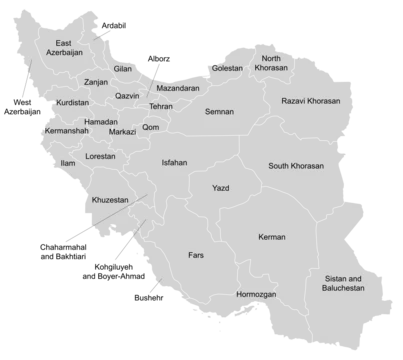
Hamadan province
Ancient province in western Iran, site of Ecbatana.

سید محمود جوادی · CC BY 3.0
Hamadan Province is one of the 31 provinces of Iran, situated in the Zagros Mountains and covering an area of 19,546 square kilometers. Its capital, the city of Hamadan, occupies the site of Ecbatana, the ancient capital of the Medes built before their union with the Persians. According to the poet Ferdowsi, Ecbatana was founded by the legendary King Jamshid. Historical records describe a castle in the city called Haft Hessar, said to have a thousand rooms and comparable grandeur to the Tower of Babylon. The city’s structures are linked to Diya Aku, a Median king from around 700 BC, who according to Greek sources transformed the settlement into a vast capital known as Ekbatan or Hegmataneh. During the Parthian era, while Ctesiphon served as Persia’s main capital, Hamadan became the summer capital and residence for Parthian rulers, a tradition continued by the Sassanids who built summer palaces there. After the Arab conquest following the war of Nahavand in 633, the province experienced periods of prosperity and decline. It suffered damage under the Buwayhids, and in the 11th century, the Seljuks moved their capital from Baghdad back to Hamadan. The city was completely destroyed during the Timurid invasion but revived under the Safavids. In the 18th century, it was surrendered to the Ottomans before being retaken by Nader Shah Afshari and returned to Iran by treaty. Lying on the Silk Road and major western trade routes, Hamadan has long been a commercial center. Local Jewish tradition identifies the city with Shushan, the capital of ancient Persia in the Book of Esther, and the Tombs of Mordecai and Esther are located in modern Hamadan. The province is linguistically diverse: Persian is spoken in Hamadan and Tuyserkan, Azerbaijani in the north, Kurdish in the west, and Luri and Laki in the south. The population is overwhelmingly Muslim, predominantly Shia, with small Sunni and Zoroastrian communities.
- Capital
- Hamadan
- Major languages
- Persian, Azerbaijani, Kurdish, Luri, Laki
Lore & Background
Hamadan Province is situated in the Zagros Mountains and covers an area of 19,546 square kilometers. Its landscape is defined by this mountainous terrain. The province is one of the most ancient parts of Iran, with its capital city, Hamadan, built on the site of Ecbatana, the capital of the Medes. According to the poet Ferdowsi, Ecbatana was founded by the mythical King Jamshid. Historical records describe a castle in the city called Haft Hessar, said to have a thousand rooms and grandeur equaling the Tower of Babylon. The city’s structures are linked to Diya Aku, a Median king from around 700 BC. During the Parthian era, Hamadan served as the summer capital for Parthian rulers, and the Sassanids later built their summer palaces there. The city lay on the Silk Road and was a significant trade hub. Local Jewish traditions identify Hamadan as Shushan, the capital of Ancient Persia under King Ahasuerus as mentioned in the Book of Esther, and the Tombs of Mordecai and Esther are located in the modern city. The population is overwhelmingly Muslim, with Persian spoken in the city of Hamadan and Tuyserkan, while Azerbaijani is common in the north, Kurdish in the west, and Luri and Laki in the southern areas.
Reader's Guide
Hamadan Province holds enduring significance as a cradle of Iranian civilization, preserving the legacy of the Medes and serving as a political and cultural center for successive empires. Its capital, Hamadan, is one of the oldest continuously inhabited cities in Iran, with roots in the biblical and classical worlds. The province's location on the Silk Road facilitated commerce and cultural exchange for centuries. Today, its demographic diversity—with Persian, Azerbaijani, Kurdish, Luri, and Laki speakers—reflects its historical role as a crossroads. The province's mountainous geography, dominated by Mount Alvand, shapes its agriculture and settlement patterns. Despite deforestation, much of the land remains farmland or pasture. The province's literacy rate, household access to electricity and piped water, and urbanization trends indicate ongoing development. Hamadan's historical layers, from Median palaces to Safavid revival, make it a key site for understanding Iran's pre-Islamic and Islamic past.
Did You Know?
- The Tombs of Mordecai and Esther are located in modern-day Hamadan.
Gallery
Frequently Asked Questions
Who is Hamadan province?
Hamadan province is one of Iran's 31 provinces, nestled in the Zagros Mountains of western Iran. Its capital, the city of Hamadan, is built directly on the site of Ecbatana, the ancient capital of the Medes.
What role does Hamadan province play in Iran's history?
The province long served as a summer seat of power for both Parthian and Sassanid rulers, making it a recurring political center across multiple empires. It is widely regarded as one of the cradles of ancient civilization in the region.
How does Hamadan province's story end?
There is no single narrative conclusion; the province persists today as an active administrative region home to roughly 1.7 million people. Its ancient chapter is preserved in the archaeological remains of Ecbatana, while its modern identity continues to evolve.
More in Provinces Of Iran 1-24
Spotted an error? Know more?
This is a living reference — every entry is fact-audited, and reader corrections feed straight into our audit queue. Suggest an edit · See this site's audit record