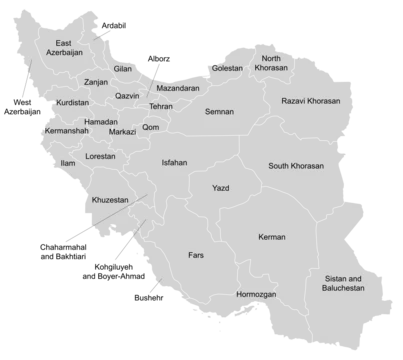
Golestan province
Iranian province known as 'land of flowers' with diverse ethnic groups.

Aboutaleb Nadri · CC BY 4.0
Golestan province sits in northeastern Iran, southeast of the Caspian Sea, and is one of the country’s 31 provinces. Its capital, Gorgan, was known as Esterabad until 1937. The province was created in 1997 when it was separated from Mazandaran. To the north, it shares a border with Turkmenistan; the crossing at Incheh Borun is a key point between the two nations. In 2014, Golestan became part of Region 1, a division made solely for coordination and development. Most residents are Shia Muslims.
The name Golestan—also spelled Gulistan or Golastan—comes from Iranian languages like Persian, Kurdish, and Mazandarani, combining “gul” (flower) with “-stan” (land), meaning “land of flowers.” The capital Gorgan traces its name to the historical region of Gorgân, from Middle Persian Gurgān and Old Persian Varkāna, which means “land of wolves” (the root of the Greek Hyrkanía and Latin Hyrcania). Wild wolves still live in the province.
Human settlement in the area dates back to around 10,000 BC. Ruins of the ancient city of Jorjan remain near present-day Gonbad-e Kavus; Jorjan was an important Persian city on the Silk Road. Under the Achaemenid Empire, the region was likely administered as part of Parthia and does not appear separately in the provincial lists of Darius and Xerxes. However, Herodotus mentions the Hyrcanians, led by Megapanus, in Xerxes’ army during the invasion of Greece.
According to a 2006 estimate by Iran’s Ministry of Education, the ethnic composition of the province was: Turkmens 34.20%, Mazandaranis 30.40%, Sistanis and Persians 14.90%, Baluchis 10.90%, Qizilbash 7.30%, and others (including Azeris, Kazakhs, Kurds, Armenians, and Georgians) 2.3%. Official statistics subsumed Mazandaranis living in the foothills to Shah Pasand under “Persian.” Locally, Persians and Mazandaranis are considered the old natives, while other groups are seen as ethnic immigrants. Most Mazandaranis live in Gorgan, Ali Abad, Kordkuy, Bandar-e Gaz, and Gonbad-e Kavus, and speak the Mazanderani language. Turkmens, who are Sunni Muslims, inhabit the northern plain called Turkmen Sahra; they have lived there since the 15th century, with main cities being Gonbad-e Kavus and Bandar Torkaman, and sizable communities in Gorgan, Ali Abad, Kalaleh, and eastern townships. Azeris and Qizilbash arrived centuries before the Turkmens and became fully Shia, culturally aligning with Persians and other Shias. Sistani Persians and Baluchis began arriving in the early 20th century and continue to come due to drought in Sistan. People in Kordkuy originate from Kurdish areas of western Iran (Kermanshah and Kurdistan provinces) and belong to the Kord-rostami tribe, with subtribes Aghili and Sepanlou; they also live in Gorgan and Bandare Gaz. Maraveh Tappeh has a mixed population of Sunni Turkmens and Shia Kurds. Other groups—Kazakhs, Khorasani Kurds, Georgians, and Armenians—also reside here, preserving their traditions. A small Baháʼí community exists in Shahpasand.
The province’s population was 1,593,055 in 2006, 1,777,014 in 2011, and 1,868,819 in 2016. Over 54% of the population (1,015,774 people) lived in cities as of 2016.
The Gonbad-e Qabus tower, the world’s tallest brick structure of its kind, stands in the province. Golestan has mild, temperate weather for most of the year. Geographically, it consists of plains and the Alborz mountain range; in the eastern Alborz, the mountains run northeast and decrease in height. The highest point is Shavar, at 3,945 meters. Major rivers include the Gharasu and Gorganrud.
Golestan National Park, Iran’s largest national park, spans three provinces: Golestan, Mazandaran, and North Khorasan. It is notable for containing a range of climates, from humid near the Caspian Sea to desert farther south. A road has been built through the forest, allegedly to ease travel for villagers and woodmen, despite experts’ repeated calls to route such roads around the forest instead. This construction threatens the park’s animal and plant life. The park is rich in biodiversity, with wildlife including wild deer.
- Capital
- Gorgan
- Majority Religion
- Shia Islam
- Key Border Crossing
- Incheh Borun (with Turkmenistan)
Lore & Background
Golestan province, whose name means "land of flowers" in Iranian languages, is situated in northeastern Iran, southeast of the Caspian Sea. Its capital, Gorgan, was historically known as Esterabad until 1937; the name Gorgan derives from the Old Persian term Varkāna, meaning "land of wolves," and wild wolves still inhabit the province. The province was created in 1997 when it was split from Mazandaran Province. It shares a northern border with Turkmenistan, with Incheh Borun serving as a key crossing point. Geographically, Golestan features both plains and the Alborz mountain range; the highest point is Mount Shavar at 3,945 meters, and major rivers include the Gharasu and Gorganrud. The climate is generally mild and temperate. The province is home to the Gonbad-e Qabus tower, the world's tallest brick structure of its kind. Golestan National Park, Iran's largest national park, spans three provinces and is noted for its significant biodiversity, including wild deer, and encompasses a range of climates from humid Caspian conditions to desert. Human settlement in the area dates back to 10,000 BC, with the ancient city of Jorjan, an important Silk Road center, located near modern Gonbad-e Kavus. Under the Achaemenid Empire, the region was likely administered as a sub-province of Parthia, and Hyrcanians led by Megapanus are recorded in Herodotus' account of Xerxes' invasion of Greece. The population is ethnically diverse, including Turkmens, Mazandaranis, Sistanis, Baluchis, Qizilbash, and others such as Azeris, Kazakhs, Kurds, Armenians, and Georgians, with the majority being Shia Muslims.
Reader's Guide
Golestan province holds significance as a historically rich region bridging Iran and Central Asia. Its location on the Silk Road fostered ancient trade and cultural exchange, evidenced by the world's tallest brick structure, the Gonbad-e Qabus tower. The province's ethnic diversity—including Turkmens, Mazandaranis, Sistanis, Baluch, Qizilbash, and others—reflects centuries of migration and settlement. The Turkmen Sahra plain in the north is home to Sunni Turkmen communities, while Mazandaranis are considered the old natives. Golestan National Park, Iran's largest, spans three provinces and contains remarkable biodiversity, though its ungulate populations declined sharply due to poaching between the 1970s and 2010s. The province's temperate climate and geography, ranging from Alborz mountains to plains, support agriculture and unique ecosystems.
Did You Know?
- Golestan means 'land of flowers' in Persian, Kurdish, and Mazandarani.
- The capital Gorgan derives from Old Persian Varkāna, meaning 'land of wolves'.
- The world's tallest brick structure, the Gonbad-e Qabus tower, is located in the province.
A Name Carved in Wolves and Flowers
The name Golestan carries a poetic weight that echoes across the Persian-speaking world. Breaking it into its components, "gul" (flower) and "stan" (land or region), the province literally means "land of flowers"—a toponym shared by places in several countries with Persian linguistic heritage. Yet the capital city tells a far older and wilder story. Gorgan traces its name through Middle Persian Gurgān back to Old Persian Varkāna, recorded in the Behistun Inscription, where it signified "land of wolves." That same root gave rise to the Ancient Greek Hyrcania and its Latin counterpart, linking the region to classical scholarship. Remarkably, wild wolves still roam the province's terrain, keeping that ancient association alive. The capital itself only received its current name in 1937, when the city formerly known as Esterabad was renamed, marking a modern administrative rebranding layered atop millennia of linguistic evolution.
A Tapestry of Peoples
Few provinces in Iran showcase such layered ethnic diversity. A 2006 Ministry of Education estimate placed Turkmens at roughly a third of the population, followed closely by Mazandaranis, with Sistani Persians, Baluchis, Qizilbash, and smaller groups of Azeris, Kazakhs, Kurds, Armenians, and Georgians rounding out the mosaic. The Mazandaranis, concentrated in cities like Gorgan, Kordkuy, and Gonbad-e Kavus, are regarded by nearly all residents as the original inhabitants. The Turkmens, who settled the northern Turkmen Sahra plain from the fifteenth century onward after centuries of nomadic life, practice Sunni Islam and form a significant presence in several eastern towns. Azeris and Qizilbash arrived even earlier and have since become fully Shia, culturally aligning with the broader Shia community. Sistani Persians and Baluchis are the most recent arrivals, migrating from the early twentieth century onward, driven by persistent drought in their Sistan homeland. A small Baháʼí community also resides in Shahpasand. Population figures climbed steadily from about 1.59 million in 2006 to nearly 1.87 million by 2016.
Between Caspian Mist and Desert Air
Golestan's landscape is split into two distinct zones: broad plains and the rugged eastern Alborz mountains, which trend northeastward and taper in elevation as they extend. The province's summit, Shavar, rises to 3,945 meters, while the Gharasu and Gorganrud rivers carve through the terrain. The climate is generally mild and temperate, but the range is striking—humid air from the Caspian coast gives way to arid conditions farther south. This gradient is most vividly captured in Golestan National Park, Iran's largest, which stretches across Golestan, Mazandaran, and North Khorasan. Covering five percent of the country's forests, the park harbors at least 1,362 recorded plant species. Its western zone, typical of the Hyrcanian range, shelters broad-leaved remnant species like oak and maple, while the eastern steppe is dominated by evergreen shrubs such as juniper and artemis. Fauna include wild deer, bears, and smaller antelope species. Yet a 2017 study documented a 68 to 89 percent decline in ungulate numbers between the late 1970s and 2014, attributed largely to poaching. Plans to cut a road through the park, despite expert warnings, threaten this fragile ecological corridor.
From Silk Road Crossroads to Modern Province
Archaeological evidence places human habitation in this region as far back as 10,000 BC. The ancient city of Jorjan, whose traces still surface near present-day Gonbad-e Kavus, once thrived as a significant Persian trading hub along the Silk Road. Under the Achaemenid Empire, the area appears to have been administered as a sub-province of Parthia, never appearing as a distinct entry in the provincial registers of Darius or Xerxes. Nevertheless, the Hyrcanians—led by a figure named Megapanus—feature in Herodotus's account of Xerxes' invasion force, confirming the region's presence in classical military history. The province's modern administrative identity is comparatively recent: it was carved out of Mazandaran Province in 1997, and on 22 June 2014 it was assigned to Region 1 in a nationwide reorganization aimed at streamlining development coordination. To the north, the border with Turkmenistan is marked by the Incheh Borun crossing, a vital point of passage between the two nations. The province also claims a singular architectural landmark: the Gonbad-e Qabus tower, recognized as the world's tallest brick structure of its type.
Gallery
Frequently Asked Questions
What is Golestan Province in Iran?
Golestan is a northeastern Iranian province situated along the southeastern shore of the Caspian Sea, often nicknamed the 'land of flowers' for its lush, varied terrain. It hosts a mix of ethnic communities and is administered from its capital city, Gorgan.
What is the capital of Golestan Province?
The provincial capital is Gorgan, a city that carried the older name Esterabad until it was officially renamed in 1937. It functions as the administrative and cultural hub for the entire province.
Does Golestan Province share a border with another country?
Yes, Golestan meets Turkmenistan to the north, and the Incheh Borun crossing point serves as a vital gateway between the two nations. This border connection makes the province strategically important for regional trade and cross-border travel.
More in Provinces Of Iran 1-24
Spotted an error? Know more?
This is a living reference — every entry is fact-audited, and reader corrections feed straight into our audit queue. Suggest an edit · See this site's audit record