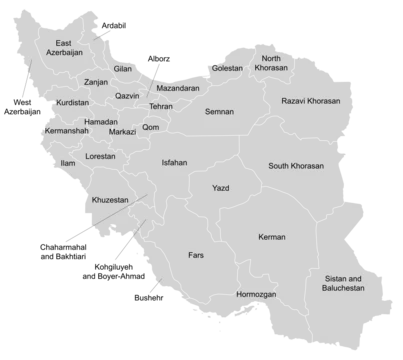
North Khorasan province
Province in northeast Iran, created from the 2004 division of Khorasan.

North Khorasan province, with Bojnord as its capital, sits in the northeast of Iran. It is one of the country’s 31 provinces. The province was established in 2004, when the former Khorasan—once Iran’s largest province—was divided into three separate entities: Razavi Khorasan, North Khorasan, and South Khorasan. This division was approved by Iran’s parliament on 18 May 2004 and by the Council of Guardians on 29 May 2004, taking effect on 29 September 2004. In 2014, North Khorasan was placed within Region 5.
The broader region of Greater Khorasan has seen many dynasties and governments rise and fall. Over time, various groups—Persians, Arabs, Turks, Kurds, and Turkmens—have repeatedly reshaped the area. Ancient Iranian geographers split Iran into eight parts, with Greater Khorasan being the largest. Among the province’s cities, Esfarayen was a key settlement for Aryan tribes entering Iran. The Parthian Empire was based near Merv in Khorasan for many years, and during that era, Esfarayen was an important village of Nishapur.
Under the Sasanians, the province was governed by a Spahbod (Lieutenant General) known as “Padgoosban,” along with four margraves, each commanding one of the province’s four sections. In 651, the army of Islamic Arabs invaded Khorasan. The Abbasid clan held the territory until 820, after which the Iranian Taherid clan ruled from 896, followed by the Samanid dynasty in 900. During the Muslim conquest of Persia, Khorasan was split into four parts, each named after its largest city: Nishapur, Merv, Herat, and Balkh. Mahmud of Ghazni conquered Khorasan in 994, and in 1037 Tuğrul Beg, the first Seljuq ruler, took Nishapur. Mahmud Qaznavi fought back against invaders several times, and eventually the Qaznavi Turks defeated Sultan Sanjar. In 1157, the Khwarazmids conquered Khorasan, and in 1220 it was annexed by the Mongols under Genghis Khan. After his death in 1226, Khorasan passed to his son Tolui, then to Tolui’s son Hulegu, the first emperor of the Mongolic Ilkhanate of Persia. In the 14th century, the Sarbedaran movement raised a flag of independence in Sabzevar, and in 1368 Khorasan fell to Tamerlane. Uzbek tribes occupied it in 1507, and after Nader Shah’s death in 1747, the Afghans took control. In 1824, Herat became independent for several years when the Afghan Empire split between the Durranis and Barakzais. The Persians besieged the city in 1837, but the British helped the Afghans repel them. In 1856, the Persians invaded again and briefly recaptured Herat, leading directly to the Anglo-Persian War. Hostilities ended in 1857 with the Treaty of Paris, and Persian troops withdrew from Herat. Afghanistan reconquered Herat in 1863 under Dost Muhammad Khan, two weeks before his death.
Today, North Khorasan is one of Iran’s most ethnically diverse provinces. Most residents are Shia Muslims, including Khorasani Kurds, Persians, and Khorasani Turks, though a small Sunni minority, mostly Turkmen, also exists. A sizeable Lur population once lived here, but most have returned to western Iran, leaving no trace in the province today. There was also a large Arab community that settled during the Arab invasion, but by 1875 they had intermarried so extensively with Persians and Turks that they became indistinguishable, abandoning their language and culture for local ones.
According to the 2006 National Census, the province had 791,930 people in 198,626 households. By 2011, the population was 867,727 in 240,885 households. The 2016 census recorded 863,092 people in 254,747 households. Over 56% of the population—484,346 people—lived in cities as of 2016.
The province offers many historical and natural attractions, including mineral water springs, small lakes, recreational areas, caves, protected regions, and hiking spots. Most historical relics date from the Qajar era, as earthquakes have repeatedly destroyed older structures. The Cultural Heritage Organization of Iran lists 1,179 sites of historical and cultural significance across all three Khorasan provinces. Popular attractions include Besh Qardash (five brothers) and Baba-Aman springs, as well as the Jameh Mosque of Jajarm.
Higher education institutions in the province include the University of Bojnurd, Islamic Azad University of Bojnurd, Eshragh Institute of Higher Education (Bojnurd), Islamic Azad University of Shiravan, Hakiman Institute of Higher Education (Bojnurd), and Khorasan University of Medical Science (Bojnurd).
- Capital
- Bojnord
- Country
- Iran
- Established
- 29 September 2004 (division of Khorasan)
- Major ethnic groups
- Khorasani Kurds, Persians, Khorasani Turks, Turkmen
- Major religion
- Shia Islam (majority), Sunni Islam (minority)
Lore & Background
North Khorasan province is situated in the northeast of Iran, with Bojnord as its capital. It is one of three provinces created in 2004 when the former Khorasan province—once the largest in Iran—was divided. The province lies within the historical region of Greater Khorasan, which ancient Iranian geographers considered the largest of Iran’s eight segments. This territory has been shaped by successive waves of Persians, Arabs, Turks, Kurds, and Turkmens. The city of Esfarayen, located in the province, was a notable settlement for Aryan tribes entering Iran and later, during Parthian times, an important village of Nishapur. Under the Sasanian Empire, the area was administered by a Spahbod (Lieutenant General) titled "Padgoosban," alongside four margraves commanding separate sections. Following the Arab conquest in 651, Khorasan came under Abbasid control until 820, then passed to the Iranian Taherid and Samanid dynasties. The region was later conquered by Mahmud of Ghazni in 994, the Seljuq ruler Tuğrul Beg in 1037, and the Khwarazmids in 1157. Mongol forces under Genghis Khan annexed it in 1220, and it later passed to his son Tolui and grandson Hulegu of the Ilkhanate. The Sarbedaran movement briefly raised an independent flag in Sabzevar in the 14th century, and Tamerlane took control in 1368. Uzbek tribes occupied the area in 1507, and after Nader Shah’s death in 1747, it fell to the Afghans. The province is ethnically diverse, with most inhabitants being Shia Muslims, including Khorasani Kurds, Persians, and Khorasani Turks, alongside a Sunni Turkmen minority. A once-present Arab community had largely assimilated by 1875. The province features many Qajar-era historical sites, as older relics have been lost to earthquakes, and natural attractions such as mineral springs, lakes, caves, and protected hiking areas.
Reader's Guide
North Khorasan province is significant as one of the three provinces created from the historic division of Khorasan in 2004, reflecting a major administrative reorganization of Iran's largest former province. Its territory is part of Greater Khorasan, a region central to Iranian history, having been a base for the Parthian empire and a focal point for Aryan settlement. The province is noted for its ethnic and linguistic diversity, including Khorasani Kurds, Persians, Khorasani Turks, and Turkmen, with a Shia Muslim majority and a Sunni Turkmen minority. Historically, the area saw waves of conquests by Arabs, Turks, Mongols, and others, and its older relics have been ravaged by earthquakes, leaving most historical sites from the Qajar era.
Did You Know?
- North Khorasan was created after the division of Khorasan, which was the largest province of Iran, on 29 September 2004.
- Most people in North Khorasan are Shia Muslims, with a Sunni minority who are generally Turkmen.
Frequently Asked Questions
What is North Khorasan province?
North Khorasan is one of Iran's 31 provinces located in the northeastern part of the country, with Bojnord as its capital city. It came into being in 2004 when the formerly single, massive Khorasan province was divided into three smaller administrative units.
When was North Khorasan officially created and who approved it?
The Iranian parliament gave its approval on 18 May 2004, and the Council of Guardians followed with its own sign-off on 29 May 2004. The province's formal establishment date is recorded as 29 September 2004, marking the completion of the Khorasan split.
Why was the original Khorasan province split into three?
The old Khorasan had been the largest single province in Iran, making centralized governance unwieldy. Breaking it into Razavi Khorasan, North Khorasan, and South Khorasan in 2004 allowed each area to have its own dedicated provincial administration and capital.
More in Provinces Of Iran 1-24
Spotted an error? Know more?
This is a living reference — every entry is fact-audited, and reader corrections feed straight into our audit queue. Suggest an edit · See this site's audit record