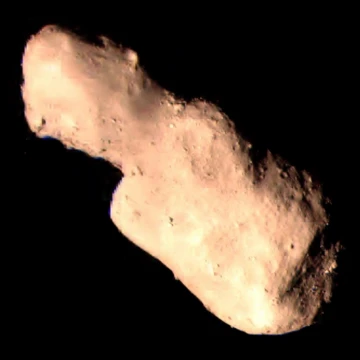
101955 Bennu
A carbonaceous asteroid with a notable impact risk and OSIRIS-REx sample return.
Last updated
101955 Bennu is a carbonaceous Apollo-group asteroid discovered by the LINEAR Project on 11 September 1999. It is a potentially hazardous object with the second highest cumulative rating on the Palermo scale, having a cumulative chance of about 1 in 1,750 of impacting Earth between 2178 and 2290. The asteroid was the target of the OSIRIS-REx mission, which returned samples to Earth in 2023.
Physical characteristics
Bennu has a roughly spheroidal, spinning-top shape with a well-defined equatorial ridge. Its axis of rotation is tilted 178 degrees to its orbit, and its rotation is retrograde. Ground-based radar initially suggested a fairly smooth shape with one prominent boulder, but OSIRIS-REx revealed a much rougher surface with over 200 boulders larger than a certain size, the largest being across.
The boulders contain veins of high-albedo carbonate minerals, 3 to 15 centimeters wide and over one meter long, believed to have formed in hot water channels on the parent body. A 2026 analysis indicated that Bennu is blanketed by boulders of differing physical properties, with cracks resulting from geological processes, micrometeoroid impacts, or thermal fatigue. Fine-grained regolith has accumulated at the equator, possibly due to low gravity and fast rotation.
Bennu's rotation is accelerating by about one second per century due to the Yarkovsky–O'Keefe–Radzievskii–Paddack effect. Spitzer Space Telescope observations in 2007 gave an effective diameter consistent with other studies and a low visible geometric albedo. Thermal inertia varies by about 19% per rotation, and no dust coma emission has been detected.
Origin and evolution
Bennu's carbonaceous material originated from the breakup of a much larger parent body, likely a minor planet or proto-planet. It is thought to be a rubble pile formed within the past 65 million years, with its atoms created in dying stars and its material accreting 4.5 billion years ago. Its mineralogy and chemistry were established during the first 10 million years of the Solar System, involving geologic heating and chemical transformation inside a larger body. Bennu probably began in the inner asteroid belt as a fragment from a 100 km diameter body, with simulations suggesting a 70% chance of origin from the Polana family and 30% from the Eulalia family.
Impactors on its boulders indicate it has been in near-Earth orbit for 1–2.5 million years. Its orbit drifted due to the Yarkovsky effect and mean motion resonances with giant planets. A possible cometary origin has been suggested based on spectroscopic similarities with known comets.
Orbit
Bennu orbits the Sun with a period of 1.19 years as of 2022. Earth gets as close as about 480,000 km from its orbit around 23 to 25 September. Past close approaches include 0.0147 au on 22 September 1999 and 0.033 au on 20 September 2005. Future approaches under 0.04 au will occur on 30 September 2054 and 23 September 2060, perturbing the orbit slightly.
A closer approach on 25 September 2135 will reach about 0.0014 au. Between the 2060 and 2135 approaches, Bennu completes 64 orbits, changing its period to 427 days; after 2135, the period will increase to about 452 days. Before the 2135 approach, Bennu will be at its maximum distance from Earth on 27 November 2045 at 2.34 AU.
An asteroid of 500 m diameter impacts Earth about every 130,000 years on average. A 2010 study predicted eight potential impacts between 2169 and 2199, with a cumulative probability not exceeding 0.071%. Improved estimates in 2014 gave a cumulative probability of 0.037% between 2175 and 2196, corresponding to a Palermo scale rating of −1.71. An impact would release 1,200 megatons of TNT equivalent.
Exploration
The OSIRIS-REx mission launched on 8 September 2016 and arrived at Bennu on 3 December 2018. Investigators soon announced spectroscopic evidence for hydrated minerals, implying liquid water on the parent body. On 20 October 2020, the spacecraft descended and collected a sample.
After a final flyover on 7 April 2021, departure was completed on 10 May 2021. The sample capsule returned to Earth on 24 September 2023, landing in Utah. Upon opening, black dust and debris were found on the avionics deck. On 11 October 2023, the capsule was opened for a first look at the sample.
Further studies on 13 December 2023 reported organic molecules and unknown materials. On 11 January 2024, the container was fully opened, revealing a total of 121.6 g of material, over twice the mission goal. An overview of preliminary analytical studies was reported on 15 May 2024.
Did You Know?
- Bennu was named by third-grade student Michael Puzio from North Carolina, who entered a 'Name that Asteroid!' contest in 2012.
- Its features are named after birds and bird-like creatures in mythology.
- The asteroid's provisional designation was assigned by the Lincoln Near-Earth Asteroid Research (LINEAR) survey.
More in Potential Impact Events Caused by near-Earth Objects
Sources
Compiled from Wikipedia and the sources listed below. Text from Wikipedia is available under CC BY-SA 4.0; this entry is adapted from it.
- Wikipedia: 101955 Bennu (CC BY-SA 4.0).
Spotted an error? Know more?
Reader corrections go straight into our review queue. Suggest an edit · How this site is sourced