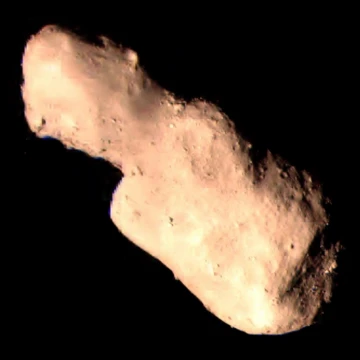
2018 VP1
A small Apollo asteroid with a brief observation arc.
Last updated
2018 VP1 is an Apollo near-Earth asteroid roughly 2 m in diameter. It was discovered on 3 November 2018 when it was about 0.003 AU from Earth. The asteroid had a 0.41% chance (1 in 240) of impacting Earth on 2 November 2020 01:12 UT.
Return
This small asteroid, roughly two meters across, orbits the Sun every two years and has a very low orbital tilt of just 3.2 degrees relative to the plane of the planets. Its closest possible approach distance to Earth’s orbit is only 9,700 kilometers. After passing near Earth in November 2018, it was predicted to return around November 2, 2020, give or take three days. While astronomers know exactly where Earth will be at any given time, the asteroid’s position along its path was uncertain because it had only been tracked for a short time and not seen for two years.
Because its orbit crosses Earth’s path, small differences in the calculated trajectory could shift its arrival time: one model (NEODyS) put it early, another (Sentry) right on schedule, and a third (JPL) late. The NEODyS solution predicted a close approach of 0.0004 AU on November 1, 2020, while Sentry estimated a 1-in-240 chance of impact on November 2. JPL’s nominal approach was 0.0028 AU, with a possible error range of plus or minus 4 million kilometers. The line of possible positions stretched across the Pacific Ocean.
By late May 2020, the asteroid reached opposition but was far too dim—magnitude 31—for any telescope to see; even the Hubble Space Telescope would need weeks of exposure to detect such a faint object. The November 2020 flyby itself was hidden in the Sun’s glare due to the asteroid’s low angle from the Sun. At just two meters in diameter, it could only produce a bright fireball and a meteorite field, similar to the Sutter’s Mill or 2014 AA events. It is not classified as a potentially hazardous object, since that category requires a diameter larger than 140 meters.
More in Potential Impact Events Caused by near-Earth Objects
Sources
Compiled from Wikipedia and the sources listed below. Text from Wikipedia is available under CC BY-SA 4.0; this entry is adapted from it.
- Wikipedia: 2018 VP1 (CC BY-SA 4.0).
Spotted an error? Know more?
Reader corrections go straight into our review queue. Suggest an edit · How this site is sourced