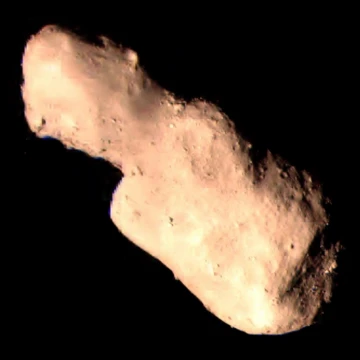
2020 CD3
A minimoon temporarily captured by Earth's gravity.
Last updated
2020 CD3 is a small near-Earth asteroid, also called a minimoon, which usually orbits the Sun but can briefly enter Earth's orbit through temporary satellite capture. Discovered on 15 February 2020 at Mount Lemmon Observatory, it was confirmed as an Earth-orbiting object ten days later. It is the second temporary satellite found while orbiting Earth, following 2006 RH120. According to its predicted path, 2020 CD3 entered Earth's gravitational pull around 2016–2017 and left it on 7 May 2020.
Discovery
On February 15, 2020, Theodore Pruyne and Kacper Wierzchoś spotted this object at the Mount Lemmon Observatory as part of the Mount Lemmon Survey, which itself is a component of the Catalina Sky Survey based in Tucson, Arizona. At the time, it was a dim 20th-magnitude point of light in Virgo, roughly 0.0019 AU from Earth. Its movement across the sky hinted that it might be orbiting Earth, so astronomers gathered more data to confirm its path. The find was submitted to the Minor Planet Center’s Near-Earth Object Confirmation Page, where a preliminary orbit was worked out from follow-up observations taken over six days.
The Minor Planet Center officially announced it in a Minor Planet Electronic Circular on February 25, 2020. No signs of solar radiation pressure were detected, and it couldn’t be matched to any known human-made object. While evidence pointed to it being a dense, rocky asteroid, the chance it was a dead satellite or rocket stage wasn’t completely dismissed. Precovery images have been traced back to May 2018.
Nomenclature
First called C26FED2, the asteroid was later confirmed and assigned the provisional name 2020 CD3 by the Minor Planet Center on 25 February 2020, a label that reflects when it was found. A permanent minor planet number has not been given, since the object’s observation span is only a few years and it hasn’t been tracked during enough oppositions.
Orbit
Prior to its temporary capture, the asteroid's heliocentric orbit was probably Earth-crossing, likely an Aten-type orbit (semi-major axis less than 1 AU). Because its heliocentric orbit is Earth-like, its motion relative to Earth is low, allowing slow approach and capture. Nominal orbit solutions suggest it was captured by Earth between 2016 and 2017 and left geocentric orbit by May 2020.
Its geocentric orbit is chaotic due to tidal forces from the Sun and Earth and repeated close encounters with the Moon, which gravitationally perturb it and cause instability. Between September 2017 and February 2020 it made 12 close approaches to Earth, never exceeding 0.0112 AU. On 15 September 2017 it passed 12000 km from the Moon. Its closest approach to Earth occurred on 4 April 2019 at 13104 km.
The final close approach in 2020 was on 13 February at about 41000 km from Earth's surface. Its orbital period around Earth ranged from 70 to 90 days. It escaped Earth's Hill sphere at roughly 0.01 AU in March 2020 and returned to solar orbit on 7 May 2020.
Physical characteristics
This space rock has an absolute magnitude of about 31.7, marking it as extremely tiny. By November 2020, research put its diameter at 1 to 2 meters.
Because there are too few observations, its rotation and reflectivity remain unknown. If it reflects light like a dark, carbon-rich C-type asteroid, its size could be 1.9 to 3.5 meters across, roughly the length of a small car. Based on a 2-meter diameter, the JPL Sentry system estimates its mass at 4,900 kilograms.
More in Potential Impact Events Caused by near-Earth Objects
Sources
Compiled from Wikipedia and the sources listed below. Text from Wikipedia is available under CC BY-SA 4.0; this entry is adapted from it.
- Wikipedia: 2020 CD3 (CC BY-SA 4.0).
Spotted an error? Know more?
Reader corrections go straight into our review queue. Suggest an edit · How this site is sourced