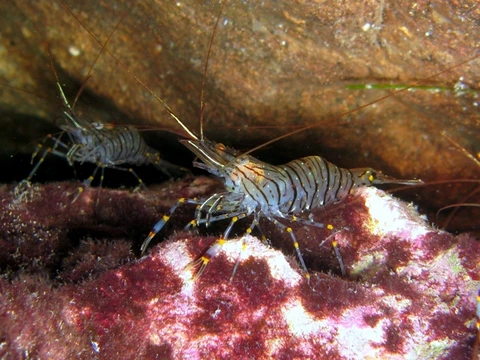
Tiger pistol shrimp
A snapping shrimp with a symbiotic goby partner and a sonic claw.

The tiger pistol shrimp (Alpheus bellulus) is a species of snapping shrimp in the family Alpheidae. It is notable for its symbiotic relationship with goby fish and its powerful claw, which can produce a high-speed bubble that stuns prey.
Quick Facts
- Taxon
- Alpheus bellulus
Facts from the source article.
Lore & Background
The tiger pistol shrimp was originally described by Miya & Miyake in a 1969 publication. Its body is stout and opaque, with a yellowish white or yellow background and irregular but symmetric patterns in light brown, brownish purple, or brownish orange. The right cheliped is larger and modified into a weapon that expels an air bubble at extreme speed, creating a violent shock wave that can kill or knock out prey. The sound from the collapsing bubble can reach 218 decibels and temperatures up to 4,800 degrees Celsius.
This shrimp dwells in sandy, muddy, and detrital substrata in shallow waters. It constructs burrows reinforced with shell and coral pieces, and constantly removes sediment to keep them clean. During initial burrow construction, the shrimp prioritizes building over feeding or resting, and is highly vulnerable to predation due to its limited vision. Burrow production contributes to sediment cycling in the marine ecosystem.
The tiger pistol shrimp lives in symbiosis with goby species such as Cryptocentrus cinctus, Amblyeleotris guttata, and Stonogobiops yasha. The shrimp maintains the burrow while the goby acts as a lookout. In one study, when no other food was available, the shrimp survived by eating goby feces. Some burrows are also shared with the porcelain crab Enosteoides lobatus, forming a three-way relationship.
Reader's Guide
The tiger pistol shrimp is one of the more popular pistol shrimp species in the marine aquarium hobby, valued for its subdued temperament, low cost, and basic care requirements. In captivity, it accepts a variety of prepared foods including flakes, pellets, frozen mysis shrimp, brine shrimp, and finely chopped seafood. Although sometimes blamed for fish deaths in aquariums, it is generally considered unlikely to attack fish for food.
Phylogenetic analysis suggests that Alpheus bellulus and Alpheus randalli belong to the same taxon within a monophyletic group. The amino acid composition of its cytochrome b protein is similar to that of A. randalli and A. lobidens. The species shares a translocation and inversion event of trnE in its mitogenome with several other Alpheus species, though there is not enough evidence to say this is common across the entire genus.
The symbiotic relationship with gobiid fish, particularly Amblyeleotris japonica off the coast of Japan, begins early in development and often continues into adulthood. The shrimp is not found in areas where the partner fish is absent and usually does not leave the burrow unless the fish is near the entrance. This relationship is considered important to the survival of both species.
Did You Know?
- The bubble produced by the tiger pistol shrimp can reach temperatures of up to 4,800 degrees Celsius, slightly cooler than the surface of the Sun.
- In one study, tiger pistol shrimp survived by eating the feces of their goby partner when no other food was available.
The Naming Paradox: When Common Names Defy Science
The terms shrimp and prawn are vernacular labels that carry no formal taxonomic weight whatsoever. They are not species, genera, or any recognized rank in biological classification. As crustacean taxonomist Tin-Yam Chan observed, neither word points to a definite group of organisms. The usage shifts from country to country and even within a single region, with some places applying "shrimp" to larger commercial species while others reserve it for smaller forms. L. B. Holthuis, writing in 1980, documented that the two words were used inconsistently even within one geographic area. In practice, the terms have drifted so far from any stable meaning that contemporary speakers treat them as nearly interchangeable. Biologists occasionally attempt to restrict these common names to particular taxa, but popular usage resists such constraints and continues to evolve independently of scientific intent.
Taxonomic Identity and the Problem of Classification
Prawns and shrimp are small aquatic crustaceans belonging to the order Decapoda, characterized by a hard exoskeleton and ten legs. Commercially significant swimming forms often fall under the suborder Dendrobranchiata, though some also belong to Caridea within the suborder Pleocyemata. In Europe, taxonomic work was heavily shaped by two abundant coastal species: the common shrimp (Crangon crangon), classified by Carl Linnaeus in 1758, and the common prawn (Palaemon serratus), described by Thomas Pennant in 1777. The former is a small burrowing species that reinforced the cultural association of "shrimp" with smallness, while the latter is considerably larger. The expressions "true shrimp" and "true prawn" sometimes appear in casual writing to signal a particular person's mental category, but these phrases do not carry standing in scientific literature because the underlying common names themselves lack any formal taxonomic reference.
A Linguistic Geography of Shrimp and Prawn
The way English speakers divide these crustaceans into "shrimp" versus "prawn" follows a rough geographic pattern rooted in British tradition. In the United Kingdom, Ireland, and most Commonwealth nations, "prawn" typically denotes the larger, commercially fished forms, while "shrimp" applies to smaller species, particularly those in the family Crangonidae. New Zealand authors offer a practical rule of thumb: shrimp are three inches or less, caught by netting in shallow water; prawns reach up to twelve inches and are harvested by trapping or trawling. In the northeastern United States, "prawn" still appears for large swimming crustaceans, but across the rest of North America the term is used sparingly, mostly for freshwater or notably large specimens. Australia presents the most idiosyncratic usage, where some writers call small Palaemonidae species "prawns" and label Alpheidae as "pistol shrimp," while others assign "prawn" to families like Pandalidae and "shrimp" to Processidae and Atyidae.
Etymology: Where the Words Came From
The word "shrimp" emerged around the fourteenth century from the Middle English shrimpe, which connects to Middle Low German schrempen (meaning to contract or wrinkle) and Old Norse skorpna (to shrivel up) or skreppa (a thin person). The association between the word and smallness in English remains unexplained; linguist Anatoly Liberman notes that no other Germanic language links "shrimp" to size, and the same gap exists across Romance languages. The circumstances under which the name was first applied to the crustacean are unknown. "Prawn" is even more opaque in origin. Early English forms appeared in the early fifteenth century as prayne, praine, and prane, but no definitive etymology has been established. What is clear is that both words entered English as ordinary descriptive terms long before anyone attempted to map them onto a biological classification system.
Frequently Asked Questions
What is the Tiger pistol shrimp?
The Tiger pistol shrimp (Alpheus bellulus) is a small snapping shrimp in the Alpheidae family, with a body length of roughly 4 to 5 cm excluding antennae. It is one of the better-known Alpheus species, prized by reef hobbyists for its oversized snapping claw and its close partnership with goby fish.
How does the Tiger pistol shrimp's claw work?
The shrimp snaps its enlarged claw shut so fast that the water trapped between the surfaces accelerates past 100 km/h, forming a cavitation bubble. When that bubble collapses, it briefly hits temperatures near 4,800 °C and releases a shockwave powerful enough to stun small prey.
What is the Tiger pistol shrimp's relationship with goby fish?
The shrimp pairs with a blind or partially blind goby, and the two usually share a single burrow in soft sediment. The shrimp does the digging and guards the tunnel mouth, while the goby's sharper vision serves as an early-warning lookout for approaching predators.
Where does the Tiger pistol shrimp live?
This species ranges across the tropical Indo-West Pacific and is typically found in shallow waters no deeper than about 20 metres. It favours sandy or muddy substrates where it can excavate and maintain its burrow.
How loud is the Tiger pistol shrimp's snap?
A single cavitation-bubble collapse can produce a sound of up to 218 decibels, roughly on par with a jet engine heard at close range. In dense aggregations, the combined snapping has been likened to the patter of heavy rain on a tin roof.
More in Pistol and Cleaner Shrimp 1-15
Spotted an error? Know more?
Reader corrections go straight into our review queue. Suggest an edit · How this site is sourced