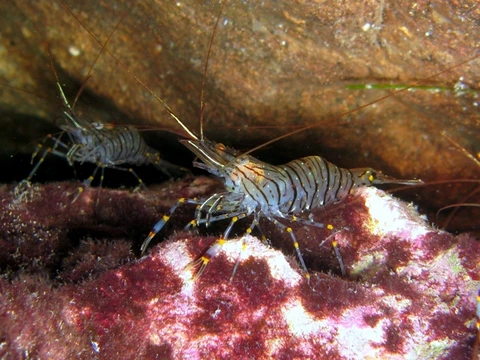
Metabetaeus lapillicola
A pebble-dwelling alpheid shrimp from Japanese shingle beaches.

Metabetaeus lapillicola, a shrimp from the alpheid family, is one of four species in its genus and lives only in Japan. It has been found on beaches in Shizuoka and Mie Prefectures on the island of Honshu. This shrimp is semi-transparent, with a few red chromatophores scattered across its carapace and pleomeres. Its darkly pigmented eyes sit on stalks, and its smooth, hairless carapace features a pterygostomial spine—a trait that helps distinguish it from other Metabetaeus species. The antennal scale ends in a strong spine that extends past the lamella, while the antennules and antennae carry long, multi-segmented flagella.
The first pair of pereopods is distinctly unequal: one cheliped is greatly elongated with an almost hairless palm, while the other is shorter and more slender. The remaining pereopods are slender walking legs, some with small spines. The pleon has rounded margins on its front segments, a small tooth on the fifth segment, and a sub-rectangular telson without anal tubercles but with several pairs of stout setae. The uropodal exopod has a strong lateral tooth, and the uropodal endopod lacks a distinct distolateral spine. Sexual dimorphism is most visible in the pleopods: males have a well-developed appendix masculina on the second pleopod, while females have relatively long endopods on the first pleopods.
Females carry between 25 and 41 eggs, which start greyish-green and are large—0.36 to 0.77 mm in diameter. This suggests the young may hatch at a relatively advanced stage, skipping multiple free-swimming larval phases. Egg-carrying females have been recorded from June to September.
This marine shrimp lives in the spaces between uniformly sized pebbles (1 to 3 cm in diameter) on shingle beaches, occupying the lower intertidal to upper subtidal zones. The pebble gaps provide shelter and access to water during tidal changes. Its habitat is notable because such dynamic interstitial pebble environments are generally considered unsuitable for macrobenthos like Caridean shrimp. The species name *lapillicola* comes from a Latin word meaning “pebble dweller,” referencing this habitat.
Quick Facts
- Taxon
- Metabetaeus lapillicola
Facts from the source article.
Lore & Background
Metabetaeus lapillicola is semi-transparent with infrequent red chromatophores speckling the carapace and pleomeres. Its eyes are darkly pigmented on eyestalks, and the carapace is smooth and hairless. The antennal scale ends in a strong spine projecting beyond the lamella, and the antennules and antennae bear long, multi-segmented flagella. The first pair of pereopods is distinctly unequal, with one cheliped greatly elongated and almost hairless, while the other is shorter and more slender. The remaining pereopods are slender walking legs, some with small spines. The pleon has rounded margins on anterior segments, a small tooth on the fifth segment, and a sub-rectangular telson lacking anal tubercles but armed with several pairs of stout setae. The uropodal exopod bears a strong lateral tooth. Sexual dimorphism is visible in the pleopods: males have a well-developed appendix masculina on the second pleopod, while females have relatively long endopods on the first pleopods. The species can be distinguished from other Metabetaeus by the presence of a pterygostomial spine on the carapace, highly unequal chelipeds, and the lack of a distinct distolateral spine on the uropodal endopod.
Reader's Guide
Metabetaeus lapillicola is significant as a member of the genus Metabetaeus, which contains only four known species. Its habitat—the spaces between uniformly sized pebbles (1 to 3 cm in diameter) on shingle beaches—is unusual for Caridean shrimp, as such dynamic interstitial environments are generally considered unsuitable for macrobenthos. The species occupies both the lower intertidal and upper subtidal zones, relying on gaps between pebbles for shelter and access to water during tidal fluctuations. Its reproductive strategy involves carrying 25 to 41 large eggs (0.36–0.77 mm in diameter) from June to September, with egg size suggesting hatching at a relatively advanced stage rather than passing through multiple free-swimming larval phases. The species name lapillicola, meaning 'pebble dweller,' directly references its specialized habitat. Its discovery adds to the understanding of alpheid shrimp diversity in Japan and the ecological niches available in shingle beach ecosystems.
Did You Know?
- Metabetaeus lapillicola is one of only four known species in the genus Metabetaeus.
- Females carry between 25 and 41 eggs, which start off greyish-green in colour.
- The species name lapillicola means 'pebble dweller' in Latin.
Frequently Asked Questions
What is Metabetaeus lapillicola?
It is a small, semi-transparent alpheid shrimp found exclusively in Japan and one of only four recognized species in the genus Metabetaeus. Fans often call it a pebble-dweller because it inhabits shingle beaches rather than open water.
Where can I find Metabetaeus lapillicola in the wild?
This shrimp has been recorded solely from shingle beaches in Shizuoka and Mie Prefectures on Honshu, Japan. No confirmed populations are known outside those two coastal areas.
How do I tell Metabetaeus lapillicola apart from the other three Metabetaeus species?
Check for a pterygostomial spine on an otherwise smooth, hairless carapace, plus an antennal scale whose terminal spine projects clearly past the lamella. Those two morphological details, combined with its restricted Japanese range, separate it from its genus-mates.
What does Metabetaeus lapillicola look like?
The body is largely translucent with a sparse scattering of red chromatophores across the carapace and pleomeres, and it carries dark, stalked eyes. The overall impression is a delicate, see-through shrimp dotted with subtle reddish flecks.
How many eggs does a female Metabetaeus lapillicola brood?
Females carry between 25 and 41 eggs at a time. That modest clutch size is consistent with a small, intertidal alpheid rather than a larger open-water species.
More in Pistol and Cleaner Shrimp 1-15
Spotted an error? Know more?
Reader corrections go straight into our review queue. Suggest an edit · How this site is sourced