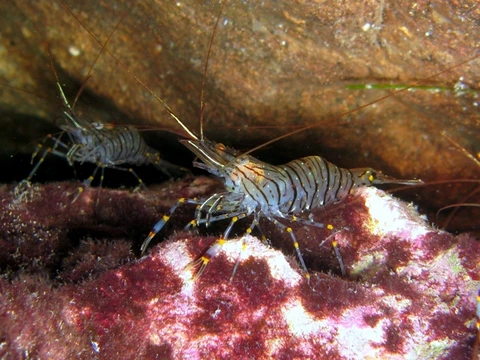
Alpheus tricolor
A snapping shrimp named for its white, red and orange coloration.

Alpheus tricolor is a species of snapping shrimp. It was first collected in Indonesia and Sri Lanka. Its name comes from its distinctive white, red, and orange coloration.
The shrimp has a carapace length of about 13.5 millimetres and a total length of 36 millimetres, with chelae measuring 16 millimetres. The carapace is smooth, with shallow grooves on the sides and erect setae on top. The pterygostomial angle is rounded, and the rostrum is well developed and pointed. The orbital hoods are swollen and lack teeth. The eyes have small forward projections, and the antennular peduncles are stout. The antenna has a basicerite with a sharp ventrolateral tooth. The mouthparts are typical for the genus: the mandible has a two-jointed palp, an incisor process with about 12 teeth, and a stout molar process; the maxillula has a bilobed palp; the maxilla shows no notable features.
Each abdominal somite has conspicuous setae near its rear upper edge. The uropodal exopod has a strong lateral spine and a sinuous diaresis. The telson is broad and tapers toward the tip, with two pairs of dorsal spines set in deep pits, and many long setae between the lateral spines. The anal tubercles are well developed.
The carapace is mostly yellow-orange, with three white patches on the sides. The rostrum is reddish-orange, and the orbital hoods are translucent. The antennal and antennular stalks are orange-red. The mouthparts are mostly colourless except for the reddish palp and caridean lobe of the first maxilliped. Both chelipeds are orange-red, with a white patch on the merus and nearly white tips on the fingers. In younger shrimp, the fingers and the front parts of the palms are white. The abdominal segments are yellow-orange on top and deep red on the sides and underside. The tail fan is deep red with a broad white band across about half its length.
Based on aquarium observations, the shrimp is thought to spend most of its time in burrows and does not interact much with other species. This behaviour differs from that seen in *Alpheus bellulus*.
Quick Facts
- Taxon
- Alpheus tricolor
Facts from the source article.
Lore & Background
Alpheus tricolor has a setose carapace, an acute rostrum, shallow adrostral furrows and a basicerite with a strong ventrolateral tooth. Its carapace is smooth, possessing shallow grooves latero-anteriorly and erect setae dorsally. The lamella of its scaphocerite is not reduced, with an anterior margin that is concave. Its third maxilliped counts with an epipodial plate bearing thick setae, while its first chelipeds have a merus bearing a strong disto-mesial tooth. Its third pereiopod has an armed ischium, with a simple and conical dactylus. The telson is broad, distally tapering, with 2 pairs of dorsal spines in deep depressions.
The species' coloration is distinctive: the carapace is mostly yellow-orange with three white patches laterally; the rostrum is reddish-orange; the orbital hoods are translucent; the antennal and antennular peduncles are orange-red; the major and minor chelipeds are orange-red with a distal white patch on the merus and almost white tips on the fingers. The abdominal segments are dorsally yellow-orange and lateroventrally deep red, and the tail fan is deep red with a broad white band across its near half. In younger individuals, the fingers and distal portions of the palms are white.
Behaviourally, the shrimp is thought to spend most of its time in burrows and not interacting with other species, as observed with specimens in aquariums. This is different behaviour from that observed in Alpheus bellulus.
Reader's Guide
Alpheus tricolor is notable for its distinctive tricolor pattern of white, red and orange, which gives the species its name. The article describes its morphology in detail, including a setose carapace, acute rostrum, and a basicerite with a strong ventrolateral tooth. Its chelipeds and pereiopods show specific armature, such as a strong disto-mesial tooth on the merus of the first chelipeds and an armed ischium on the third pereiopod. The telson is broad and distally tapering with two pairs of dorsal spines. The species was first isolated in Indonesia and Sri Lanka, indicating an Indo-Pacific distribution. Its behaviour, as observed in aquariums, suggests a burrow-dwelling lifestyle with little interaction with other species, contrasting with the behaviour of Alpheus bellulus. The article provides detailed coloration descriptions for both adults and younger individuals, noting that younger specimens have white fingers and distal portions of the palms. The species is a member of the snapping shrimp family Alpheidae, and its mouthparts are typical for the genus Alpheus, with a 2-jointed mandibular palp and a bilobed maxillular palp. The uropodal exopod has a strong lateral spine and a sinuous diaresis. The species' significance lies in its clear morphological and colorational distinctiveness within the genus.
Did You Know?
- Its carapace length is about 13.5 mm and total length is 36 mm.
- The species is named after its characteristic colour pattern of white, red and orange.
Frequently Asked Questions
Who is Alpheus tricolor?
Alpheus tricolor is a small snapping shrimp first described from specimens gathered off the coasts of Indonesia and Sri Lanka. It sits within the Alpheus genus and is instantly recognizable by its tri-color palette of white, red, and orange.
What are Alpheus tricolor's powers or role?
Its signature ability comes from a pair of large chelae, roughly 16 mm long, that it snaps shut with considerable force to stun prey or defend itself. In the reef ecosystem it acts as a tiny benthic predator and scavenger, picking through sediment for small invertebrates.
Why is Alpheus tricolor important?
It broadens the known diversity of snapping shrimp in the Indonesian and Sri Lankan waters where it was first isolated. Its bold white-red-orange coloration also gives taxonomists a handy visual marker for separating it from look-alike Alpheus species.
What does Alpheus tricolor look like?
The carapace is smooth, about 13.5 mm long, with shallow grooves running along the sides and a row of erect setae on the dorsal surface. A well-developed, pointed rostrum and rounded pterygostomial angle frame the head, while the eyes carry small forward projections and the antennular peduncles are notably stout.
More in Pistol and Cleaner Shrimp 1-15
Spotted an error? Know more?
Reader corrections go straight into our review queue. Suggest an edit · How this site is sourced