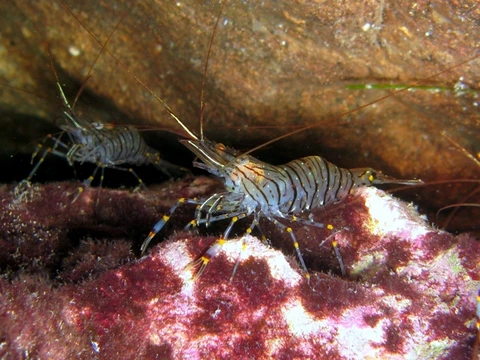
Alpheus bellulus
A symbiotic snapping shrimp with a powerful sonic claw.

The tiger pistol shrimp (*Alpheus bellulus*) is a snapping shrimp from the diverse Alpheidae family, which contains over 500 species worldwide. Its mitogenome shares a specific translocation and inversion event of trnE with several other *Alpheus* species, though this is not confirmed as universal across the genus. Phylogenetic analysis places *A. bellulus* and *A. randalli* in the same monophyletic group, and the amino acid makeup of its cytochrome b protein resembles that of *A. randalli* and *A. lobidens*.
This shrimp reaches 4 to 5 cm (1.6 to 2.0 in) long, excluding antennae. Its body is stout, opaque, and yellowish white to plain yellow, with irregular but symmetrical patterns in light brown, brownish purple, or brownish orange on the cephalothorax, abdomen, and tail. The legs and chelipeds are banded in the same colors and covered in short bristles; the antennae are red. The right cheliped is larger and modified into a weapon: when it closes at extreme speed, it expels an air bubble at over 100 km/h (62 mph), producing a loud bang. Pressure builds as the claw opens, filling a small chamber with water; the claw then snaps shut, forcing a plunger to push the water out at high pressure, releasing a high-speed bubble. The collapsing bubble generates a shock wave of up to 218 decibels and temperatures reaching 4,800°C—slightly cooler than the Sun’s surface—which can stun or kill prey such as other shrimp or small fish.
The tiger pistol shrimp inhabits tropical waters of the Indo-West Pacific, dwelling in sandy, muddy, and detrital substrata in shallow waters up to 20 m (66 ft). Resin casts of its burrows reveal their three-dimensional structure and construction habits. Burrows are essential for shelter and protection; during initial construction, the shrimp prioritizes burrow growth over feeding or resting, a trait common among alpheid shrimp. Without a burrow, *A. bellulus* is highly vulnerable to predation, especially early on, due to poor vision and reliance on tactile cues from partner gobiid fish. Burrows are reinforced with shell and coral fragments to prevent collapse, and sediment is constantly removed to keep the interior clean. This burrowing activity also contributes to sediment cycling in the marine ecosystem.
The shrimp primarily eats small invertebrates but also consumes detritus, macroalgae, and animal carcasses near its burrow.
Quick Facts
- Taxon
- Alpheus bellulus
Facts from the source article.
Lore & Background
The tiger pistol shrimp was originally described in a publication by Miya & Miyake in 1969. It belongs to the Alpheidae family, which includes over 500 species worldwide. Phylogeny suggests Alpheus randalli and Alpheus bellulus belong to the same taxon within a monophyletic group. The amino acid composition of the cytochrome b protein in A. bellulus was similar to those of A. randalli and A. lobidens. The species shares a translocation and inversion event of trnE in its mitogenome with several other Alpheus species, though there is not enough evidence to say this is a shared commonality among the entire genus.
The tiger pistol shrimp grows to a size of up to 4 to 5 cm, with a stout, opaque body colored yellowish white or plain yellow. Its patterns are irregular but symmetric, ranging from light brown to brownish purple to brownish orange. The right cheliped is larger and modified into a weapon that expels an air bubble at extreme speed, creating a loud bang and a shock wave that can kill or knock out prey. The sound from the collapsing bubble can reach 218 decibels, with temperatures up to 4,800 degrees Celsius.
The shrimp dwells in sandy, muddy, and detrital substrata in shallow waters up to 20 m. It relies on burrows for shelter and protection, and during initial construction shows no interest in feeding or resting. Burrows are reinforced with small pieces of shell and coral, and sediment is constantly removed to keep them clean. Burrow production is crucial to sediment cycling in the marine ecosystem.
Reader's Guide
The tiger pistol shrimp is significant for its symbiotic relationship with goby fish, particularly species such as Cryptocentrus cinctus, Amblyeleotris guttata, and Stonogobiops yasha. The shrimp digs and maintains burrows used by both animals, while the goby acts as a lookout due to the shrimp's poor eyesight. A study found that when no other food source was available, the shrimp survived by eating the feces of the goby fish, illustrating the close partnership. The symbiotic relationship with the gobiid fish Amblyeleotris japonica begins early in development and often continues into adulthood. A. bellulus is not found in areas where the partner fish is absent and usually does not leave the burrow unless the fish is near the entrance. Some burrows were also shared with the porcelain crab Enosteoides lobatus, forming a three-way relationship. The tiger pistol shrimp is considered one of the more popular pistol shrimp species in the marine aquarium hobby due to its subdued temperament, relative low cost, and basic care requirements. Its legacy is tied to its unique biological weapon and its role in marine symbiosis.
Did You Know?
- The tiger pistol shrimp's claw produces a bubble that can reach temperatures up to 4,800 degrees Celsius, slightly cooler than the surface of the Sun.
- The sound emitted from the collapsing bubble can be up to 218 decibels.
- Some burrows of Alpheus bellulus are shared with the porcelain crab Enosteoides lobatus, forming a three-way relationship with the gobiid fish.
Frequently Asked Questions
Who is Alpheus bellulus?
Alpheus bellulus, commonly called the tiger pistol shrimp, is a small snapping shrimp within the Alpheidae family, a group that spans more than 500 species worldwide. It is best known for its vivid tiger-like striping and its function as a symbiotic cleaner on coral reefs.
What are Alpheus bellulus's powers/role?
Its asymmetrical snapping claw can close at over 100 km/h, creating a cavitation bubble that briefly reaches roughly 4,800 °C and emits sound up to 218 decibels. Ecologically, the shrimp serves as a cleaner, picking parasites and dead tissue off fish and other reef dwellers in a mutualistic relationship.
How big is Alpheus bellulus?
The shrimp's body measures about 4 to 5 cm (1.6–2.0 in) long, not including its antennae. This compact size makes it one of the more manageable members of the Alpheus genus for reef-keeping enthusiasts.
Where does Alpheus bellulus live?
It is native to tropical waters across the Indo-West Pacific region and can be encountered at depths of up to approximately 20 m (66 ft). Phylogenetic analyses place it in a monophyletic clade alongside A. randalli, and its cytochrome b amino-acid profile closely mirrors those of A. randalli and A. lobidens.
Why is Alpheus bellulus important?
As a symbiotic cleaner, it contributes directly to reef health by providing parasite-removal services to a broad range of host species. From an evolutionary standpoint, its mitogenome carries a shared trnE translocation and inversion event found in several other Alpheus species, offering a useful marker for tracing the family's lineage.
More in Pistol and Cleaner Shrimp 1-15
Spotted an error? Know more?
Reader corrections go straight into our review queue. Suggest an edit · How this site is sourced