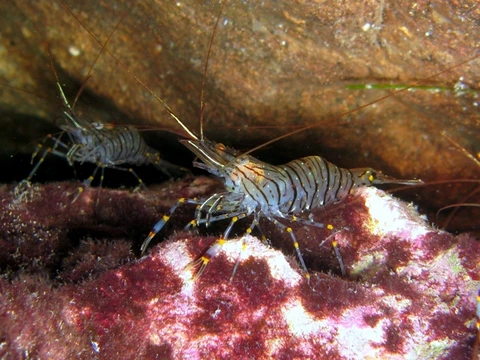
Alpheidae
A shrimp family known for its powerful snapping claw and ocean noise.

Alpheidae, also known as the snapping shrimp, pistol shrimp, or cracker shrimp, is a family within the shrimp infraorder Caridea. It is notable for the enlarged and highly modified chelae (claws) on one leg of the first pair, which is used for hunting, communication, defense, burrowing, and rock-boring. The family is diverse and worldwide in distribution, consisting of about 1,119 species within 38 or more genera, and is a major source of sound in the ocean, capable of interfering with sonar and underwater communication.
Quick Facts
- Taxon
- Alpheidae
Facts from the source article.
Lore & Background
Snapping shrimp grow to 3–5 cm in length. Many species have one disproportionately large claw, larger than half the shrimp's body, which forms a pistol-like organ. When released, it snaps into the other part of the claw, emitting a powerful wave of bubbles capable of stunning larger fish and breaking small glass jars. The development of increasingly powerful snaps is linked to an 'orbital hood' in species of Alpheus and Synalpheus, which dampens shockwaves and protects against neurotrauma. Snapping shrimp have the ability to reverse claws: if the snapping claw is lost, the missing limb regenerates into a smaller claw and the original smaller appendage grows into a new snapping claw, a process thought to be unique in nature.
Reader's Guide
The snapping shrimp is a major source of noise in the ocean, competing with much larger animals like the sperm whale and beluga whale for the title of loudest animal in the sea. When in colonies, the sound produced can interfere with sonar and other forms of underwater communication, including anti-submarine warfare. The snap can also produce sonoluminescence from the collapsing cavitation bubble, emitting a short flash of light with a broad spectrum, the first known instance of an animal producing light by this effect. Some species share burrows with goby fish in a mutualistic symbiotic relationship, and eusocial behavior has been discovered in the genus Synalpheus, with colonies living inside sponges and divided into workers and soldiers. Snapping shrimp are monogamous and practice mate guarding, with larvae developing in three stages: nauplius, zoea, and postlarval stages.
Did You Know?
- Around half of the species, such as those in the genus Potamalpheops, lack the enlarged snapping claw and are called 'non-snapping shrimp'.
- The snapping claw can create a cavitation bubble that reaches speeds of 25 m/s (90 km/h; 56 mph).
- The snap duration is less than 1 millisecond.
The Pistol Shrimp Paradox
In Australia, the family Alpheidae occupies a curious position in the language of crustacean identification. Some Australian authors explicitly refer to members of this family as "pistol shrimp," distinguishing them from the small species of Palaemonidae that those same authors choose to call prawns. Yet other Australian writers take a different approach, grouping Alpheidae alongside Hippolytidae, Pandalidae, and Campylonotoidea under the umbrella term "prawns." This means that within a single country, the same family can be labeled a shrimp in one text and a prawn in another, depending entirely on the author's preference. The situation is further complicated by the fact that the terms shrimp and prawn themselves carry no formal taxonomic weight. They are vernacular labels of convenience, not scientific designations, and their application shifts across regions, time periods, and individual usage. For Alpheidae, this results in a family whose common-name identity remains genuinely unsettled even within the one nation where it receives the most explicit naming attention.
No Taxonomic Home in Common Language
The family Alpheidae exists within the order of decapods, a group of aquatic crustaceans characterized by an exoskeleton and ten legs. Yet when it comes to common naming, Alpheidae has no fixed linguistic home. The terms "shrimp" and "prawn" are not scientific names at all; they are colloquial expressions with no circumscriptional significance in taxonomy. The crustacean taxonomist Tin-Yam Chan observed that neither term has a definite reference to any known taxonomic group, and while shrimp is sometimes applied to smaller species and prawn to larger forms, there is no clear distinction and usage is often confused or reversed across different countries. L. B. Holthuis, writing in 1980, noted that even within a single region the two terms were applied inconsistently. For Alpheidae, this means that any attempt to pin down whether its members are "shrimps" or "prawns" in a universal sense is futile. The popular use of these names continues unchanged despite periodic declarations by biologists that certain common names should be confined to specific taxa.
The Australian Exception
Among all the regions where the shrimp-prawn distinction plays out, Australia stands out as the place where Alpheidae receives the most explicit and contradictory naming treatment. In the broader British and Commonwealth tradition, prawn is typically reserved for larger, laterally compressed species with a long rostrum, while shrimp applies to smaller, dorsoventrally depressed forms with a shorter rostrum. Prawn is never applied to very small species. However, Australia breaks from this pattern in ways that specifically affect Alpheidae. Some Australian authors call members of this family "pistol shrimp," while simultaneously referring to small Palaemonidae species as prawns. Other Australian authors go the other direction, listing Alpheidae among the families they designate as prawns, placing it in the same category as Hippolytidae, Pandalidae, and Campylonotoidea. This internal disagreement within a single national tradition means that Alpheidae's common-name identity in Australia is not a matter of regional convention but of individual authorial choice.
A Family in the Shadow of Ambiguity
The linguistic history of the words that Alpheidae members are called by adds another layer of uncertainty to the family's common-name identity. The word "shrimp" traces back to the 14th century Middle English shrimpe, related to Middle Low German schrempen meaning to contract or wrinkle, and Old Norse skorpna meaning to shrivel up. The word "prawn" first appeared in England in the early 15th century in forms like prayne, praine, and prane, though its ultimate origin remains unclear. The linguist Anatoly Liberman has noted that it is unexplained why English associates shrimp with smallness, since no other Germanic or Romance language makes that same connection. For Alpheidae, this etymological murkiness compounds the taxonomic ambiguity. Whether a member of this family is called a pistol shrimp in one Australian text or a prawn in another, the underlying words carry no biological precision. They are terms of convenience, shaped by centuries of shifting usage, and they offer no stable anchor for a family that, in the scientific literature, is identified by its Latin name rather than by any common English label.
Frequently Asked Questions
Who is Alpheidae?
Alpheidae is a family of small shrimp within the infraorder Caridea, widely known by the nicknames snapping, pistol, or cracker shrimp. It is one of the most species-rich shrimp families on Earth, encompassing roughly 1,119 species spread across at least 38 genera in oceans worldwide.
What are Alpheidae's signature abilities?
The family is defined by a single massively enlarged claw on the first leg pair, which it snaps shut to hunt, communicate, defend itself, dig burrows, and even bore into rock. That rapid closure can produce pressures of up to about 80 kilopascals measured four centimetres from the claw.
How big is Alpheidae in the field?
Most members of the family are small, typically measuring between three and five centimetres (roughly 1.2 to 2 inches) in body length. Despite that modest size, their collective snapping makes them one of the dominant sources of ambient sound in the ocean.
What is Alpheidae's role in the wider ocean story?
As a major contributor to natural underwater noise, the family can interfere with sonar systems and other forms of underwater communication. Ecologically, its members also shape reef and sediment habitats through burrowing, rock-boring, and predation on small invertebrates.
Who are Alpheidae's closest relatives in the family tree?
The largest genus within the family is Alpheus, which alone contains over 330 described species, while the second-largest is Synalpheus with more than 160 species. Together these two genera account for a substantial share of the family's roughly 1,119 total species.
More in Pistol and Cleaner Shrimp 1-15
Spotted an error? Know more?
Reader corrections go straight into our review queue. Suggest an edit · How this site is sourced