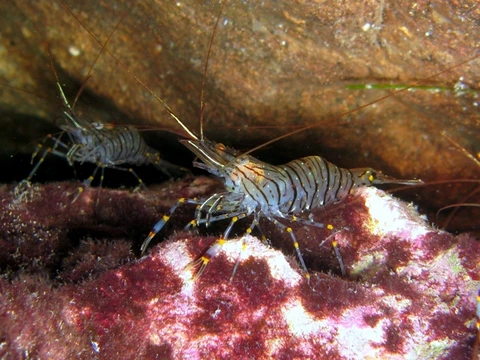
Alpheus deuteropus
A pistol shrimp that carves petroglyph-like grooves in coral.

Alpheus deuteropus, called the petroglyph shrimp, is a type of pistol shrimp from the family Alpheidae. It makes its home on tropical coral reefs in the Indian and Pacific Oceans and the Red Sea, living as a commensal on corals like *Porites lobata*. Its burrowing activity carves tunnels, cracks, and grooves into the coral's surface.
The shrimp’s carapace is dotted with red spots, while the rest of its body is colorless. Males reach up to 3 centimeters (1.2 inches) long. Like other snapping shrimp, it has one cheliped much larger than the other, modified to produce a loud clicking noise. Its body is only slightly flattened from side to side, with no crest on the carapace, and it has an orbital hood covering its eyes. It moves through the water by drag-powered swimming with its legs. The body is bilaterally symmetrical, as is typical for its family. Its main food is algae.
This shrimp is mostly found in the Indo-West Pacific, with most specimens collected near East Africa, the Philippines, and Hawaii. It lives in tropical coral reef environments at depths of 1 to 15 meters, preferring water temperatures between 23°C and 29°C.
The common name "petroglyph shrimp" comes from the fact that its burrows often resemble ancient Hawaiian petroglyphs.
Quick Facts
- Taxon
- Alpheus deuteropus
Facts from the source article.
Lore & Background
Alpheus deuteropus has red dots on its carapace and is otherwise colorless. Like other snapper shrimp, one of its chelipeds is much larger than the other and is modified to produce an explosive clicking noise. Its body is only slightly laterally compressed and lacks a crest on the carapace, but it has an orbital hood surrounding the eyes. The shrimp uses drag-powered swimming with its legs to move through water, and its body is bilaterally symmetrical, as is typical for its family. Its primary food source is algae.
Reader's Guide
The significance of Alpheus deuteropus lies in its commensal relationship with corals such as Porites lobata, where its presence among the coral lobes creates tunnels, cracks, and grooves on the surface. These burrows have been noted to resemble ancient Hawaiian petroglyphs, which gives the shrimp its common name. The species is mainly distributed in the Indo-West Pacific ocean regions, with most specimens found in East Africa, the Philippines, and Hawaii. It lives in tropical coral reef environments at depths of 1 to 15 meters, with an optimal temperature range of 23°C to 29°C. As a pistol shrimp, it contributes to the ecological dynamics of coral reefs through its burrowing behavior, which alters the physical structure of the coral substrate. Its legacy is tied to the cultural reference of Hawaiian petroglyphs, linking a biological phenomenon to human artistic expression.
Did You Know?
- The shrimp's common name comes from its burrows resembling ancient Hawaiian petroglyphs.
- It lives as a commensal of corals such as Porites lobata.
- Male shrimp can grow to 3 centimeters (1.2 inches) in length.
Frequently Asked Questions
What is Alpheus deuteropus?
Alpheus deuteropus, commonly known as the petroglyph shrimp, is a species of pistol shrimp in the family Alpheidae. It is a small marine crustacean that lives as a commensal on tropical coral reefs across the Indian and Pacific Oceans and the Red Sea.
What makes Alpheus deuteropus unique among other pistol shrimp?
Its burrowing behavior carves petroglyph-like tunnels, cracks, and grooves into the surface of host corals such as Porites lobata. This distinctive sculpting of the coral substrate gives the species its common name and sets it apart from many other snapping shrimp.
Where and at what depth can I find Alpheus deuteropus?
The petroglyph shrimp inhabits tropical reef environments in the Indian Ocean, Pacific Ocean, and Red Sea, typically between 1 and 15 meters below the surface. It thrives in water temperatures ranging from 23 °C to 29 °C.
How big does Alpheus deuteropus grow?
Males reach a maximum body length of about 3 centimeters (roughly 1.2 inches). Despite its modest size, it carries one dramatically enlarged cheliped that it snaps shut to produce a loud clicking sound, a hallmark of the Alpheidae family.
What does Alpheus deuteropus look like?
The shrimp's carapace is dotted with scattered red spots, while the rest of its body remains largely colorless and translucent. Its most eye-catching feature is the single oversized snapping claw, which stands in stark contrast to the much smaller opposing cheliped.
More in Pistol and Cleaner Shrimp 1-15
Spotted an error? Know more?
Reader corrections go straight into our review queue. Suggest an edit · How this site is sourced