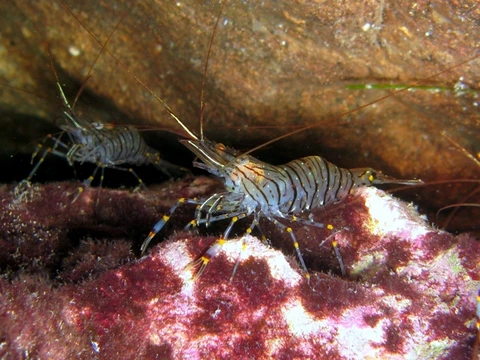
Synalpheus
Genus of snapping shrimp with over 160 species, including eusocial aquatic species.

Synalpheus is a genus of snapping shrimp in the family Alpheidae, currently containing more than 160 described species, though the exact number is disputed as new species are regularly described. The genus is notable for containing the only known eusocial aquatic species, with several species exhibiting complex colonial behavior.
Quick Facts
- Taxon
- Synalpheus
- Type Species
- Synalpheus falcatus
- Type Species Authority
- Bate, 1888
Facts from the source article.
Lore & Background
The genus Synalpheus was originally described within the family Alpheidae. A proposed genus Zuzalpheus for S. gambarelloides, S. brooksi, and their closest relatives has not been adopted and is not considered a monophyletic clade within Synalpheus. The distribution of Synalpheus in the narrower sense is primarily in the eastern Pacific, where they are most plentiful and likely originated, with lesser presence in the Atlantic and Indian Ocean. Species placed in Zuzalpheus occur mainly in the western Atlantic, with their lineage probably originating there, and to a lesser extent in the eastern Atlantic, Indian Ocean, and eastern Pacific. The closure of the Isthmus of Panama in the Piacenzian (about 3 million years ago) may have been a key factor in separating the two lineages.
The snapping behavior of Synalpheus is well studied; in Synalpheus parneomeris, peak-to-peak source levels of 185–190 dB re 1 μPa at 1 m were measured, depending on claw size. Eusociality has evolved at least three times within Synalpheus, with multiple rapid radiations between 3 and 9 million years ago. Eusociality is thought to have arisen due to competition for space, as empty host sponges are rarely found. The evolution of eusociality is linked to a generalist ecological role and kin selection, as all eusocial species are non-dispersing shrimp that hatch directly into crawling individuals.
Reader's Guide
Synalpheus holds significant scientific importance as the only genus known to contain eusocial aquatic species. The article notes that eusociality has evolved at least three times within the genus, with multiple rapid radiations occurring between 3 and 9 million years ago. The level of eusociality varies among species: highly eusocial species have one reproducing female (queen) per colony, while others like S. brooksi and S. rathbunae may have up to a dozen reproducing females, leading to higher reproductive competition. Eusociality is thought to have arisen due to competition for space in sponges, as empty sponges are rarely found. The evolution of eusociality is also linked to a generalist ecological role and kin selection, since all eusocial species are non-dispersing shrimp that hatch directly into crawling individuals. Until recently, eusocial species have appeared in far greater abundance than less social species and appear to outcompete them for space in sponges. The snapping behavior of Synalpheus is also well studied, with measured sound levels of 185–190 dB re 1 μPa at 1 m in Synalpheus parneomeris. The genus continues to be actively described, with new species regularly added and the exact number of described species disputed.
Did You Know?
- Synalpheus contains the only known eusocial aquatic species.
- The snapping sound of Synalpheus parneomeris can reach 185–190 dB re 1 μPa at 1 m.
- The closure of the Isthmus of Panama about 3 million years ago may have separated two lineages within the genus.
Frequently Asked Questions
What is Synalpheus?
Synalpheus is a genus of snapping shrimp in the family Alpheidae that currently includes more than 160 formally described species. It stands out in crustacean biology because it is the only genus known to contain eusocial aquatic species, making it a unique case in the animal kingdom.
How many species are in the Synalpheus genus?
Over 160 species have been described to date, though taxonomists caution that the precise count is still in flux as new species are regularly identified and published. The exact total remains a point of mild debate within the field.
What makes Synalpheus special compared to other shrimp?
The genus is the sole known home of eusocial aquatic organisms, meaning several of its species live in structured colonies with a division of labor among members. This is an extraordinary rarity, as virtually all other aquatic crustaceans are solitary or merely gregarious.
How loud is a Synalpheus snap?
Measurements from Synalpheus parneomeris place the snap at 185–190 dB re 1 μPa at a distance of one meter. That acoustic output ranks among the loudest biological sounds documented in marine settings.
Which Synalpheus species are confirmed eusocial?
The recognized eusocial species include S. brooksi, S. chacei, S. elizabethae, S. filidigitus, S. rathbunae, S. regalis, S. microneptunus, and S. duffyi, with S. riosi also considered a likely candidate. In these colonies, non-breeding individuals assist with nest maintenance and brood care alongside the reproductive females.
More in Pistol and Cleaner Shrimp 1-15
Spotted an error? Know more?
Reader corrections go straight into our review queue. Suggest an edit · How this site is sourced