Marcian Hoff
One of the inventors of the microprocessor.

Dicklyon · CC BY-SA 4.0
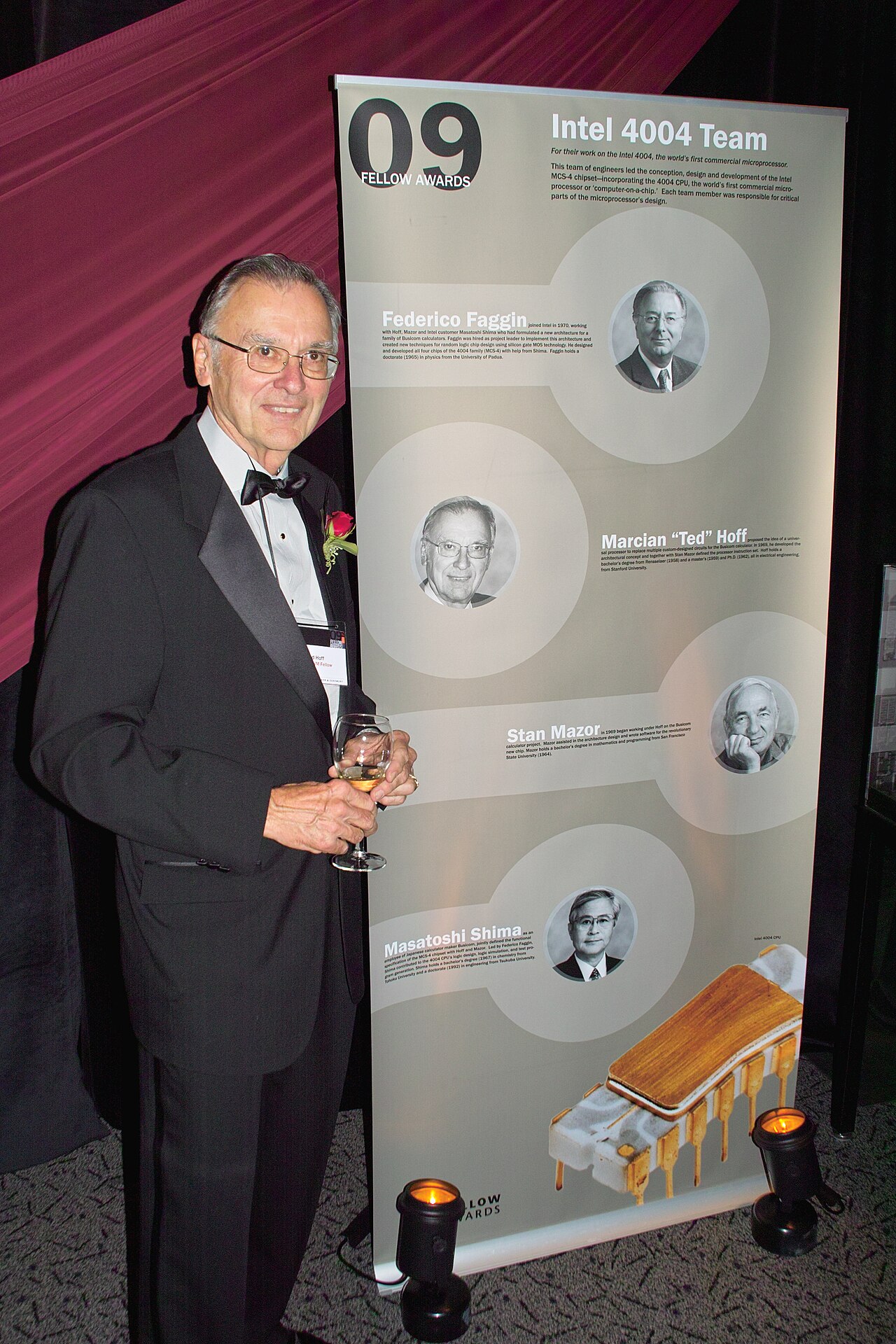
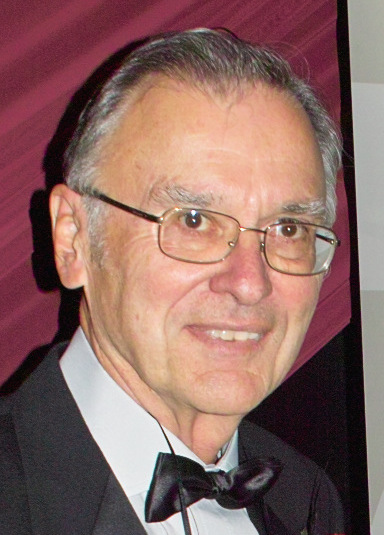
Marcian Edward 'Ted' Hoff Jr. is one of the inventors of the microprocessor. Born October 28, 1937, in Rochester, New York, he is credited with formulating the idea of using a 'universal processor' rather than a variety of custom-designed chips while at Intel.
Quick Facts
- Birth Date
- 1937-10-28
- Birth Place
- Rochester, New York
- Fields
- Electrical engineering / microprocessor
- Workplaces
- Intel (1968–1983) / Atari / Teklicon (1990–2007)
- Education
- Rensselaer Polytechnic Institute (B.S., 1958) / Stanford University (M.S., 1959; Ph.D., 1962)
- Thesis Title
- <!--(or
- Known For
- Microprocessor
- Awards
- Stuart Ballantine Medal (1979) / Intel Fellow (the First, 1980–1983) / Kyoto Prize (1997) / National Medal of Technology and Innovation (2009) / Computer History Museum Fellow (2009)
Facts from the source article.
Lore & Background
Hoff joined Intel in 1968 as Manager of Applications Research. In 1969, working with Stanley Mazor, Federico Faggin, and Masatoshi Shima, the team developed the Intel 4004, which started the microprocessor revolution. In 1975 he started a group to work on large-scale integration for use in the telephone industry, resulting in various commercial products: first commercial monolithic telephone (named 'CODEC'), first commercial switched-capacitor filter, a microprocessor for real-time digitizing analog signals (Intel 2920), and speech recognition hardware. In 1980, Hoff was named the first Intel Fellow, the highest technical position in the company. He stayed in that position until 1983 when he left for Atari. After the video game crash of 1983, Atari was sold in 1984, and Hoff became an independent consultant. He then joined Teklicon in 1986 as an agent, and since 1990 as an employee. Hoff was featured in an Intel advertisement, calling him the 'rock star' of Intel and comparing him to the rock stars of American culture.
Reader's Guide
Hoff's significance lies in his role as one of the inventors of the microprocessor, specifically the Intel 4004, which started the microprocessor revolution. His earlier work included co-inventing the least mean squares filter and the ADALINE neural network as part of his Ph.D. dissertation. At Intel, he formulated the concept of a universal processor, replacing custom-designed chips. Later, he led development of key telecommunications products including the first commercial monolithic telephone CODEC and the Intel 2920 microprocessor. His legacy is recognized through numerous awards: the Stuart Ballantine Medal (1979), IEEE Cledo Brunetti Award (1980), induction into the National Inventors Hall of Fame (1996), the National Medal of Technology and Innovation (2009), and being named a Fellow of the Computer History Museum (2009). He also received the 2011 IEEE/RSE Wolfson James Clerk Maxwell Award.
Did You Know?
- Hoff co-invented the least mean squares filter and the ADALINE neural network with Bernard Widrow as part of his Ph.D. dissertation.
- He was named the first Intel Fellow in 1980, the highest technical position at the company.
- Hoff was a finalist in the 1954 Westinghouse Science Talent Search (now Regeneron STS).
- He received the National Medal of Technology and Innovation in 2009 from President Barack Obama.
Gallery
Frequently Asked Questions
Who is Marcian Hoff?
Marcian Edward 'Ted' Hoff Jr. is an electrical engineer born in Rochester, New York, on October 28, 1937, widely recognized as one of the creators of the microprocessor. He studied electrical engineering at Rensselaer Polytechnic Institute (B.S., 1958) and completed both his master's and doctoral degrees at Stanford University.
What did Marcian Hoff invent?
Hoff is credited with conceiving the idea of a single 'universal processor' chip that could replace numerous specialized circuits, a concept that materialized as the Intel 4004 microprocessor in 1969. He developed this breakthrough alongside Stanley Mazor, Federico Faggin, and Masatoshi Shima while working at Intel.
How did the microprocessor idea originate?
While at Intel, Hoff argued that a single programmable processor could handle all the functions that would otherwise require dozens of custom-designed chips. This 'one chip to rule them all' philosophy became the architectural foundation of the 4004 and effectively launched the personal-computing era.
What major awards has Marcian Hoff received?
Hoff has been honored with the National Medal of Technology and Innovation (2009), the Stuart Ballantine Medal (1979), and the IEEE Cledo Brunetti Award (1980). These recognitions reflect his foundational role in creating the microprocessor architecture that underpins virtually all modern computing.
What was Marcian Hoff's highest technical role at Intel?
He served as the First Intel Fellow from 1980 to 1983, the company's most senior technical designation at the time. The title underscored his status as the architect of the very technology that put Intel at the center of the computing industry.
More in PC Hardware, Part 2 1-24
Spotted an error? Know more?
Reader corrections go straight into our review queue. Suggest an edit · How this site is sourced