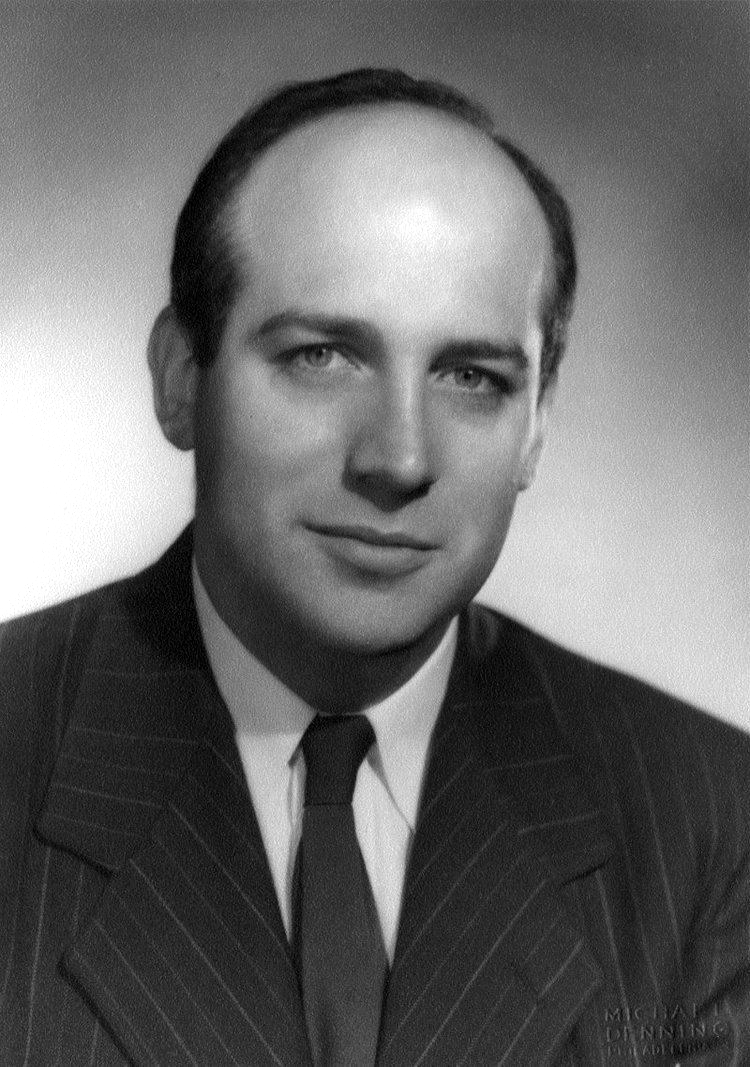
J. Presper Eckert
Co-inventor of ENIAC and designer of the UNIVAC.

Unknown, dedicated to Bettmann Archive · Public domain
J. Presper Eckert was an American electrical engineer and computer pioneer who, with John Mauchly, designed the first general-purpose electronic digital computer (ENIAC). He also co-founded the Eckert–Mauchly Computer Corporation and designed the first commercial computer in the U.S., the UNIVAC, which incorporated his invention of the mercury delay-line memory.
Quick Facts
- Birth Name
- John Adam Presper Eckert Jr.
- Birth Date
- April 9, 1919
- Birth Place
- Philadelphia, Pennsylvania, US
- Death Date
- 1995-06-03
- Death Place
- Bryn Mawr, Pennsylvania, US
- Education
- University of Pennsylvania
- Occupation
- Electrical engineer
- Known For
- ENIAC UNIVAC I
- Other Names
- "Pres"
- Awards
- Harry H. Goode Memorial Award / (1966) · National Medal of Science / (1968) · Harold Pender Award / (1973) · IEEE Emanuel R. Piore Award (1978)
Facts from the source article.
Lore & Background
Eckert was born in Philadelphia to a wealthy real estate developer and a mother from an old Quaker family. He attended the University of Pennsylvania's Wharton School before transferring to the Moore School of Electrical Engineering in 1937. At age 21, he applied for his first patent, 'Light Modulating Method and Apparatus'. He participated in radar timing research, improved the Moore School's differential analyzer, and assisted in teaching a summer electronics course under the Engineering, Science, and Management War Training program.
John Mauchly, a student in that summer course, later secured a teaching position at the Moore School. Mauchly's proposal for an electronic digital computer using vacuum tubes to compute ballistics tables led to a contract for the ENIAC, with Eckert as chief engineer. ENIAC was completed in late 1945 and unveiled in February 1946. After a dispute over intellectual property rights, Eckert and Mauchly left the Moore School in March 1946 and founded the Electronic Control Company, which built the Binary Automatic Computer (BINAC) and later became the Eckert–Mauchly Computer Corporation. The company received an order from the National Bureau of Standards to build the UNIVAC, which was finished on December 21, 1950. Financial troubles led to the company's acquisition by Remington Rand in 1950.
Reader's Guide
Eckert's significance lies in his central role in the creation of the first general-purpose electronic digital computer, ENIAC, and the first commercial computer in the U.S., UNIVAC. His invention of the mercury delay-line memory was a key component of UNIVAC. After leaving the Moore School, he co-founded the Eckert–Mauchly Computer Corporation, which built BINAC and UNIVAC. The company was later acquired by Remington Rand, where Eckert remained as an executive through its merger into Unisys, retiring in 1989. He was awarded the National Medal of Science in 1968 for pioneering contributions to high-speed electronic digital computing. Eckert also contended that the stored-program concept central to the 'von Neumann architecture' should be called the 'Eckert architecture', a view supported by ENIAC programmer Jean Bartik. His legacy is that of a foundational figure in the commercial and technical development of digital computing.
Did You Know?
- Eckert placed second in the country on the math portion of the College Board examination.
- Eckert's invention of the mercury delay-line memory was incorporated into the UNIVAC.
- He was inducted into the National Inventors Hall of Fame in 2002.
Gallery
Frequently Asked Questions
Who is J. Presper Eckert?
J. Presper Eckert (April 9, 1919 – June 3, 1995) was a Philadelphia-born American electrical engineer best known for co-designing the ENIAC with John Mauchly and later building the UNIVAC, the first commercially available computer in the United States. He also co-founded the Eckert–Mauchly Computer Corporation, the company that brought those machines to market.
What is J. Presper Eckert's most notable invention?
His signature contribution was the mercury delay-line memory, a technique that stored digital data as ultrasonic pulses travelling through a column of liquid mercury. This became the core memory technology in the UNIVAC and represented one of the earliest practical forms of electronic computer storage.
What role did Eckert play in the creation of ENIAC?
Working alongside John Mauchly, Eckert was a co-designer of ENIAC, the first general-purpose electronic digital computer. The project, completed in the mid-1940s, marked the transition from mechanical calculators to fully electronic computation and laid the groundwork for every modern PC.
What major awards and honors did J. Presper Eckert receive?
He was presented with the Howard N. Potts Medal in 1949 and the National Medal of Science in 1968 during his lifetime. After his death in 1995, he was inducted into the National Inventors Hall of Fame in 2002.
Why is J. Presper Eckert important to the history of PC hardware?
Eckert bridged the gap between military-grade computing and the commercial market by turning the ENIAC concept into the UNIVAC, the first U.S. computer sold to businesses. His mercury delay-line memory and system-level design choices directly shaped the architecture that later microprocessor-based PCs inherited.
More in PC Hardware, Part 2 1-24
Spotted an error? Know more?
Reader corrections go straight into our review queue. Suggest an edit · How this site is sourced