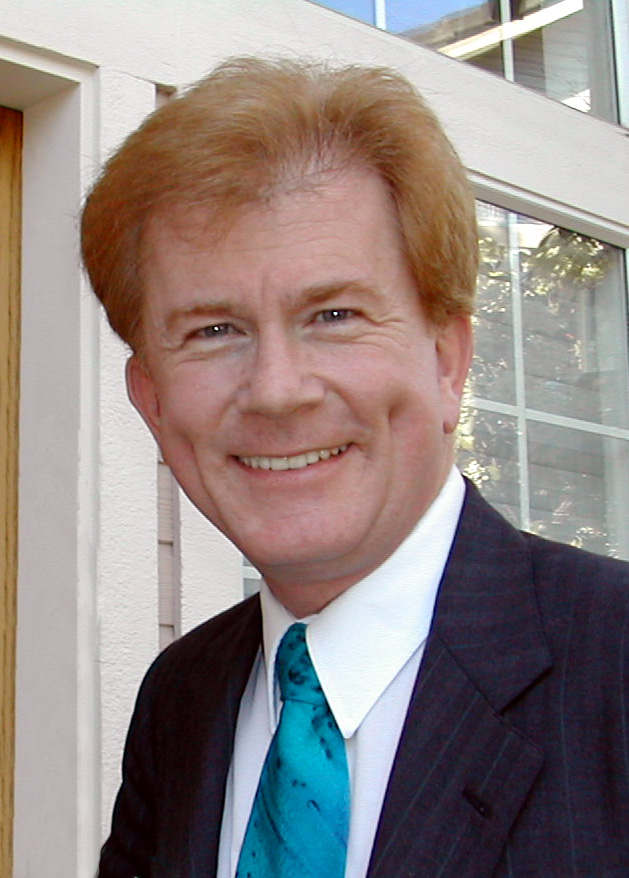
John Gustafson (scientist)
American computer scientist known for Gustafson's law and unum number format.

Karl Brooks Heisey · CC BY 4.0
John Leroy Gustafson (born January 19, 1955) is an American computer scientist and businessman recognized for contributions to high-performance computing. He created Gustafson's law, built the first commercial computer cluster, developed the QUIPS measurement method, oversaw the restoration of the Atanasoff–Berry Computer, and invented the unum number format and its associated computing system. He has also received several awards for improving computer speed. Currently, Gustafson serves as Chief Technology Officer at Ceranovo, Inc. Previously, he was Chief Graphics Product Architect and Senior Fellow at AMD from September 2012 to June 2013, and has held roles including Architect of Intel Labs-SC, CEO of Massively Parallel Technologies, Inc., and CTO at ClearSpeed Technology. He holds degrees in applied mathematics from the California Institute of Technology and Iowa State University.
Quick Facts
- Birth Date
- 1955-01-19
- Birth Place
- United States
- Education
- California Institute of Technology · Iowa State University
- Thesis Title
- Asymptotic Expansions of Elliptic Integrals
- Thesis Year
- 1982
- Doctoral Advisor
- Bille C. Carlson
- Known For
- Gustafson's law · Unum
- Awards
- Gordon Bell Prize · International Atanasoff Award
Facts from the source article.
Lore & Background
Gustafson was raised in Des Moines, Iowa. After completing a degree in Applied Mathematics at California Institute of Technology in 1977 he moved to Ames, Iowa and completed his M.S. (1981) and Ph.D. (1982) at Iowa State University. His mother was an electronics technician at Collins Radio and his father was a chemical engineer turned MD, both as a result of World War II. His parents encouraged his scientific explorations at a young age. Assembling radio transmitters, designing and executing chemistry experiments, and making holograms are some of his favorite childhood explorations.
Gustafson has devised a new format for storing real numbers in computers use a variable number of bits depending on the number of digits required, called unum number format. Normal formats store numbers as a fixed number of bits, for example 64 bits is usual for double-precision floating-point format numbers. This can allow them to be smaller than doubles for fast processing and also more precise or larger than the limits for double when desirable.
In 1988, Gustafson was the recipient of the inaugural Gordon Bell Prize. He has received other awards for his work in HPC, including the International Atanasoff Award (2006). He was awarded the IEEE Computer Society Golden Core Award in 2007.
Reader's Guide
Gustafson's significance stems from his contributions to high-performance computing, particularly through Gustafson's law, which addresses the scaling of parallel computing performance. He introduced the first commercial computer cluster and developed the QUIPS measurement metric. His reconstruction of the Atanasoff–Berry computer preserved an important piece of computing history. The unum number format represents a novel approach to real number storage, offering flexibility in precision and range compared to fixed-bit formats like double-precision floating-point. His awards, including the inaugural Gordon Bell Prize (1988), the International Atanasoff Award (2006), and the IEEE Computer Society Golden Core Award (2007), recognize his impact on computer speedup and HPC. His career spans roles at AMD, Intel Labs-SC, Massively Parallel Technologies, Inc., and ClearSpeed Technology, and he currently serves as CTO at Ceranovo, Inc.
Did You Know?
- Gustafson invented the unum number format, which uses a variable number of bits depending on the number of digits required.
- He received the inaugural Gordon Bell Prize in 1988.
- He led the reconstruction of the Atanasoff–Berry computer.
A Place Among the Pioneers
The landscape of computing history is populated by individuals who fundamentally reshaped what machines could accomplish. From the earliest conceptualizations of computation to the sophisticated systems we rely on today, a lineage of thinkers pushed boundaries that seemed immovable in their era. John Gustafson occupies a position within this broader constellation of figures who transformed the creation, development, and imagination of computational possibility. The field has no single origin point; rather, it emerged from a convergence of mathematical insight, engineering ingenuity, and visionary thinking. Those who contributed to this evolution—whether in hardware, software, or theoretical foundations—share a common thread: they saw beyond the limitations of their moment and built frameworks that would outlast their own lifetimes. Gustafson's work, situated within this tradition, reflects the ongoing human drive to extend the reach of what silicon and logic can achieve, adding another chapter to a story that began long before any single name could claim it.
Foundations That Shaped the Field
Before any individual could push computing forward, a bedrock of mathematical and theoretical work had to be laid. Richard Hamming's 1950 paper on error detecting and correcting codes exemplifies this kind of foundational contribution—a piece of work that quietly undergirds virtually every digital system that followed. The coding theory that grew from such insights, later formalized in textbooks by scholars like San Ling and Chaoping Xing, became the invisible architecture of reliable computation. John Gustafson's contributions to the field must be understood against this backdrop of accumulated knowledge. Each generation of computing pioneers builds upon the mathematical and engineering foundations laid by those before them. The progression from Hamming's theoretical codes to the complex parallel and high-performance systems of later decades illustrates how a single insight, properly extended over time, can reshape an entire discipline and open doors that previous generations could not even see.
Awards, Honors, and the Architecture of Recognition
The computing field has developed a rich ecosystem of recognition that marks its most significant contributors. From the Turing Award to the IEEE John von Neumann Medal, from the Computer Pioneer Award to the Grace Murray Hopper Award, these honors serve as formal acknowledgments of work that transcends routine advancement. They create a public record of who did what, and when, in the long story of computation. For figures like John Gustafson, whose work touches on the high-performance and parallel computing domains, such recognition places their contributions within a broader narrative of achievement. The existence of dedicated lists of computer scientists, Internet pioneers, and women in technology further demonstrates how the field has matured enough to catalog its own history. These institutional markers help ensure that the people who made computing possible are remembered alongside the machines they created, preserving a human dimension in an otherwise technical record.
A Field in Continuous Becoming
Computing is not a static discipline with a fixed canon; it is a field in perpetual motion, each decade revealing new possibilities that the previous one could not have imagined. The history of computing hardware from the 1960s to the present, the evolution of software, and the ongoing development of the Internet all testify to this restless forward momentum. John Gustafson's work exists within this living tradition—a tradition that has no final chapter. The fact that we continue to produce new lists of pioneers, new timelines, and new biographical collections speaks to a field that is still being written. Whether through the lens of a 2010 book about the man who invented the computer or through the ongoing work of scholars documenting Russian IT developers and international technology leaders, the story of computing remains unfinished. Each new generation of researchers inherits not just tools, but an open question about what comes next, and the courage to attempt an answer.
Gallery




Frequently Asked Questions
Who is John Gustafson (scientist)?
John Leroy Gustafson is an American computer scientist and entrepreneur, born in Des Moines, Iowa in 1955, who has spent his career advancing high-performance computing. He earned applied mathematics degrees from both Caltech and Iowa State University before moving into industry leadership roles.
What is Gustafson's law and why do PC hardware fans care about it?
Gustafson's law is a principle he formulated showing that scaling up problem size alongside added processors still delivers real speedups, pushing back against Amdahl's more pessimistic prediction. It became a key argument for why multi-core and parallel architectures keep mattering in consumer and server hardware.
What is the unum number format Gustafson invented?
The unum is a new numeric representation he created that flexes its precision and exponent range per-value, reducing the rounding errors common in standard IEEE 754 floating-point math. It was designed to give scientific and engineering workloads more accurate results without the overhead of arbitrary-precision arithmetic.
What major hardware and computing roles has Gustafson held?
He served as CEO of Massively Parallel Technologies, CTO at ClearSpeed Technology, and Chief Graphics Product Architect and Senior Fellow at AMD. He is currently the Chief Technology Officer at Ceranovo, Inc.
Why is John Gustafson considered important to the PC hardware community?
He built the first commercial computer cluster and created the QUIPS benchmarking method, both of which shaped how parallel systems are evaluated and deployed in the 1990s. His lasting influence on speed scaling theory and numeric representation keeps his name central to hardware-architecture discussions.
More in PC Hardware, Part 2 1-24
Spotted an error? Know more?
Reader corrections go straight into our review queue. Suggest an edit · How this site is sourced