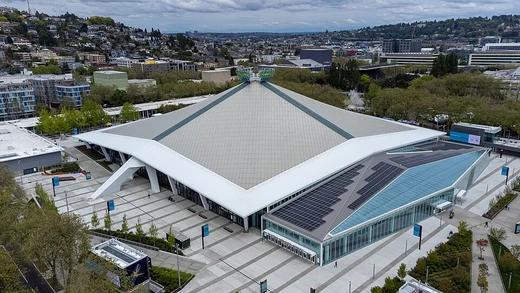
PPG Paints Arena
First LEED gold-certified arena in the NHL and AFL.

PPG Paints Arena, located in Pittsburgh, Pennsylvania, is a multi-purpose indoor venue primarily used by the NHL's Pittsburgh Penguins. From 2011 to 2014, it also hosted the Pittsburgh Power of the Arena Football League. It holds the distinction of being the first arena in both the NHL and AFL to earn a Leadership in Energy and Environmental Design (LEED) gold certification. Shortly after its 2010 debut, the arena received the Pollstar Concert Industry Award for "Best New Major Concert Venue" and was named "Best NHL Arena" in a Sports Business Journal reader poll.
Quick Facts
- Nickname
- The Paint Can / The House that Crosby Built
- Address
- 1001 Fifth Avenue
- Location
- Pittsburgh, Pennsylvania, U.S.
- Groundbreaking
- August 14, 2008
- Built
- August 2008 – August 2010
- Opened
- August 18, 2010
- Owner
- Sports & Exhibition Authority of Pittsburgh and Allegheny County
- Operator
- Anschutz Entertainment Group
- Surface
- Multi-surface (ice)
- Cost
- US$321 million / ($ in US dollars)US
- Architect
- Populous (formerly HOK Sport) / Astorino / Architectural Innovations / Fukui Architects / Lami Grubb
- Project Manager
- ICON Venue Group
Facts from the source article.
Lore & Background
The arena replaced the Penguins' former arena, Civic Arena (formerly known as Mellon Arena), which was completed in 1961. A ceremonial ground-breaking was held on August 14, 2008. The arena was originally named Consol Energy Center after Consol Energy purchased the naming rights in December 2008. The current name comes from Pittsburgh-based PPG Industries, who purchased naming rights in October 2016. The arena's funding plan was agreed upon by Penguins owner Mario Lemieux, Pittsburgh mayor Luke Ravenstahl, and Pennsylvania governor Ed Rendell on March 13, 2007, after much negotiation. During negotiations, the Penguins explored moving the franchise to Kansas City or Las Vegas; after the deal was made the Penguins agreed to stay in Pittsburgh for at least 30 more years. Lemieux later stated that relocating the franchise was never a possibility, but instead it was a negotiation tactic. The arena was originally scheduled to open for the 2009–10 NHL season, but was pushed back to the 2010–11 NHL season. The expected cost of approximately $290 million rose to $321 million due to increased cost of steel and insurance. Populous, designers of PNC Park and Heinz Field, designed the building working with local architect Astorino. More than a dozen buildings were razed to create room for the new arena. The Penguins have contacted the Pittsburgh Technology Council to find new technologies to implement into the arena's design. On demand replays from touch-screens are available in luxury suites, while 'Yinz Cam'—a system developed by Carnegie Mellon University students—allows any fans to view instant replays from multiple angles on their cell phones. The arena's capacity for hockey is 18,087, in honor of Sidney Crosby's number 87, and includes 66 suites, in honor of Mario Lemieux's number 66.
Reader's Guide
PPG Paints Arena is significant as the first LEED gold-certified arena in both the NHL and AFL, marking a milestone in sustainable sports venue design. Its construction was the result of a complex funding plan involving casino licensing, state and local government contributions, and private investment, which ultimately kept the Penguins in Pittsburgh for at least 30 years. The arena's naming rights changed from Consol Energy to PPG Industries in 2016 due to Consol's financial struggles from low energy prices. The arena is notable for its unique soft drink contract history: prior to 2024, it was one of the only major sports venues not contracted with Coca-Cola or PepsiCo, instead serving Dr Pepper Snapple Group products. As of July 2024, Coca-Cola became the official in-game beverage provider. The Penguins' goal horn, made by Nathan Manufacturing, Inc. and introduced in 2005 to coincide with Sidney Crosby's arrival, was brought over from the Civic Arena. The arena's design was revised after initial renderings received negative feedback from the Pittsburgh City Planning Commission, with local architect Rob Pfaffmann comparing the original design to a Home Depot. The revised plans were unanimously approved. The arena's interior was modeled after that of the venue then known as Jobing.com Arena in Glendale, Arizona, at the request of Penguins CEO Ken Sawyer, who praised the seat views.
Did You Know?
- The arena's hockey capacity of 18,087 honors Sidney Crosby's jersey number 87, and its 66 suites honor Mario Lemieux's number 66.
- Shovels with shafts made from Sidney Crosby's used hockey sticks were used for the ceremonial ground-breaking on August 14, 2008.
- The Penguins brought the Stanley Cup to the arena's construction site on July 9, 2009, during the offseason while the arena was under construction.
- Prior to 2024, PPG Paints Arena was one of the only major sports venues whose soft drink contract was not with Coca-Cola or PepsiCo, instead serving Dr Pepper Snapple Group products.
More in NHL Arenas 1-24
Spotted an error? Know more?
Reader corrections go straight into our review queue. Suggest an edit · How this site is sourced