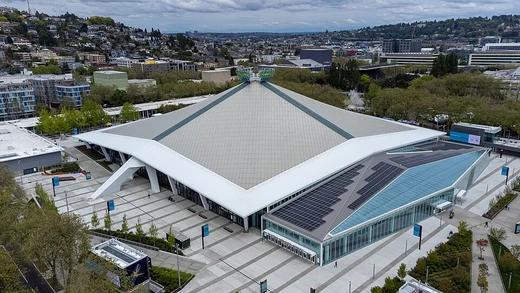
Enterprise Center
Home of the St. Louis Blues since 1994.

Remy Connors · CC BY 2.0
Enterprise Center is a multipurpose indoor arena in downtown St. Louis, Missouri, with a seating capacity of 18,096. It serves primarily as the home of the NHL’s St. Louis Blues, but also hosts NCAA basketball and hockey games, concerts, professional wrestling, and other events. The venue typically holds around 175 events per year. Pollstar, an industry trade publication, once ranked it among the world’s top ten arenas for non-team event ticket sales, though by 2017 it had dropped to the upper sixties.
The arena opened in 1994 as Kiel Center, replacing the demolished Kiel Auditorium. It was renamed Savvis Center from 2000 to 2006, then Scottrade Center from 2006 to 2018. On May 21, 2018, the Blues and Enterprise Holdings—a St. Louis–based company—announced a naming-rights deal, and the facility became Enterprise Center on July 1, 2018.
The site originally housed Charles H. Turpin’s Booker T. Washington Theater, later replaced by the Municipal Auditorium, which was renamed for Mayor Henry Kiel after his death in 1943. The Blues had played at the St. Louis Arena before moving into Kiel Center, but their first game there was delayed until January 1995 due to the 1994–95 NHL lockout. The first professional sports event in the building was an indoor soccer match featuring the St. Louis Ambush. The Kiel name remains on the adjacent parking structure and the building’s cornerstone, and nearby MetroLink signs now read “Civic Center” due to the arena’s four name changes.
The Opera House portion of the original auditorium was not demolished but remained closed from 1992, after Civic Progress members failed to fund its renovation despite promises. In June 2009, the St. Louis Board of Aldermen voted 25–1 to subsidize its renovation, using municipal bonds and historic tax credits. It reopened on October 1, 2011, as the Peabody Opera House, after a $79 million renovation, and is now called Stifel Theatre following a naming-rights deal with a local investment bank.
For Blues games, public address announcer Tom Calhoun and organist Jeremy Boyer are regulars. National anthems are performed by a rotating group of local singers; former anthem singer Charles Glenn retired in 2018 due to health issues and a move to San Diego but returned for the 2019 Stanley Cup run. Head ice technician Jim Schmuke has worked at the arena since August 1994 and with the Blues since 1979.
Quick Facts
- Address
- 1401 Clark Avenue
- Location
- St. Louis, Missouri, U.S.
- Groundbreaking
- 1992-12-14
- Opened
- 1994-10-08
- Owner
- City of St. Louis
- Operator
- SLB Acquisition Holdings LLC , GBC 996 Inc.
- Cost
- $135 million / ($ in US dollarsUS)
- Architect
- Ellerbe Becket
- Structural Engineer
- The Consulting Engineers Group, Inc.
- Services Engineer
- William Tao & Associates, Inc.
- General Contractor
- J.S. Alberici Construction
- Main Contractors
- DKW Construction, Inc.
Facts from the source article.
Lore & Background
The arena opened in 1994 as the Kiel Center, replacing the Kiel Auditorium which was torn down in December 1992. The site was originally home to Charles H. Turpin's Booker T. Washington Theater, later replaced by the Municipal Auditorium, renamed for mayor Henry Kiel after his death in 1943. The Blues had played in the St. Louis Arena prior to moving into Kiel Center in 1994; however, they would not play in the arena until January 1995 due to the lockout that delayed the start of the 1994–95 season. The first professional sports match was played by the St. Louis Ambush, an indoor soccer team.
The arena has undergone multiple name changes: Savvis Center from 2000 to 2006, Scottrade Center from 2006 to 2018, and Enterprise Center since July 1, 2018. The naming rights were acquired by Enterprise Holdings, based in St. Louis, in a 15-year agreement announced on May 21, 2018. The Kiel name still exists on the adjoining parking structure and the building cornerstone. A three-phase renovation began in 2017 and was completed in 2019, including engineering upgrades, new scoreboard, theater boxes, and rebuilt concourses.
The Opera House portion of the original building remained closed from 1992 until it was renovated and reopened as the Peabody Opera House on October 1, 2011, after a $79 million renovation. It is now known as the Stifel Theatre after naming rights were purchased by a locally based investment bank.
Reader's Guide
Enterprise Center is significant as the long-standing home of the St. Louis Blues, who moved there in 1994 after playing at the St. Louis Arena. The arena has hosted numerous NCAA championship events, including the men's hockey Frozen Four in 2007, the women's basketball Final Four in 2001 and 2009, and multiple wrestling championships. It has been the annual host of the Missouri Valley Conference men's basketball tournament since 1995, known as 'Arch Madness'. The facility has also hosted the SEC men's basketball tournament in 2018 after Missouri joined the SEC. Its naming rights history reflects corporate changes, with the current name coming from Enterprise Holdings in 2018. The arena's renovation from 2017 to 2019 modernized the facility while minimizing schedule disruption. The largest crowd recorded was 22,612 for a basketball tournament, and the largest concert crowd was 20,648 for Bon Jovi in 2011. The building is operated by SLB Acquisition Holdings LLC, owner of the St. Louis Blues, under chairman Tom Stillman.
Did You Know?
- The first professional sports match played in the arena was by the St. Louis Ambush, an indoor soccer team.
- The largest crowd to attend an event at the arena was 22,612, which happened twice during the 2007 Missouri Valley Conference men's basketball tournament.
Naming Rights and Arena Identity
In the modern NHL arena landscape, corporate naming rights have become the dominant model for venue branding. Nearly every current arena carries a corporate sponsor's name as part of its official identity. The notable exception is Madison Square Garden, which stands alone among active NHL venues as the only arena whose name is not held by a corporate sponsor. At the other end of the spectrum, Climate Pledge Arena in Seattle exemplifies how naming rights can extend beyond simple branding. Amazon holds the naming rights to that venue and leverages the contract to promote its climate change awareness initiative, turning a sponsorship deal into a platform for environmental messaging. This contrast between a century-old venue that retains its original name and a modern arena whose identity is shaped by a tech giant's sustainability goals illustrates the wide range of approaches arenas take to define their public identity within the league.
Reconstruction and the Evolution of Arena Infrastructure
Some of the most significant transformations in the NHL arena landscape have involved complete rebuilds while preserving the original structure's outer shell. Seattle's venue, for instance, underwent a major reconstruction between 2018 and 2021. The project resulted in an entirely new arena bowl and concourses built underneath the original roof of the Seattle Center Coliseum, a structure that dates back to 1962. This approach allowed the city to maintain the recognizable exterior while delivering a modern interior experience. A similar philosophy guided another renovation from 2010 to 2013, where a completely new arena bowl and concourses were constructed within the original building's framework. These projects represent a distinct middle path in arena development: not a full demolition and ground-up construction, but a thorough internal replacement that honors the architectural heritage of the existing structure while meeting contemporary standards for fan experience and operational efficiency.
The Outdoor NHL Tradition
The NHL has cultivated a rich tradition of outdoor hockey that extends well beyond the four walls of indoor arenas. The Heritage Classic, which began in 2003, established a pattern of frequent—though not strictly annual—outdoor matchups. The Winter Classic followed in 2008 and has become an annual event, with only 2013 and 2021 seeing it skipped. The Stadium Series arrived in 2014, adding another annual outdoor spectacle, though 2021 was again an exception. In 2017, the league marked the 100th anniversary of the NHL with both the Centennial Classic and the 100 Classic, creating a dual celebration of the sport's century of history. More recently, the 2021 NHL Outdoors at Lake Tahoe brought the game to a scenic natural setting. Together, these events demonstrate how the league has woven outdoor play into its identity, creating marquee moments that draw fans far beyond the regular arena-going audience and connect the sport to broader cultural celebrations.
Neutral Sites and the Broader Venue Ecosystem
The NHL arena ecosystem extends well beyond the dedicated home venues of individual teams. Neutral venues have played a meaningful role in the league's history by hosting games that counted toward regular season standings, adding a layer of competitive significance to what might otherwise be exhibition-style matchups. The broader context of NHL venues also includes a substantial catalog of former arenas that no longer host professional hockey, as well as defunct teams whose home venues have since been repurposed or demolished. The league's venue landscape is also part of a wider sports infrastructure picture: the NHL arena list sits alongside comparable inventories of Major League Baseball stadiums, Major League Soccer venues, NBA arenas, and NFL stadiums, as well as European ice hockey arenas. This interconnected web of sports facilities reflects how professional athletics shares common patterns of investment, renovation, and community identity, with each league's venues contributing to the broader cultural fabric of the cities that host them.
Gallery




Frequently Asked Questions
What is Enterprise Center and where is it located?
Enterprise Center is a multipurpose indoor arena in downtown St. Louis, Missouri, that primarily serves as the home of the NHL's St. Louis Blues. It seats roughly 18,096 and typically hosts around 175 events each year beyond hockey.
What was Enterprise Center called before its current name?
The venue cycled through several naming-rights sponsors: Kiel Center (1994–2000), Savvis Center (2000–2006), and Scottrade Center (2006–2018). It has carried the Enterprise Center name since July 1, 2018.
When did Enterprise Center open and what did it replace?
The building opened in 1994 as Kiel Center, taking over the site where the older Kiel Auditorium had stood after that venue was demolished. It has been the Blues' home ice ever since its first season.
What is the largest crowd Enterprise Center has ever held?
Its standard hockey capacity is 18,096, but the record attendance was 22,612, set during the 2007 Missouri Valley Conference men's basketball tournament. That figure reflects the arena's ability to expand seating for non-hockey events.
What kinds of events does Enterprise Center host besides NHL games?
Beyond Blues hockey, the arena regularly stages NCAA basketball and hockey tournaments, major concerts, professional wrestling shows, and other live events. Pollstar once ranked it among the world's top ten arenas for non-team event ticket sales, though by 2017 it had slipped to the upper sixties.
More in NHL Arenas 1-24
Spotted an error? Know more?
Reader corrections go straight into our review queue. Suggest an edit · How this site is sourced