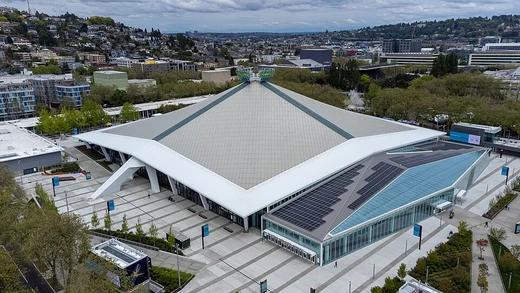
Capital One Arena
Multi-purpose arena atop Gallery Place Metro station in Washington, D.C.

3d U.S. Infantry Regiment (The Old Guard) · Public domain
Capital One Arena is a multi-purpose indoor arena in Washington, D.C., located in the Chinatown section of the Penn Quarter neighborhood atop the Gallery Place rapid transit station of the Washington Metro. It is the home arena of the Washington Capitals (NHL), the Washington Wizards (NBA), and the Georgetown University men's basketball team, and is owned and operated by Monumental Sports & Entertainment.
Quick Facts
- Address
- 601 F Street NW
- Location
- Washington, D.C., U.S.
- Groundbreaking
- October 18, 1995
- Opened
- December 2, 1997
- Owner
- Monumental Sports & Entertainment
- Cost
- US$260 million / (US$ in US-GDP dollarsUS-GDP)
- Architect
- Ellerbe Becket / Devrouax & Purnell / KCF-SHG Architects
- Structural Engineer
- Delon Hampton & Associates
- Services Engineer
- John J. Christie Associates
- Project Manager
- John Stranix and Seagull Bay Sports, LLC
- General Contractor
- Clark/Smoot
- Former Names
- MCI Center (1997–2006) / Verizon Center (2006–2017)
Facts from the source article.
Lore & Background
The block between 6th and 7th and F and G Streets historically held residences and small businesses, but by the 1960s suffered from urban decay. In 1973, the District government bought the land during development of the Gallery Place Metro station. A planned mixed-use complex by Capital Landmark Associates was selected in 1979 but canceled in 1992 after years of languishing. Before the arena's opening, the Capitals and Wizards (then the Bullets) played at USAir Arena in Landover, Maryland, where attendance was subpar due to inconvenient location and outdated facilities. In December 1993, owner Abe Pollin began studying options for a new arena with public financing. A group of Washington business leaders brokered a deal with the District government to build at the Gallery Place site, with the District initially paying $150 million. After a competing proposal from Robert Johnson of Black Entertainment Television for mostly private financing, Pollin agreed to privately fund the $200 million construction, while the District paid $79 million for land, site preparation, and Metro expansion. The District leased the land to Pollin at $300,000 per year. The groundbreaking was in October 1995, and the first event was a Wizards game against the Seattle SuperSonics on December 2, 1997, with President Bill Clinton in attendance. The arena featured a 25,000-square-foot Discovery Channel Store (1998–2001), the MCI National Sports Gallery (1998–2000 or 2001), and arenaNet multimedia stations. In 1999, a group led by Ted Leonsis bought a 36% stake in Pollin's holdings, increasing to 44% in 2000. After Pollin's death in November 2009, the Leonsis group (Monumental Sports & Entertainment) bought full ownership in June 2010.
Reader's Guide
Capital One Arena is notable for its role in revitalizing downtown Washington, D.C., replacing an earlier failed development on the same site. It brought the Capitals and Wizards from a suburban arena that had subpar attendance and was not up to NBA and NHL standards. The arena was built with spectator seats arranged vertically rather than out, providing better views but limited leg room in upper levels, and featured spacious quarters for players and coaches with advanced competitive research technology. Its naming rights changed three times: from MCI Center (1997) to Verizon Center (2006) after Verizon acquired MCI, and to Capital One Arena (2017) when Capital One purchased the rights. The arena hosted the Washington Mystics (WNBA) from 1998 to 2018, after which they moved to CareFirst Arena. In 2019–2020, Monumental Sports undertook a $30 million renovation replacing seating, improving the concourse, and adding a new overhead video board and SkyRing video screen. In July 2020, William Hill opened the first brick-and-mortar sportsbook in the District at the arena, also the first at a professional sports venue in the United States. In 2023–2024, Monumental Sports considered moving the Capitals and Wizards to a new arena in Northern Virginia, but in March 2024, D.C. mayor Muriel Bowser announced a deal to keep the teams in the District at least until 2050, with a $1 billion renovation (including $515 million from the District government) expected to be completed by 2028.
Did You Know?
- The arena opened on December 2, 1997, with a Wizards game against the Seattle SuperSonics attended by President Bill Clinton.
- It was the first brick-and-mortar sportsbook at a professional sports venue in the United States, opened by William Hill in July 2020.
- The arena's naming rights changed three times: MCI Center (1997), Verizon Center (2006), and Capital One Arena (2017).
- A $1 billion renovation is underway, with $515 million from the District of Columbia government, expected to be completed by 2028.
From Blighted Block to $200 Million Landmark
The parcel between 6th and 7th Streets, F and G Streets, in what is now the Chinatown portion of Penn Quarter, was once a patchwork of small shops and working-class homes that fell into disrepair by the 1960s, mirroring the broader decay along the eastern edge of downtown. In 1973, as the Gallery Place Metro station was taking shape beneath the site, the District government acquired the land with redevelopment aspirations. By 1979, a vision for the block included a mixed-use complex featuring retail space, office towers, residential apartments, and a hotel. The last of the old structures came down in 1985, yet the project stalled for years before being formally scrapped in 1992. The arena ultimately emerged from a deal brokered by a group of Washington business leaders linking owner Abe Pollin with the District. Initially conceived as a $150 million publicly financed build backed by a special business tax, the plan pivoted when a rival private proposal from BET chief Robert Johnson surfaced amid the District's budget crisis. Pollin stepped in to privately fund the $200 million construction, while the District absorbed $79 million in land purchases, site preparation, and Metro station expansion. In a below-market arrangement, the District charged Pollin only $300,000 annually for the land lease.
A Home for Four Franchises and a University
The arena opened its doors on December 2, 1997, with a Wizards game against the Seattle SuperSonics, and has since anchored the sports lives of multiple professional and collegiate teams. The Washington Capitals of the NHL and the Washington Wizards of the NBA both relocated from the aging USAir Arena in suburban Landover, Maryland, where inconvenient geography had suppressed attendance for both Washington and Baltimore fans and the 20-year-old facility failed to meet the standards of other league venues. Georgetown University's men's basketball program also calls the building home. The Washington Mystics of the WNBA played here from 1998 through 2018 before relocating to CareFirst Arena in southeast Washington for the 2019 season. Before the arena's arrival, the Capitals and the then-Washington Bullets had been struggling with subpar crowds at their distant suburban home. The move to the heart of the District transformed the venue into a central gathering point for the region's sports fans, eliminating the commute that had long kept casual supporters away from the stands.
Three Names, One Address
The arena's public identity has shifted with the tides of corporate mergers and naming-rights negotiations. It debuted as the MCI Center following a naming deal struck with MCI Communications, with a groundbreaking ceremony held in October 1995. When Verizon Communications acquired MCI in January 2006, the venue became the Verizon Center. In 2017, after Verizon signaled it would not renew its agreement, Capital One bank—headquartered in nearby Tysons, Virginia—purchased the naming rights, and the arena has carried that name since August 9, 2017. Ownership followed a parallel evolution. Abe Pollin, who owned both the Capitals and the Wizards, initially financed the construction. In 1999, technology executive Ted Leonsis and a group of investors bought a 36 percent stake in Pollin's holdings, expanding to 44 percent by 2000. After Pollin's death in November 2009, the Leonsis group, reorganized as Monumental Sports & Entertainment, purchased the remaining interests in June 2010, gaining full control of the arena and the Wizards.
Built for the Spectator
The arena's design and technology set it apart from other venues of its era. Rather than extending seats outward in a traditional bowl, the structure stacked them vertically, improving sightlines for every attendee though sacrificing some leg room in the upper levels. Players and coaches benefited from spacious quarters equipped with advanced competitive research technology. In the concourse, fans could access ArenaNET multimedia stations—powered by Cabletron Systems' virtual LAN and switching technology—to check live scores, watch highlight reels, and send digital postcards by email. This replaced an earlier, abandoned concept of smart seats with built-in televisions that was scrapped over technical difficulties. The venue also hosted a 25,000-square-foot Discovery Channel Store from 1998 to 2001 and the MCI National Sports Gallery, an interactive museum featuring games, memorabilia, and the American Sportscasters Hall of Fame, which operated until around 2000 or 2001 before being converted to office space. President Clinton toured the gallery and played its interactive games before the opening-night contest. Outside, a block of F Street was branded Fun Street before being renamed Abe Pollin Way in 2007.
Gallery
Frequently Asked Questions
Where is Capital One Arena located?
The arena sits in Washington, D.C.'s Chinatown area within the Penn Quarter neighborhood, built directly on top of the Gallery Place Metro station.
Which teams call Capital One Arena home?
It serves as the primary home for the Washington Capitals (NHL) and the Washington Wizards (NBA), and also hosts Georgetown University men's basketball games.
What was Capital One Arena originally called?
The venue opened in December 1997 under the name MCI Center, was rebranded as the Verizon Center in 2006, and received its current Capital One Arena name in 2017.
Who owns and operates Capital One Arena?
Monumental Sports & Entertainment handles both ownership and day-to-day operations of the facility.
How much did it cost to build Capital One Arena?
Abe Pollin privately funded the $200 million construction, while the public sector contributed roughly $79 million toward land acquisition, site work, and expanding the Metro station beneath it.
More in NHL Arenas 1-24
Spotted an error? Know more?
Reader corrections go straight into our review queue. Suggest an edit · How this site is sourced