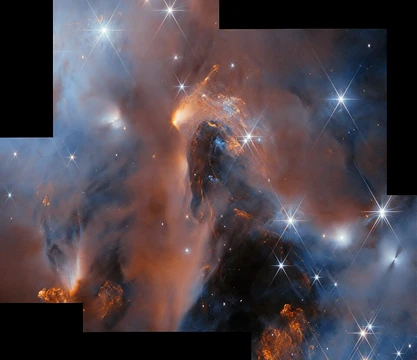
NGC 3758
A merging galaxy pair with two active supermassive black holes.

NGC 3758, nicknamed the Owl Galaxy, is an Sb-type spiral galaxy located in the constellation Leo, about 447 million light-years from our Solar System. It spans roughly 70,000 light-years in diameter. Ralph Copeland first spotted it on March 18, 1874, and Edouard Stephan independently found it ten years later.
This galaxy is classified as a Seyfert 1 type and also carries the Markarian designation Mrk 739, meaning its core emits unusually strong ultraviolet light. What makes NGC 3758 especially rare is that it hosts a binary active galactic nucleus—a sign that it is the product of a galaxy merger. The system consists of two separate galaxies, NGC 3758W and NGC 3758E, each with its own supermassive black hole. These black holes lie just 11,000 light-years apart and are actively feeding on infalling gas, which heats up and radiates energy as it spirals inward. The two galaxies are gravitationally bound, and their orbits will slowly decay until their nuclei merge, a process expected to take a few billion years.
Visually, NGC 3758 resembles a friendly face, with its two bright cores forming the eyes and a swirling, grin-like structure. The binary black holes may also fling stars out of the galaxy at extreme speeds, turning them into hypervelocity stars.
The galaxy contains an extended emission-line region (EELR), first identified through the Galaxy Zoo project. This region could be powered by one or both of the active galactic nuclei. Detailed imaging of oxygen [O III] emission could reveal which AGN is responsible. The European Southern Observatory’s VLT MUSE instrument observed NGC 3758 in 2016, but as of May 2024, no study of the EELR using that data had been published.
Quick Facts
- Constellation Name
- Leo
- Ra
- 11 · 6 · 29.10
- Dec
- 21 · 35 · 46.0
- Z
- 0.029771
- H Radial V
- 8,909 km/s
- Dist Ly
- 447 Mly (137 Mpc)
- Appmag V
- 14.3
- Notes
- Rare example of binary active galactic nucleus, seyfert galaxy
- Epoch
- J2000
Facts from the source article.
Lore & Background
NGC 3758 is composed of two separate galaxies, designated NGC 3758W and NGC 3758E, each hosting a supermassive black hole. These black holes are only 11,000 light-years apart and are actively accreting gas, causing them to radiate energy. The galaxies are gravitationally bound, and their orbits will decay over a few billion years until the nuclei merge.
The galaxy's appearance resembles a friendly face, with two luminous cores as eyes and a swirling grin. It is possible that the binary black holes, on the verge of merging, can turn stars into hypervelocity stars and eject them from the host galaxy.
NGC 3758 contains an extended emission-line region (EELR), discovered through the Galaxy Zoo project. This EELR may originate from one or both of the active galactic nuclei. Detailed oxygen [O III] imaging could reveal which AGN is responsible, and ESO's VLT MUSE instrument observed NGC 3758 in 2016, though no publication on the MUSE data concerning the EELR existed as of May 2024.
Reader's Guide
NGC 3758 is significant as a rare binary active galactic nucleus galaxy, offering a nearby laboratory for studying galaxy mergers and the dynamics of dual supermassive black holes. Its classification as a Markarian galaxy highlights its ultraviolet excess, while the presence of two active black holes only 11,000 light-years apart provides insight into the processes that lead to black hole coalescence. The extended emission-line region discovered by Galaxy Zoo adds another layer of interest, as it may help astronomers determine which of the two AGN is ionizing the surrounding gas. The potential for producing hypervelocity stars from the binary black hole system underscores the extreme gravitational interactions at play. Although MUSE observations were made in 2016, the lack of published results as of May 2024 leaves open questions about the origin of the EELR, making NGC 3758 an ongoing subject of study in extragalactic astronomy.
Did You Know?
- NGC 3758 is also known as the Owl Galaxy.
- It is a binary active galactic nucleus galaxy, a rare example of a galaxy merger.
- The two supermassive black holes in NGC 3758 are only 11,000 light-years apart.
- The galaxy's extended emission-line region was discovered through the Galaxy Zoo project.
More in NGC Objects, Part 6 1-24
Spotted an error? Know more?
Reader corrections go straight into our review queue. Suggest an edit · How this site is sourced