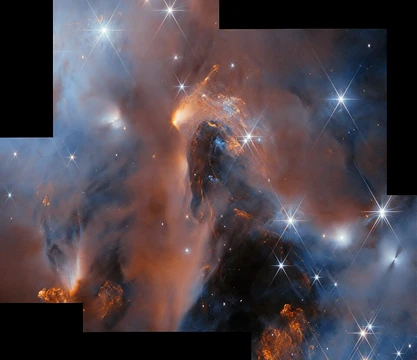
NGC 3509
A large barred spiral galaxy with a tidal tail resembling a tadpole.

NGC 3509, also known as Arp 335, is a barred spiral galaxy located in the constellation Leo, approximately 340 million light-years from the Solar System. It is notable for its large size and peculiar structure, including a sweeping tidal tail that gives it a tadpole-like appearance.
Quick Facts
- Constellation Name
- Leo
- Ra
- 11h 04m 23.554s
- Dec
- +04d 49m 43.03s
- Z
- 0.025594
- H Radial V
- 7,673 km/s
- Dist Ly
- 340 Mly (104.2 Mpc)
- Appmag V
- 13.53
- Notes
- interacting galaxy with a tidal tail feature
- Epoch
- J2000
Facts from the source article.
Lore & Background
NGC 3509 was discovered by astronomer William Herschel on December 30, 1786. It is a large galaxy, with a diameter of 215,000 light-years, significantly larger than the Milky Way. Its luminosity class is II-III, and it contains a broad HII region.
The galaxy is peculiar, showing a sweeping tidal tail feature that makes it resemble a tadpole. A sketch by Toomre depicted a large tail curving toward the northwest and a shorter one extending southwest, but later investigations indicated this is actually a bright ridge of the galaxy's disk structure. NGC 3509 has a single undisturbed nucleus surrounded by dust lanes, suggesting it has not undergone a major disk-to-disk merger but rather a minor merger with a smaller satellite galaxy. This interaction triggers starbursts along its spiral arms, leading to active star formation. The galaxy also shows signs of neutral hydrogen, and a galactic halo is growing through accretion of smaller galaxies, which leave spurs as they are tidally disrupted.
Reader's Guide
NGC 3509 is designated as Arp 335 in the Atlas of Peculiar Galaxies by Halton Arp, placed in the Miscellaneous category, which includes the well-known galaxy M82. Its peculiar tidal tail and undisturbed nucleus make it a valuable object for studying minor mergers and their effects on galaxy evolution. The galaxy's active star formation, triggered by interaction with a smaller satellite, provides insights into how starbursts occur in such systems. The discovery of a single supernova, SN 2010bi, a Type IIP event with a progenitor likely an 8–16 solar mass red supergiant, adds to its observational significance. The ongoing growth of its galactic halo through accretion of smaller galaxies further highlights its role in understanding hierarchical galaxy assembly.
Did You Know?
- NGC 3509 has a diameter of 215,000 light-years, more than twice that of the Milky Way.
- It was discovered by William Herschel on December 30, 1786.
- The galaxy's tadpole-like appearance is due to a sweeping tidal tail, later found to be a bright ridge of its disk.
- One supernova, SN 2010bi, was discovered in NGC 3509 on March 24, 2010.
Frequently Asked Questions
What is NGC 3509?
NGC 3509, also catalogued as Arp 335, is a barred spiral galaxy sitting in the constellation Leo. It lies roughly 340 million light-years from the Solar System and is recognized for its unusually large scale and distinctive shape.
What makes NGC 3509's appearance so distinctive?
A long, sweeping tidal tail stretches out from the galaxy's disk, giving the whole system a tadpole-like silhouette. This feature is what earned it a spot in Arp's catalog of peculiar galaxies.
How large is NGC 3509 compared to other galaxies?
Its diameter spans approximately 215,000 light-years, placing it well above the size of the Milky Way. That considerable scale is one of the reasons it stands out among barred spirals in Leo.
Where in the sky can I spot NGC 3509?
Look toward the constellation Leo, where the galaxy resides about 340 million light-years away. Its luminosity class is listed as II-III, indicating a relatively bright central region for its type.
Has a supernova ever been observed in NGC 3509?
Yes — SN 2010bi, classified as a Type IIP supernova, was detected in the galaxy. It remains a key data point for studying core-collapse events in large barred spirals at this distance.
More in NGC Objects, Part 6 1-24
Spotted an error? Know more?
Reader corrections go straight into our review queue. Suggest an edit · How this site is sourced