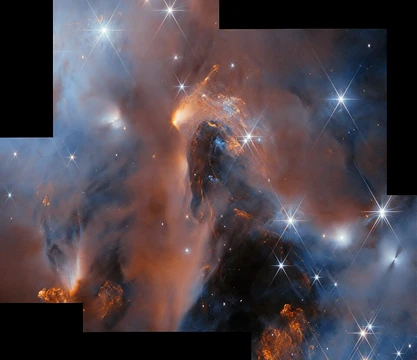
NGC 3395
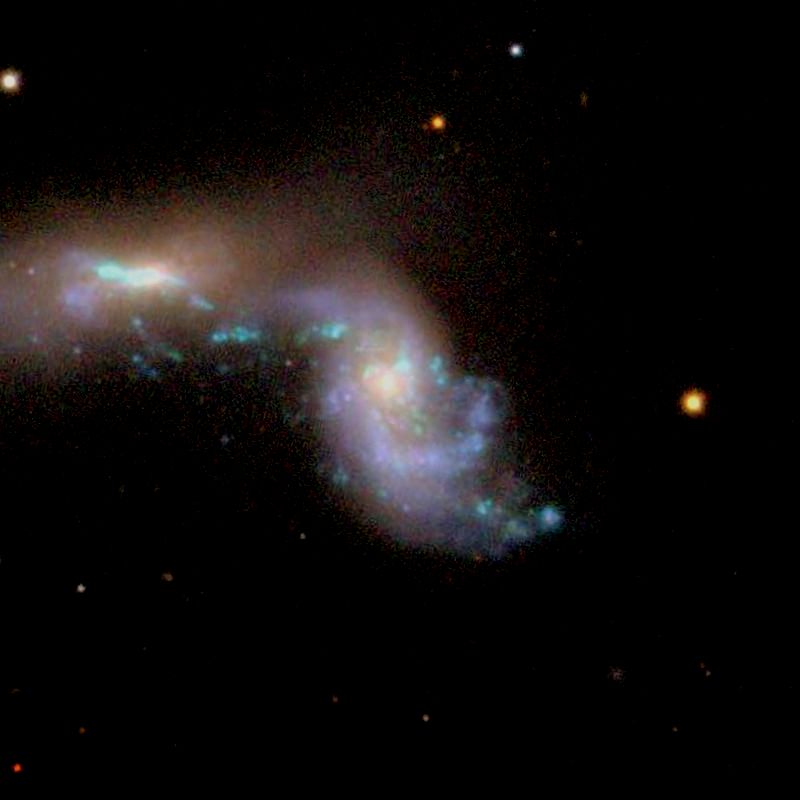
A peculiar spiral galaxy interacting with NGC 3396.

Donald Pelletier · CC BY-SA 4.0
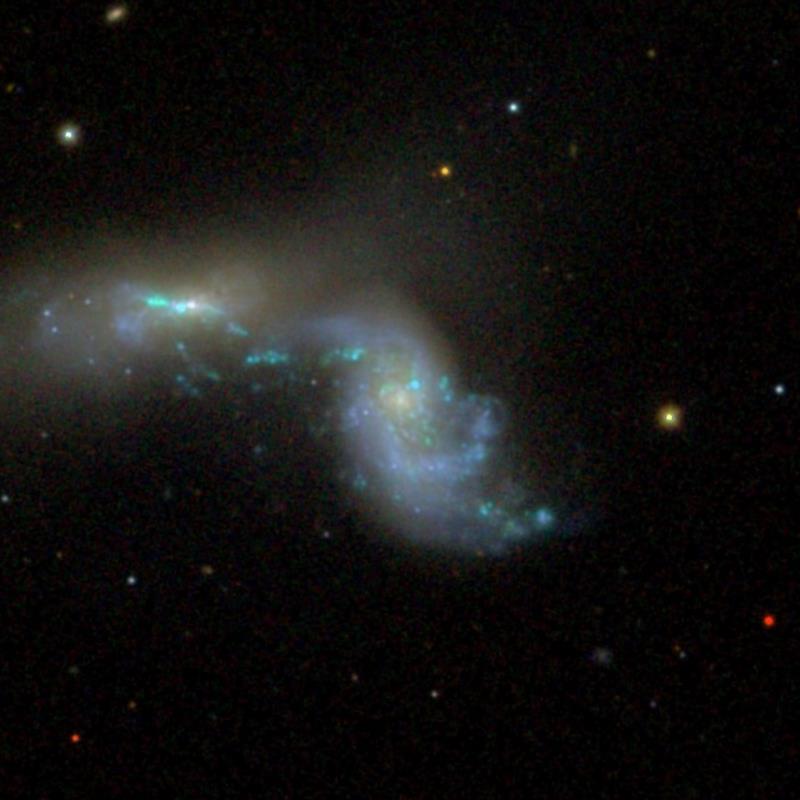
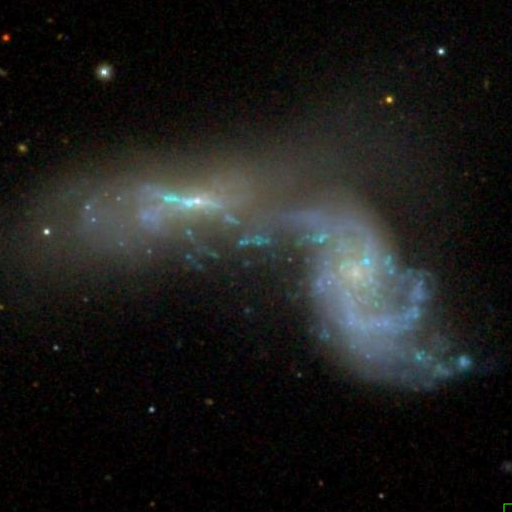
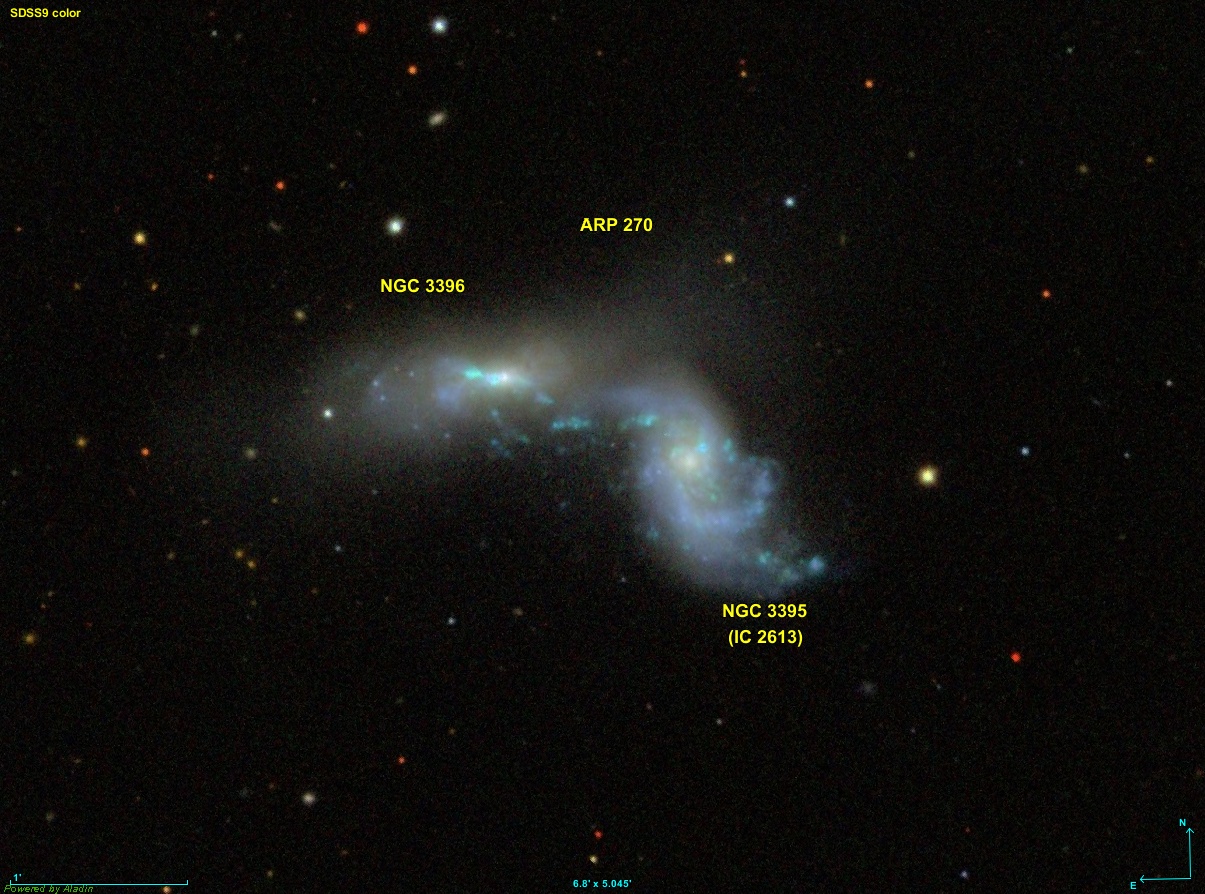
NGC 3395 is a peculiar spiral galaxy in the constellation Leo Minor, located approximately 55 million light years from Earth. It is notable for its ongoing gravitational interaction with the neighboring galaxy NGC 3396, forming a pair that exhibits tidal features and starburst activity.
Quick Facts
- Epoch
- J2000
- Ra
- 10 · 49 · 50.1
- Dec
- +32 · 58 · 58
- Dist Ly
- 54 ± 23 Mly (16.6 ± 6.9 Mpc)
- Z
- 0.005394 ± 0.000002
- H Radial V
- 1,617 ± 1 km/s
- Appmag V
- 11.8
- Constellation Name
- Leo Minor
- Notes
- Interacting galaxy
- Names
- IC 2613, UGC 5931, Arp 270, VV 246b, MCG +06-24-017, PGC 32424
Facts from the source article.
Lore & Background
NGC 3395 was discovered by William Herschel on December 7, 1785. It forms an interacting pair with NGC 3396, a magellanic spiral galaxy located 1.5 arcminutes from its nucleus. The mass ratio of the two galaxies is about 1.5 to 1. Although they appear separate, a bridge of material connects them, and tidal tails are observed. Dynamical modeling suggests the pair experienced a first close encounter that stripped gas from NGC 3395, forming a tidal tail to the southeast. A second close encounter occurred about 50 million years ago, triggering starburst activity. The two galaxies are expected to merge within the next 500 million years.
The galaxy hosts numerous HII regions where star formation is occurring. The most intense star formation lies northwest of the center, with additional star formation at the end of a spiral arm northeast of the nucleus and in three regions within the bridge between the galaxies. Three more star-forming regions are visible in a tail southwest of the galaxy. The average size of star-forming knots in NGC 3395 is an order of magnitude smaller than those in NGC 3396. The nucleus of NGC 3395 does not appear to be active.
The NGC 3395/3396 pair is part of the NGC 3430 Group (LGG 218), which also includes NGC 3381, NGC 3424, NGC 3430, NGC 3442, and IC 2604. IC 2604 lies 14 arcminutes to the southwest of the pair, and IC 2608 lies 14 arcminutes to the southeast. This group is part of the Leo II groups, which in turn belongs to the Virgo Supercluster.
Reader's Guide
NGC 3395 is significant as a key member of an interacting galaxy pair that provides a clear example of tidal interactions and induced star formation. The bridge of material and tidal tails between NGC 3395 and NGC 3396 offer observable evidence of gravitational encounters, while dynamical modeling has reconstructed a history of two close passages, the most recent about 50 million years ago, which triggered starburst activity. The presence of multiple star-forming HII regions—in the galaxy's center, spiral arms, bridge, and tidal tail—illustrates how interactions can distribute star formation across a system. The pair's eventual merger within 500 million years makes it a valuable case study for understanding galaxy evolution and merging processes. As part of the NGC 3430 Group within the Leo II groups and the Virgo Supercluster, NGC 3395 contributes to the broader picture of galaxy clustering and large-scale structure. The lack of an active nucleus in NGC 3395 contrasts with the vigorous star formation in its disk and tidal features, highlighting that starbursts can occur without nuclear activity.
Did You Know?
- The galaxy is about 35,000 light years across, roughly one-third the diameter of the Milky Way.
- NGC 3395 and NGC 3396 are expected to merge in the next 500 million years.
- The most intense star formation in NGC 3395 occurs northwest of its center.
Discovery and Physical Profile
William Herschel first recorded NGC 3395 on December 7, 1785, adding it to his expanding catalog of deep-sky objects. Classified as a peculiar spiral galaxy, it resides in the constellation Leo Minor and sits roughly 55 million light years from Earth. That distance, combined with its apparent angular size, places its physical diameter at approximately 35,000 light years. Notably, the central nucleus of NGC 3395 does not appear to be active, distinguishing it from galaxies that host luminous quasar-like engines at their cores. The peculiar designation in its classification reflects the unusual morphology it has acquired through gravitational interaction with its neighbor, NGC 3396. For nearly two and a half centuries, this galaxy has served as a quiet but instructive subject for astronomers studying how close encounters reshape spiral structure, strip gas from disks, and ignite new waves of star formation across extended regions of tail and arm.
A Gravitational Partnership Written in Tidal Tails
NGC 3395 does not exist in isolation. Its closest companion, NGC 3396, a magellanic spiral, sits just 1.5 arcminutes from the nucleus of NGC 3395, and the two share a mass ratio of roughly 1.5 to 1. Although they still appear as distinct objects, a bridge of material stretches between them, and tidal tails arc outward like the debris of a slow-motion collision. Dynamical models of the pair paint a multi-episode history. During an earlier close passage, gas was ripped from NGC 3395 and flung into a tail extending toward the south-east. A second close encounter, estimated to have occurred around 50 million years ago, triggered a burst of star formation across the system. Looking ahead, the gravitational tides that have sculpted both galaxies over hundreds of millions of years are expected to continue tightening their grip. Most models project that the two will complete their merger within the next 500 million years, ultimately forging a single larger galaxy from the remnants of their long dance.
Star-Forming Knots and the Engine of New Suns
The gravitational stress imposed by NGC 3396 has turned NGC 3395 into a landscape dotted with active HII regions where new stars are being born. The most intense concentration of star formation lies in the northwest portion of the galactic center, while additional activity is visible along the tip of the spiral arm extending northeast of the nucleus. The interaction has also seeded star formation directly in the bridge of material connecting the two galaxies, where three distinct regions glow, and in a tail trailing to the southwest, which hosts three more. Interestingly, the individual star-forming knots within NGC 3395 are, on average, an order of magnitude smaller than their counterparts in NGC 3396, suggesting the two galaxies respond to the same tidal forces in structurally different ways. Meanwhile, the nucleus of NGC 3395 remains quiescent, with no evidence of an active core driving the observed luminosity. All of the star formation appears to be a direct consequence of the pair's ongoing gravitational interplay rather than an internal engine.
A Member of the NGC 3430 Group and the Virgo Supercluster
NGC 3395 and its companion NGC 3396 are not merely a local pair; they belong to a larger gravitationally associated collection known as the NGC 3430 Group, also cataloged as LGG 218. Fellow members of this group include NGC 3381, NGC 3424, NGC 3430, NGC 3442, and IC 2604, which sits 14 arcminutes to the south-west of the interacting pair. The group itself is one component of the broader Leo II groups, a collection of galaxy groups and clusters that together form a substructure within the Virgo Supercluster. This places NGC 3395 within a hierarchical cosmic architecture: a peculiar spiral bound to a companion, that pair embedded in a small group, the group nested within a larger association, and the association forming part of the Virgo Supercluster. Understanding NGC 3395's peculiar morphology and star-formation history therefore requires viewing it not as a solitary object but as a participant in a multi-scale gravitational environment stretching from its immediate tidal partner to the supercluster beyond.
Gallery
Frequently Asked Questions
What is NGC 3395?
NGC 3395 is a peculiar spiral galaxy in the constellation Leo Minor, sitting roughly 55 million light years from Earth. Its distorted shape is the result of a gravitational dance with its neighbor, NGC 3396.
What makes NGC 3395 stand out among other galaxies?
Its ongoing interaction with NGC 3396 has warped its spiral arms and ignited starburst activity, leaving visible tidal features across both objects. This makes the pair a go-to example for astronomers studying how close encounters reshape galaxies.
Where in the sky can I find NGC 3395?
Look toward the constellation Leo Minor, where the galaxy sits about 55 million light years away. It spans roughly 35,000 light years across, so it is a sizable but faint deep-sky target.
Who discovered NGC 3395 and when?
William Herschel first logged the galaxy on December 7, 1785. It has carried its NGC designation ever since, though its peculiar, interacting nature became much clearer with modern imaging.
What galaxy group does NGC 3395 belong to?
It is cataloged as a member of the NGC 3430 Group, also known as LGG 218. This places it in a small local cluster of galaxies sharing a similar distance from us.
More in NGC Objects, Part 6 1-24
Spotted an error? Know more?
Reader corrections go straight into our review queue. Suggest an edit · How this site is sourced