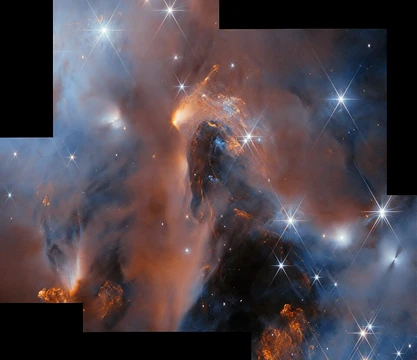
NGC 3389
Spiral galaxy in Leo with two supernovae and dual NGC listings.

NGC 3389 is a spiral galaxy located in the constellation Leo. It was discovered by German-British astronomer William Herschel on 11 March 1784, and later observed by John Herschel on 23 March 1830, which led to its second listing in the New General Catalogue as NGC 3373. The galaxy is notable for its membership in multiple galaxy groupings and for hosting two recorded supernovae.
Quick Facts
- Epoch
- J2000
- Constellation Name
- Leo
- Ra
- 10 · 48 · 27.9204
- Dec
- +12 · 31 · 59.897ned
- Z
- 0.004346 · 0.000007ned
- Dist Ly
- 21.983 ± 0.924 Mpcned
- Group Cluster
- HOLM 212, NGC 3338 Group (LGG 214)
- Appmag V
- 12.3Bned
Facts from the source article.
Lore & Background
NGC 3389 was first observed by William Herschel on 11 March 1784. John Herschel later observed it on 23 March 1830, and this second observation caused the galaxy to be recorded again in the New General Catalogue under the number NGC 3373. The galaxy's distance measurements show a discrepancy: its velocity relative to the cosmic microwave background gives a Hubble distance of 24.35 ± 1.74 Mpc, while 24 non-redshift measurements yield a closer mean distance of 21.983 ± 0.924 Mpc.
NGC 3389 is listed together with Messier 105 and NGC 3384 as Holm 212 in Erik Holmberg's 1937 study of double and multiple galaxies. According to A. M. Garcia, it is also a member of the NGC 3338 Group (LGG 214), which includes at least three other galaxies: NGC 3338, NGC 3346, UGC 5832, and MRK 1263.
Two supernovae have been observed in NGC 3389. SN1967C, a Type Ia supernova reaching magnitude 13, was discovered by A. D. Chuadze on 28 February 1967 and independently by Miklós Lovas on 10 March 1967. SN2009md, a Type II supernova reaching magnitude 16.5, was discovered by Kōichi Itagaki on 4 December 2009.
Reader's Guide
NGC 3389 holds significance as a spiral galaxy with a dual identity in the New General Catalogue, resulting from independent observations by William Herschel and his son John Herschel. This duplication underscores the challenges of early cataloging before systematic cross-referencing. The galaxy's distance remains uncertain, with Hubble-flow estimates differing from the mean of 24 non-redshift measurements, a common tension in extragalactic astronomy. Its membership in both Holm 212—a grouping with Messier 105 and NGC 3384—and the NGC 3338 Group (LGG 214) places it within a rich local environment, offering opportunities to study galaxy interactions and group dynamics. The two recorded supernovae, SN1967C (Type Ia) and SN2009md (Type II), provide data on stellar explosions at different distances and epochs. The independent discovery of SN1967C by two astronomers highlights the collaborative nature of supernova detection. Overall, NGC 3389 serves as a case study in cataloging history, distance measurement, and supernova astrophysics.
Did You Know?
- NGC 3389 was discovered by William Herschel on 11 March 1784.
- It was also observed by John Herschel on 23 March 1830, leading to a second NGC listing as NGC 3373.
Frequently Asked Questions
What is NGC 3389?
NGC 3389 is a spiral galaxy sitting in the constellation Leo. It belongs to several overlapping galaxy groupings and has been the site of two recorded supernova events.
Who discovered NGC 3389 and when?
German-British astronomer William Herschel first catalogued the galaxy on 11 March 1784. His son John Herschel returned to observe it a second time on 23 March 1830.
Why does NGC 3389 also go by NGC 3373?
John Herschel's 1830 observation was entered as a separate object in the New General Catalogue, so the same galaxy ended up carrying the alternate designation NGC 3373.
How far away is NGC 3389?
Hubble-flow calculations put the galaxy at roughly 24.35 million parsecs, while non-redshift estimates give a mean distance of about 22 million parsecs.
What makes NGC 3389 stand out for amateur and professional observers?
Its dual NGC listing and membership in multiple galaxy groupings make it a handy anchor for mapping local structure. The two supernovae recorded there also keep it on the radar of transient-observer communities.
More in NGC Objects, Part 6 1-24
Spotted an error? Know more?
Reader corrections go straight into our review queue. Suggest an edit · How this site is sourced