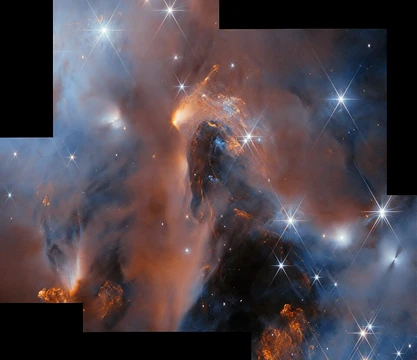
NGC 3507
Barred spiral galaxy with grand design arms and a disputed active nucleus.

NGC 3507 is a barred spiral galaxy in the constellation Leo, located approximately 50 million light years from Earth. It is notable for its prominent bar and two well-defined spiral arms, classifying it as a grand design galaxy, and for its debated active nucleus.
Quick Facts
- Epoch
- J2000
- Ra
- 11 · 03 · 25.3705
- Dec
- +18 · 08 · 07.703
- Dist Ly
- 48.9 ± 3.6 Mly (15.0 ± 1.1 Mpc)
- Z
- 0.003266 ± 0.000013
- H Radial V
- 979 ± 4 km/s
- Appmag V
- 11.9
- Constellation Name
- Leo
- Group Cluster
- NGC 3607 Group
Facts from the source article.
Lore & Background
NGC 3507 was discovered by German-British astronomer William Herschel on March 14, 1784. The galaxy is seen nearly face-on, with an inclination of 17°, and features a prominent bar from which two spiral arms emerge at a right angle. The arms are bright for about half a revolution and can be traced for nearly a full revolution before fading; the southeast arm wraps more tightly than the northwest one. The inner regions contain about 90 knots identified as young star groupings, with a mean diameter of 121 parsecs. The galaxy lacks high-velocity clouds, indicating a low star formation rate, and its hydrogen distribution is clumpy with a weak HI signal from the central region.
The nucleus has been classified as a LINER (low-ionization nuclear emission-line region), but its active status has been questioned. Ultraviolet radiation and the optical spectrum are consistent with a compact young star cluster in the nucleus, and the X-ray emission does not follow a power law, suggesting it could result from many supernova remnants creating a superbubble. However, OIII/Hα and NII/Hα ratios are in line with other active galaxies. A radio counterpart of the core extends slightly to the south, indicating the galaxy may have a jet. The bright star near the center is a spectroscopic binary catalogued as BD+18 2441.
NGC 3507 forms a pair with NGC 3501, listed together as Holm 224 in Erik Holmberg's 1937 study. It has been placed in different groups: A. M. Garcia includes it with UGC 6095, UGC 617, UGC 6112, and UGC 6181, while Makarov considers it a member of the NGC 3607 Group, along with several other galaxies.
Reader's Guide
NGC 3507 is significant as a nearby example of a grand design barred spiral galaxy, offering a clear view of spiral arm structure and bar dynamics due to its nearly face-on orientation. Its debated active nucleus—classified as a LINER but with evidence pointing to a young star cluster or superbubble rather than a traditional active galactic nucleus—makes it a subject of interest for studies of nuclear activity in galaxies. The presence of a possible radio jet and the detection of young star groupings in its inner regions provide insights into star formation processes and feedback mechanisms. The galaxy's membership in multiple group associations, including the NGC 3607 Group, highlights its role in understanding galaxy interactions and group dynamics. The spectroscopic binary star BD+18 2441 near its center adds an additional layer of interest for stellar astronomy. Overall, NGC 3507 serves as a valuable object for investigating the interplay between bars, spiral arms, nuclear activity, and star formation in a relatively nearby galaxy.
Did You Know?
- NGC 3507 is approximately 47,000 light years across.
- The galaxy's two spiral arms emerge from the ends of its bar at a right angle.
- About 90 young star groupings have been detected in its inner regions, with a mean diameter of 121 parsecs.
- The bright star near the galaxy's center is a spectroscopic binary catalogued as BD+18 2441.
Frequently Asked Questions
What is NGC 3507?
NGC 3507 is a barred spiral galaxy sitting roughly 50 million light years from Earth in the constellation Leo. It spans about 47,000 light years and is classified as a grand design galaxy thanks to its clean, well-ordered spiral structure.
Who discovered NGC 3507 and when?
William Herschel first catalogued this galaxy on March 14, 1784, during his systematic survey of the northern sky. It has carried his discovery designation in the New General Catalogue ever since.
What does NGC 3507 look like through a telescope?
Because its disk is tilted only 17 degrees relative to our line of sight, the galaxy presents a nearly face-on view that showcases its prominent central bar and two sweeping spiral arms. This low inclination is what gives it the classic grand design appearance astronomers prize.
Is NGC 3507 an active galaxy?
Its nucleus has been flagged as potentially active, but the evidence remains disputed among researchers. The debate centers on whether the observed signatures truly indicate a supermassive black hole feeding or can be explained by other processes.
Is NGC 3507 paired with another galaxy?
NGC 3501 sits just 12.7 arcminutes away in the same field of view, making the two appear as a visual pair to observers. However, they are not confirmed physical companions and likely just share a similar line of sight from Earth.
More in NGC Objects, Part 6 1-24
Spotted an error? Know more?
Reader corrections go straight into our review queue. Suggest an edit · How this site is sourced