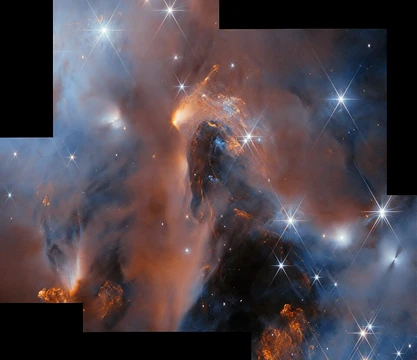
NGC 3393
Barred spiral galaxy with the nearest pair of supermassive black holes.

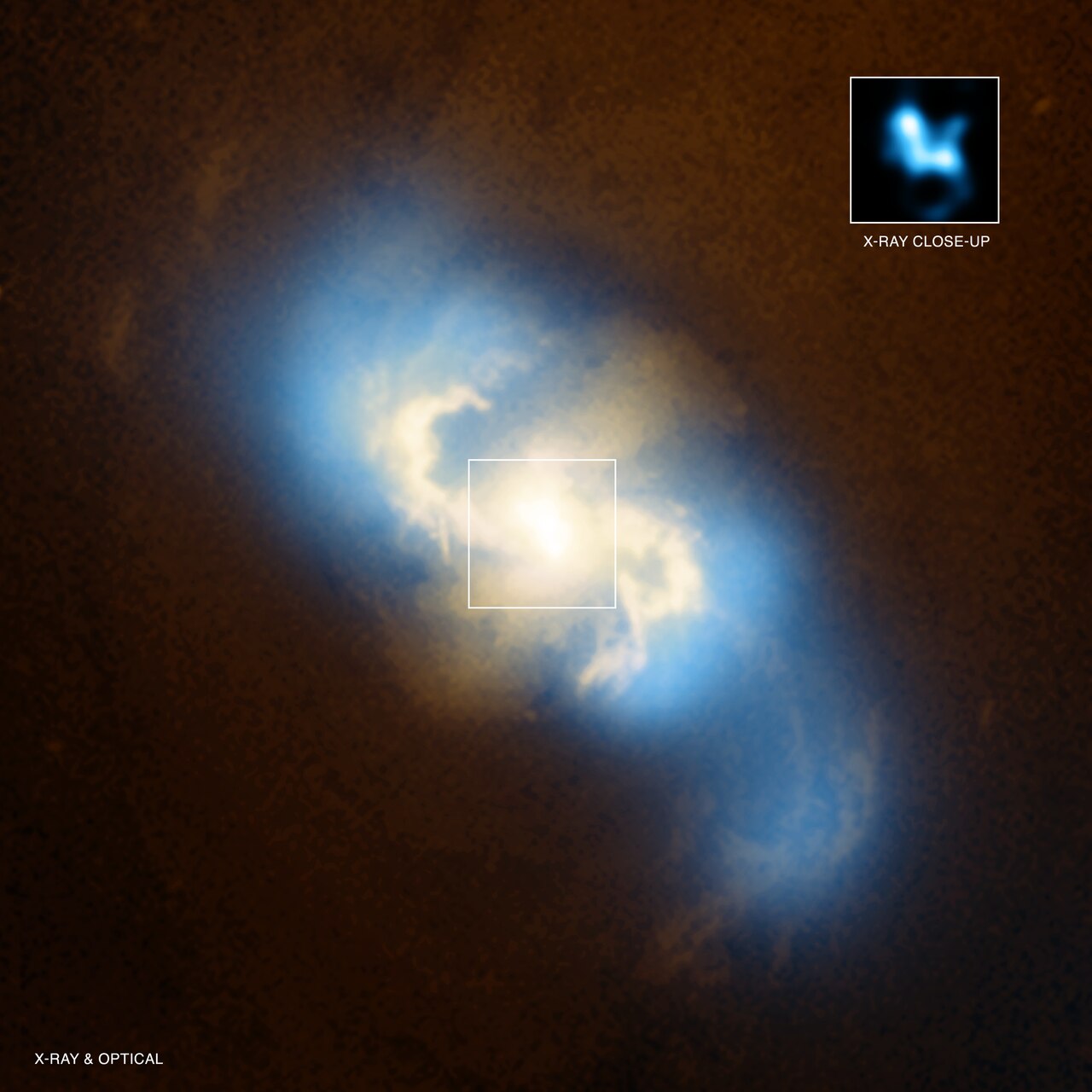
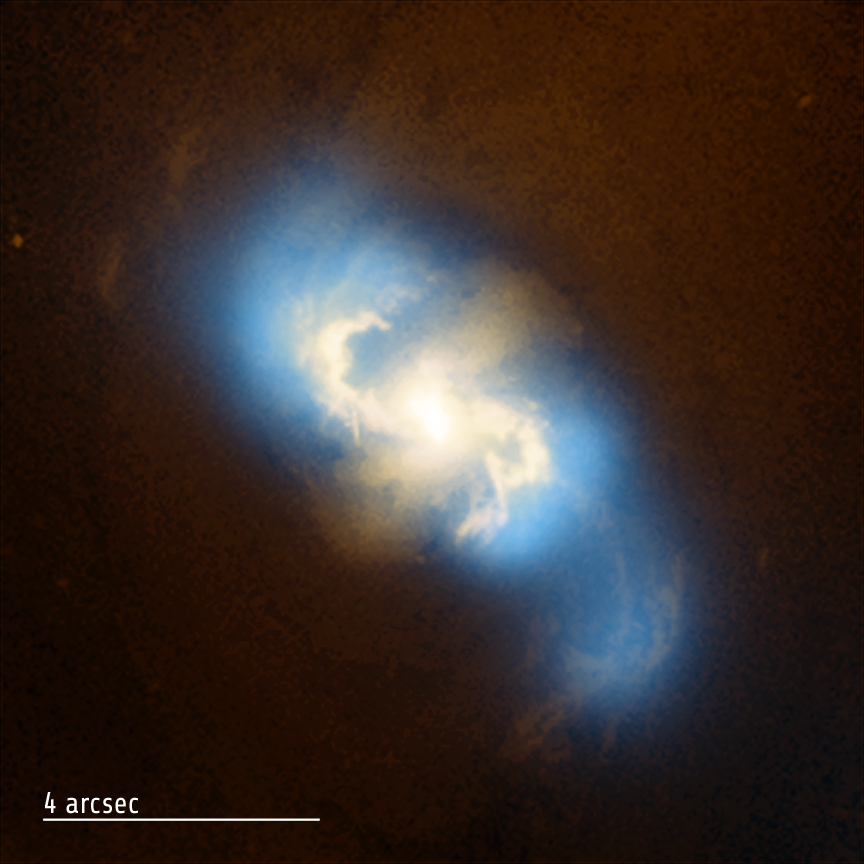
X-ray: NASA/CXC/SAO/G.Fabbiano et al; Optical: NASA/STScI · Public domain
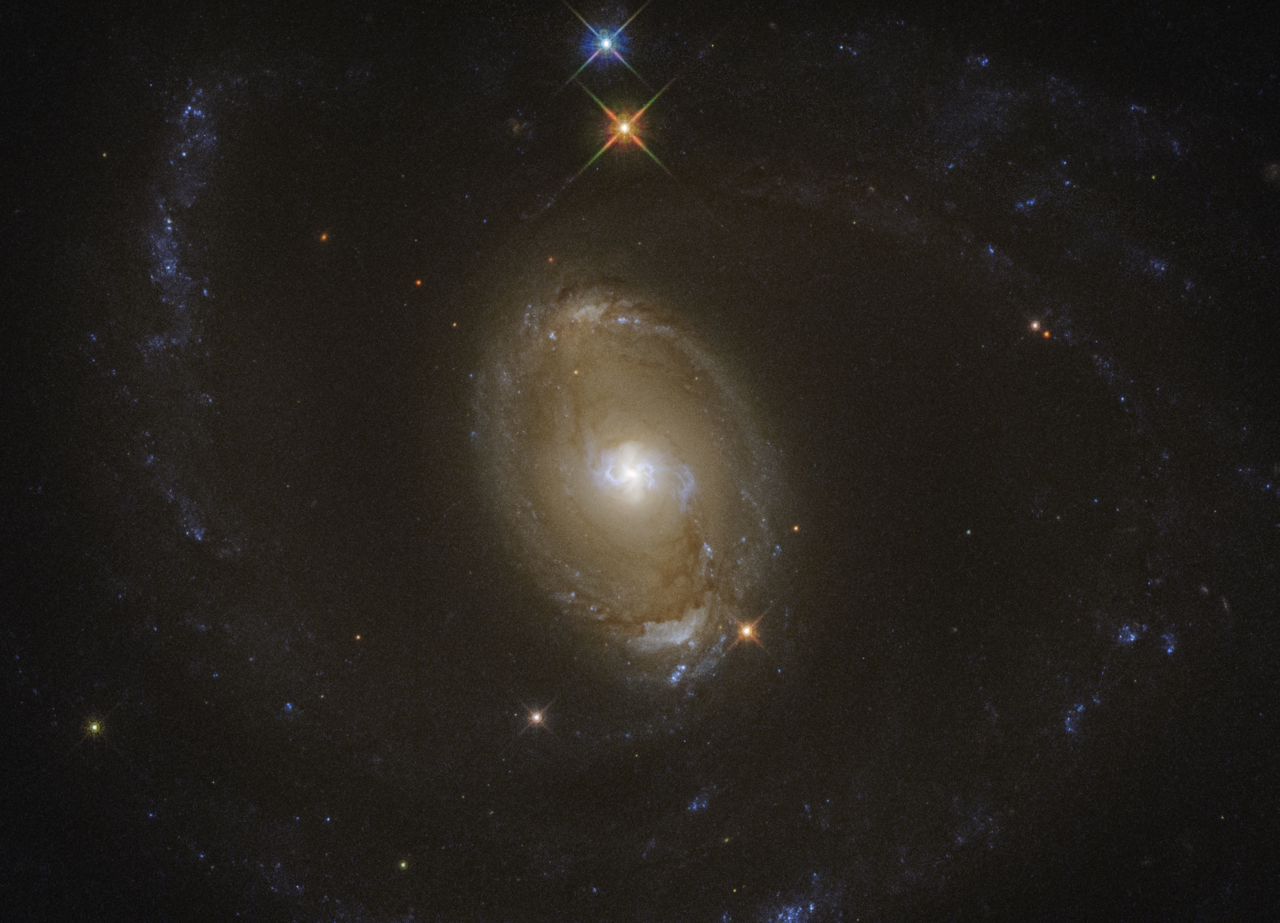
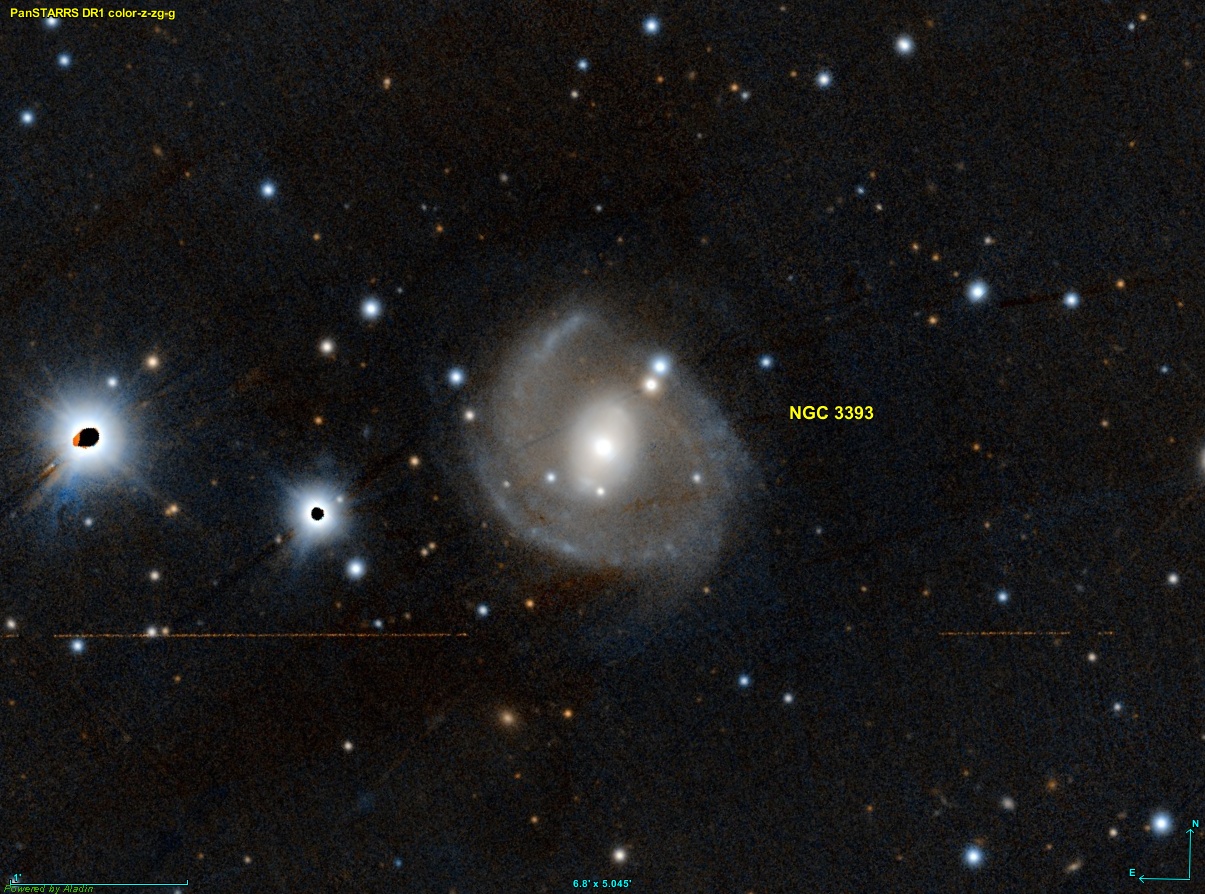
NGC 3393 is a barred spiral galaxy located in the constellation Hydra, approximately 180 million light-years from Earth. It is notable for hosting the nearest known pair of supermassive black holes to Earth, making it a key object for studying galactic mergers and active galactic nuclei.
Quick Facts
- Epoch
- J2000
- Ra
- 10 · 48 · 23.5
- Dec
- -25 · 09 · 43
- Dist Ly
- 181 Mly (56 Mpc)
- Z
- 0.012509 ± 0.000017
- H Radial V
- 3,750 ± 5 km/s
- Appmag V
- 13.1
- Constellation Name
- Hydra
- Notes
- Seyfert galaxy / Hosts a pair of supermassive black holes
- Names
- ESO 501-G100, MCG -04-26-011, AM 1045-245, PGC 32300
Facts from the source article.
Lore & Background
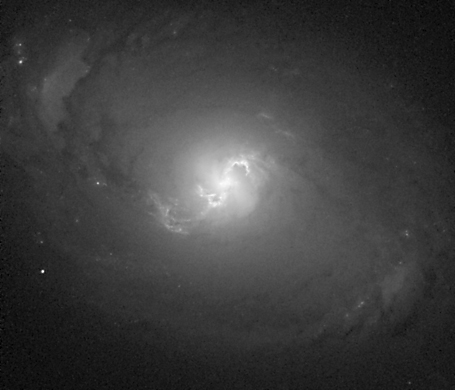
NGC 3393 was discovered by John Herschel on March 24, 1835. It is a barred spiral galaxy with H II regions at both ends of its bar, and evidence of a fainter inner bar. Its outer arms form a nearly complete ring. The galaxy is classified as a Type II Seyfert galaxy, with an active galactic nucleus whose X-ray spectrum indicates a Compton-thick cold reflection source, meaning the central region is obscured by dense gas and dust.
The galaxy's most remarkable feature is a pair of supermassive black holes at its center, separated by only 490 light-years. Observations by the Chandra X-ray Observatory revealed two separate peaks in hard X-ray emission, including iron lines, identifying both black holes as actively growing. The obscured regions around them block optical and ultraviolet light from infalling material. This pair is the first found in a spiral galaxy like the Milky Way, and they are likely the remnant of a merger of two galaxies of unequal mass a billion or more years ago. Supporting evidence includes high pre-shock densities in the narrow-line region and low O/H and Mg/H abundances, though N/H is higher than predicted, possibly due to Wolf–Rayet stars formed during the merger. The total mass of the pair is estimated between 21 and 35 million solar masses.
One supernova, SN 2018aqi, was observed in NGC 3393 on April 6, 2018. It was a Type Ia supernova discovered by ASAS-SN at an apparent magnitude of 16.4, identified 6 days before maximum brightness. NGC 3393 is the brightest galaxy in its group, which includes NGC 3369, NGC 3383, and ESO 501-086; NGC 3463 has also been proposed as a member. The group is part of the Hydra Supercluster.
Reader's Guide
NGC 3393 holds significant importance in astrophysics as the nearest known pair of supermassive black holes to Earth, offering a unique laboratory for studying black hole interactions and galaxy mergers. The close separation of the two black holes—only 490 light-years—provides insight into the final stages of galactic coalescence, where two supermassive black holes spiral toward each other. The galaxy's status as a Type II Seyfert galaxy, with a Compton-thick active nucleus, demonstrates how dense material can obscure the central engine, complicating observations. The detection of the black hole pair via X-ray observations, particularly through iron emission lines, showcases the power of multi-wavelength astronomy. The presence of a supernova, SN 2018aqi, adds to its observational history. As the brightest member of its group within the Hydra Supercluster, NGC 3393 also contributes to understanding large-scale structure. The evidence of a past merger, including chemical abundances and Wolf–Rayet star formation, makes it a key object for studying the evolution of galaxies and their central black holes.
Did You Know?
- NGC 3393 hosts the nearest known pair of supermassive black holes to Earth, separated by only 490 light-years.
- NGC 3393 is a Type II Seyfert galaxy with a Compton-thick cold reflection source, meaning its nucleus is hidden behind dense gas and dust.
Discovery & Physical Profile
NGC 3393 is a barred spiral galaxy that resides in the sprawling constellation Hydra, roughly 180 million light-years from our vantage point in the Solar System. That distance, combined with the galaxy's apparent angular size, places its physical diameter at approximately 231,000 light-years—a structure comparable in scale to our own Milky Way. The object was first catalogued by the British astronomer John Herschel on March 24, 1835, during his extensive southern-sky surveys. Structurally, the galaxy displays a prominent central bar with active H II regions—zones of vigorous star formation—anchored at each end. Astronomers have also detected the signature of a fainter, secondary inner bar nested within the primary one. Beyond the bar, the outer spiral arms trace out a nearly complete ring, giving the galaxy a distinctive, almost circular appearance in deep images. These morphological features together paint a picture of a dynamically rich system whose internal architecture has been shaped by gravitational interactions over billions of years.
The Twin Supermassive Black Holes
Perhaps the most extraordinary aspect of NGC 3393 is the presence of two supermassive black holes orbiting in close proximity at its core. Data gathered by the Chandra X-ray Observatory revealed two distinct peaks in the hard X-ray spectrum, including iron-line emission, which researchers interpreted as the signatures of two separate black holes actively accreting matter. As gas spirals inward, it heats to extreme temperatures and radiates X-rays, yet the intense optical and ultraviolet light produced by the infalling material is swallowed by thick veils of surrounding gas and dust. The two objects are separated by a mere 490 light-years and together carry a combined mass estimated between 21 and 35 million times that of the Sun. What makes this pair particularly remarkable is that they represent the closest known twin supermassive black holes to Earth and the first such pair identified in a spiral galaxy of the same general type as the Milky Way. The prevailing explanation is that the two black holes are the surviving cores of two galaxies of unequal mass that collided and merged more than a billion years ago.
Seyfert Activity & Merger Signatures
NGC 3393 is classified as a Type II Seyfert galaxy, a category defined by a luminous, point-like active nucleus. However, the X-ray spectrum of the source aligns more closely with a Compton-thick cold reflection model, meaning the true engine at the center is buried behind an enormous column of cold gas and dust. The X-rays detected by observatories are not direct emissions but rather photons that have bounced off this dense surrounding material. Beyond the nuclear activity, several chemical and kinematic clues point to a violent past. The narrow-line region exhibits unusually high pre-shock densities, while oxygen-to-hydrogen and magnesium-to-hydrogen abundance ratios fall below typical values. Conversely, nitrogen-to-hydrogen levels exceed predictions, a pattern attributed to the formation of Wolf–Rayet stars in the galactic center during the merger event. Together, these signatures reinforce the hypothesis that NGC 3393 is the product of a major collision between two galaxies of disparate mass, an encounter that ultimately left behind the paired black holes now detected at its heart.
Supernova & Galactic Neighborhood
Although NGC 3393 is best known for its twin black holes, the galaxy has also hosted a stellar explosion visible to Earth-based surveys. In April 2018, the All-Sky Automated Survey for Supernovae (ASAS-SN) detected SN 2018aqi at an apparent magnitude of 16.4. Spectroscopic analysis quickly identified it as a Type Ia supernova, and the observation was made roughly six days before the event reached peak brightness. Type Ia explosions arise from the thermonuclear disruption of a white dwarf, making them valuable standard candles for cosmological distance measurements. In the broader cosmic landscape, NGC 3393 stands as the brightest member of its small galaxy group, which also encompasses NGC 3369, NGC 3383, and the elliptical galaxy ESO 501-086. A fifth candidate, NGC 3463, has been proposed as a possible group member. The entire assembly is itself a component of the much larger Hydra Supercluster, linking this modest barred spiral to one of the great filamentary structures that thread the local universe.
Gallery
Frequently Asked Questions
What is NGC 3393?
NGC 3393 is a barred spiral galaxy sitting roughly 180 million light-years away in the constellation Hydra. It spans about 231,000 light-years across and was first catalogued by John Herschel in March 1835.
What makes NGC 3393 stand out among other galaxies?
It hosts the closest known pair of supermassive black holes to our solar system, an extremely rare configuration. This dual-black-hole system turns the galaxy into a prime natural laboratory for studying how galaxies collide and merge.
Who discovered NGC 3393 and when?
The British astronomer John Herschel identified and recorded this galaxy on March 24, 1835, during his extensive southern-sky surveys.
Why do astronomers care about NGC 3393's black holes?
Because the two supermassive black holes are the nearest known pair to Earth, they offer a rare chance to observe the late stages of a galactic merger up close. Studying them helps scientists refine models of active galactic nuclei and the eventual coalescence of black-hole pairs.
How big is NGC 3393 compared to the Milky Way?
At roughly 231,000 light-years in diameter, NGC 3393 is comparable in scale to our own galaxy. Its barred spiral structure features a central elongated bar of stars flanked by sweeping spiral arms.
More in NGC Objects, Part 6 1-24
Spotted an error? Know more?
Reader corrections go straight into our review queue. Suggest an edit · How this site is sourced