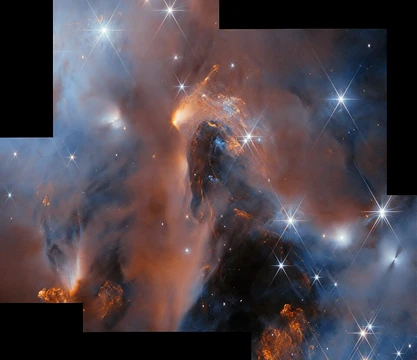
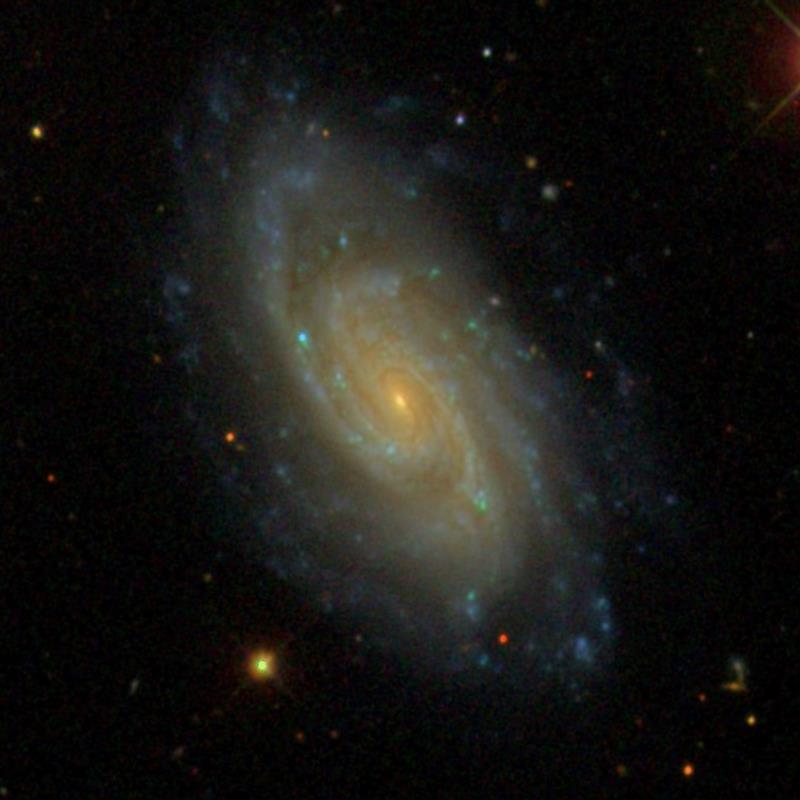
NGC 3430
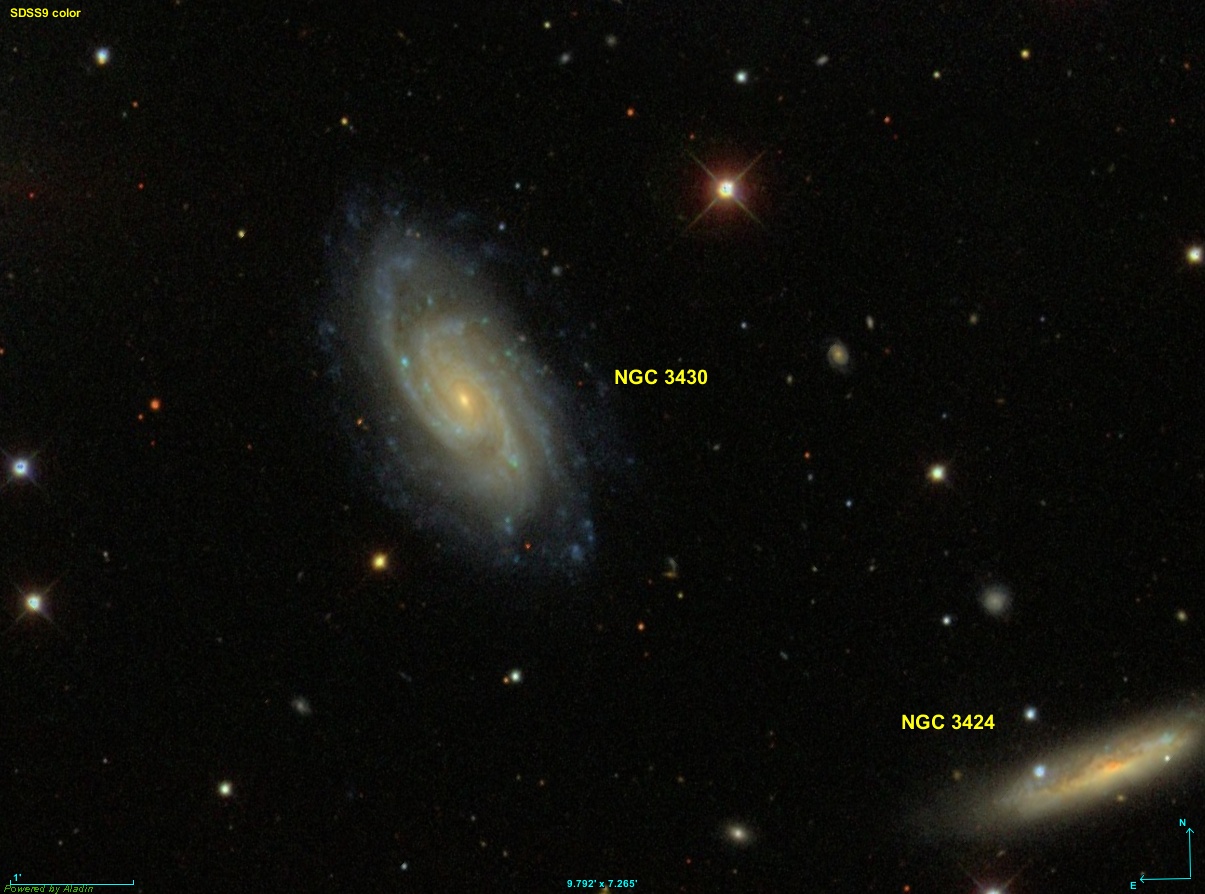
A Wolf-Rayet galaxy with open spiral arms, paired with NGC 3424.

Donald Pelletier · CC BY-SA 4.0
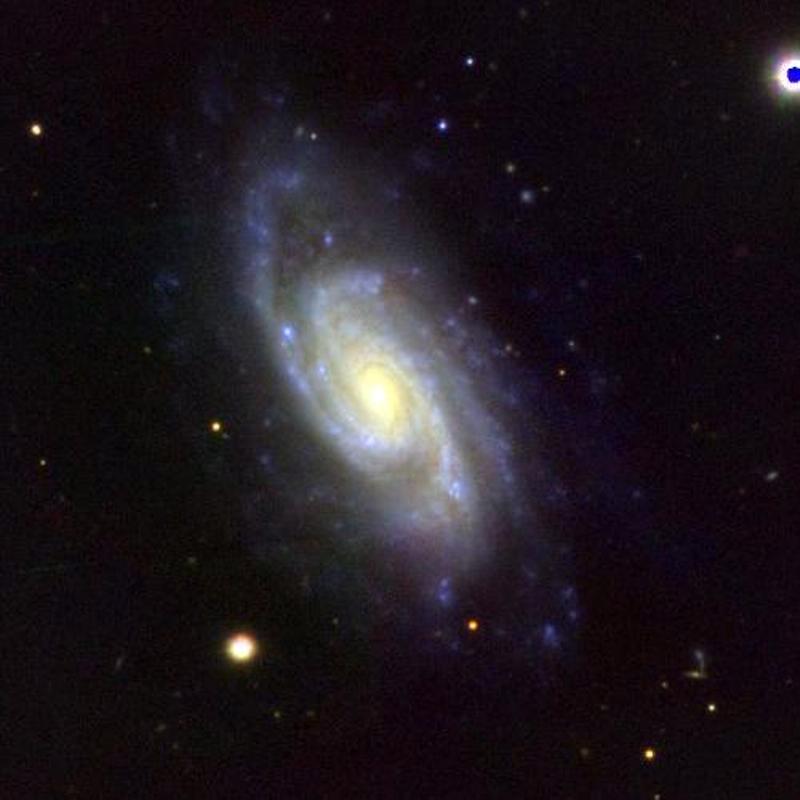
NGC 3430 is a barred spiral galaxy located in the constellation Leo Minor. It is notable as a well-known example of an SAc spiral galaxy, characterized by open, clearly defined spiral arms and no central bar structure. The galaxy is also classified as a Wolf-Rayet galaxy, indicating active star-forming regions, and it forms a pair with the nearby starburst galaxy NGC 3424.
Quick Facts
- Constellation Name
- Leo Minor
- Epoch
- J2000
- Ra
- 10 · 52 · 11.3833
- Dec
- +32 · 57 · 01.358
- Dist Ly
- 27.57 ± 1.95 Mpc
- Group Cluster
- NGC 3396 Group (LGG 218)
- Z
- 0.005290
- H Radial V
- 1586 ± 1 km/s
- Appmag V
- 11.6
Facts from the source article.
Lore & Background
NGC 3430 was discovered by German-British astronomer William Herschel on 7 December 1785. It is classified as an SAc spiral galaxy, meaning it lacks a central bar and has spiral arms that are open and clearly defined. The galaxy is also a Wolf-Rayet galaxy, a type known for hosting massive, hot stars and vigorous star formation.
NGC 3430 forms a physical pair with NGC 3424, a nearby starburst galaxy. A 1997 study indicated that these two galaxies show clear signs of tidal interaction, suggesting gravitational influence between them. The galaxy is a member of the NGC 3396 group (also known as LGG 218), which includes at least 11 galaxies, among them NGC 3395, NGC 3396, PGC 32631, and UGC 5934.
Two supernovae have been observed in NGC 3430: SN2004ez (Type II, magnitude 17.3), discovered by Kōichi Itagaki on 15 October 2004; and PSNJ10520833+3256394 (Type IIb, magnitude 17.8), also discovered by Kōichi Itagaki on 27 August 2015.
Reader's Guide
NGC 3430 holds significance as a well-studied example of an SAc spiral galaxy, offering insight into the structure and dynamics of galaxies without a central bar. Its classification as a Wolf-Rayet galaxy highlights regions of intense star formation, making it a valuable target for studying stellar evolution and the lifecycle of massive stars. The galaxy's interaction with NGC 3424, as evidenced by tidal features noted in a 1997 study, provides a case study in galactic mergers and tidal forces. As a member of the NGC 3396 group, NGC 3430 contributes to understanding group dynamics and the distribution of galaxies in the local universe. The two supernovae recorded within it—SN2004ez and PSNJ10520833+3256394—offer data on core-collapse supernovae of Types II and IIb, enriching knowledge of explosive stellar endpoints. Its discovery by William Herschel in 1785 places it within the historical context of early deep-sky surveys, and its well-measured distances (both via redshift and 22 non-redshift methods) provide a robust foundation for cosmological calibrations.
Discovery & Physical Profile
First recorded by the pioneering astronomer William Herschel on December 7, 1785, NGC 3395 is classified as a peculiar spiral galaxy residing in the northern constellation of Leo Minor. Situated roughly 55 million light years from our vantage point on Earth, the galaxy spans an estimated 35,000 light years in diameter—a figure derived from its apparent angular size combined with its known distance. Despite its spiral morphology, NGC 3395 carries the peculiar designation, a nod to the structural distortions it has acquired through gravitational interactions with its neighboring companion. Notably, the galaxy's central nucleus shows no signs of active behavior, distinguishing it from many other interacting systems where the core becomes energized. The combination of its moderate distance, measurable physical scale, and unusual morphology made it a compelling target for Herschel's systematic sky surveys in the late eighteenth century, and it has remained a subject of interest for astronomers studying the effects of galactic encounters on spiral structure.
The Interacting Pair with NGC 3396
NGC 3395 does not exist in isolation; it is locked in a gravitational dance with NGC 3396, a magellanic spiral galaxy positioned just 1.5 arcminutes from its nucleus. The two objects share a mass ratio of roughly 1.5 to 1, making them comparable partners rather than a dominant galaxy with a small satellite. Although they still appear as distinct entities to the observer, a visible bridge of material stretches between them, and tidal tails extend outward—clear signatures of their ongoing gravitational interplay. Dynamical models of the pair indicate that they have already experienced at least two close encounters. The first stripped gas from NGC 3395, producing a tidal tail that extends toward the south-east. A second encounter, occurring approximately 50 million years ago, triggered a burst of star formation. Looking ahead, simulations suggest the two galaxies are on a collision course and will most likely merge within the next 500 million years, ultimately forming a single, larger system.
Star-Forming Regions & HII Activity
Despite an inactive nucleus, NGC 3395 is remarkably rich in star-forming HII regions scattered across its disk and surrounding structures. The most vigorous zone of new star birth lies to the northwest of the galactic center, while additional activity is detected at the tip of the spiral arm extending northeast of the nucleus. Perhaps most strikingly, three separate star-forming regions have been identified within the material bridge connecting NGC 3395 to its companion, and three more glow in a tail trailing to the southwest. This distribution underscores how the gravitational interaction with NGC 3396 has redistributed gas and compressed it into new sites of stellar birth far from the core. One notable contrast with the companion galaxy is the scale of individual star-forming knots: in NGC 3395, these knots average an order of magnitude smaller than their counterparts in NGC 3396, suggesting differences in the physical conditions or the age of the star-forming episodes between the two interacting partners.
Group Membership & Cosmic Context
NGC 3395 and its companion NGC 3396 are not merely a local pair; together they anchor a broader assembly of galaxies known as the NGC 3430 Group, also catalogued as LGG 218. This group encompasses several additional members, including NGC 3381, NGC 3424, NGC 3430, NGC 3442, and IC 2604. The spatial arrangement places IC 2604 approximately 14 arcminutes to the south-west of the interacting pair, while IC 2608 sits a similar angular distance to the south-east, framing the group in the sky. On a larger cosmological scale, the NGC 3430 Group belongs to the Leo II groups, a collection of galaxy clusters and groups that themselves form part of the vast Virgo Supercluster. This layered membership—from a tightly bound interacting pair, to a local group of a handful of galaxies, to a supercluster spanning hundreds of millions of light years—illustrates the hierarchical structure of the cosmic web in which NGC 3395 resides.
Gallery
Frequently Asked Questions
What is NGC 3430 and where can it be found in the sky?
NGC 3430 is a barred spiral galaxy of type SAc, meaning it has open, loosely wound spiral arms with a relatively short bar. It sits in the constellation Leo Minor, a small and faint region of the northern sky.
Who discovered NGC 3430 and when?
William Herschel first recorded the galaxy on 7 December 1785 during his systematic survey of deep-sky objects. It has carried his catalog designation ever since.
Why do astronomers call NGC 3430 a Wolf-Rayet galaxy?
The label indicates that the galaxy hosts regions of extremely active star formation, producing massive, short-lived stars that ionize surrounding gas. This makes NGC 3430 a useful study target for understanding intense stellar nurseries in spiral systems.
What is the connection between NGC 3430 and NGC 3424?
The two galaxies form a close physical pair, with NGC 3424 being a starburst system. Their proximity suggests ongoing gravitational interaction, which may be driving the elevated star-formation activity seen in both objects.
How far away is NGC 3430 from Earth?
Based on its recessional velocity of roughly 1,869 km/s relative to the cosmic microwave background, NGC 3430 lies at an estimated Hubble distance of about 27.6 megaparsecs, or roughly 90 million light-years.
More in NGC Objects, Part 6 1-24
Spotted an error? Know more?
Reader corrections go straight into our review queue. Suggest an edit · How this site is sourced