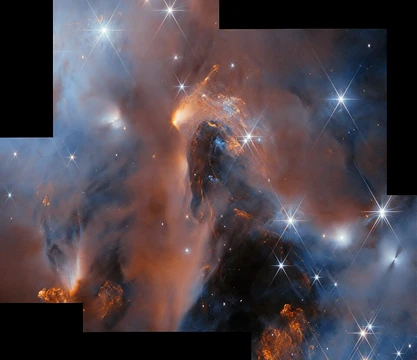
NGC 3362
Intermediate spiral galaxy in Leo with a Seyfert II nucleus.

NGC 3362 is an intermediate spiral galaxy located in the constellation Leo. It is notable for its classification as a Seyfert II galaxy, indicating a bright, quasar-like nucleus with high-ionization emission lines, while the host galaxy remains clearly detectable. The galaxy has hosted three observed supernovae and contains a supermassive black hole.
Quick Facts
- Constellation Name
- Leo
- Epoch
- J2000
- Ra
- 10 · 44 · 51.7366
- Dec
- +06 · 35 · 48.595
- Dist Ly
- 127.97 ± 8.97 Mpc
- Z
- 0.027746
- H Radial V
- 8318 ± 1 km/s
- Appmag V
- 12.8
Facts from the source article.
Lore & Background
NGC 3362 was discovered by German astronomer Albert Marth on 22 March 1865. It is classified as an intermediate spiral galaxy. The SIMBAD database lists it as a Seyfert II Galaxy, meaning its nucleus has very high surface brightness and strong, high-ionization emission lines, yet the host galaxy is clearly visible. Its velocity relative to the cosmic microwave background is 8676 ± 25 km/s, corresponding to a Hubble distance of about 127.97 Mpc, though three non-redshift measurements suggest a closer distance of about 95.8 Mpc. The galaxy is located in the same region of the celestial sphere as UGC 5892, and according to Abraham Mahtessian, the two form a pair of galaxies. Three supernovae have been observed in NGC 3362: SN 2001Y (Type II-P, mag. 18.1) discovered on 3 March 2001; SN 2010ct (Type II, mag. 19.2) discovered on 15 May 2010; and SN 2019cda (Type Ic, mag. 18.1) discovered on 24 March 2019. The mass of its central supermassive black hole is 5.89 × 10^6 solar masses, as reported in a 2002 paper.
Reader's Guide
NGC 3362 holds significance as a Seyfert II galaxy, offering a nearby laboratory for studying active galactic nuclei where the host galaxy remains observable, unlike more distant quasars. Its three recorded supernovae—spanning Types II-P, II, and Ic—provide data on stellar explosions in a galaxy with an active nucleus. The distance discrepancy between Hubble flow measurements and non-redshift estimates highlights ongoing uncertainties in extragalactic distance scales. The galaxy's pairing with UGC 5892 adds to the understanding of galaxy interactions in the Leo region. The measured mass of its central black hole contributes to the census of supermassive black holes in intermediate spiral galaxies. The discovery by Albert Marth in 1865 places it within the historical catalog of NGC objects, linking 19th-century visual astronomy to modern multi-wavelength studies.
Did You Know?
- NGC 3362 is classified as a Seyfert II galaxy, with a bright nucleus but a clearly detectable host galaxy.
- It forms a pair with the galaxy UGC 5892 according to Abraham Mahtessian.
Frequently Asked Questions
What is NGC 3362?
NGC 3362 is an intermediate spiral galaxy located in the constellation Leo. It is classified as a Seyfert II active galaxy, meaning it has a bright, quasar-like core producing high-ionization emission lines while the surrounding spiral structure is still clearly resolved.
Who discovered NGC 3362 and when?
German astronomer Albert Marth first catalogued this galaxy on 22 March 1865, adding it to the New General Catalogue of deep-sky objects.
What makes NGC 3362's central region notable?
At its heart sits a supermassive black hole that drives a Seyfert II active nucleus, radiating intense high-ionization emission lines. The broad emission features typical of Seyfert I systems are hidden by dust and gas in the host galaxy, which is what gives it the type II designation.
How far away is NGC 3362?
With a velocity relative to the cosmic microwave background of roughly 8,676 km/s, NGC 3362 lies about 128 megaparsecs from us, or approximately 417 million light-years.
What explosive events have been observed in NGC 3362?
Astronomers have recorded three confirmed supernova explosions within this galaxy. These stellar-collapse events make NGC 3362 a useful target for studying how massive stars end their lives in a Seyfert host environment.
More in NGC Objects, Part 6 1-24
Spotted an error? Know more?
Reader corrections go straight into our review queue. Suggest an edit · How this site is sourced