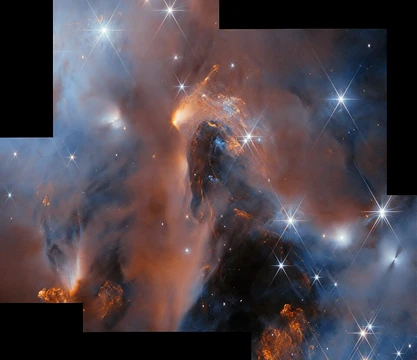
NGC 3367
A barred spiral galaxy with asymmetric arms and a weak AGN.

NGC 3367 is a barred spiral galaxy in the constellation Leo, approximately 120 million light-years from Earth. It is notable for its asymmetric, nearly face-on structure, a strong bar, and a high rate of star formation, as well as hosting a weak active galactic nucleus and six observed supernovae.
Quick Facts
- Epoch
- J2000
- Ra
- 10 · 46 · 35.0
- Dec
- +13 · 45 · 03
- Dist Ly
- 113 ± 22 Mly (34.8 ± 6.7 Mpc)
- Z
- 0.010142 +/- 0.000024
- H Radial V
- 3040 ± 7 km/s
- Appmag V
- 11.4
- Constellation Name
- Leo
- Names
- UGC 5880, CGCG 066-011, MCG +02-28-005, 4C 14.37, PGC 32178
Facts from the source article.
Lore & Background
NGC 3367 was discovered by German-British astronomer William Herschel on March 19, 1784. It is a barred spiral galaxy seen nearly face-on, with an inclination of 25 degrees. The inner arms begin at the ends of the bar, forming a ring with a major axis of 0.9 arcseconds, then branch into a multiple-arm structure studded with bright HII regions. The outer arms form a semi-circular arch toward the south, more visible in ultraviolet. The galaxy's asymmetry is not due to a large satellite; it is thought to result from a minor merger or mass accretion within the last billion years, with cold gas accretion in the past million years boosting star formation and nuclear activity.
The bar is strong and more prominent in the near infrared, indicating an old stellar population. A knot at the eastern end of the bar contains red giants and asymptotic giant branch stars. The nucleus is classified as an HII region or type 2 Seyfert galaxy. Optically, no active galactic nucleus is evident, but broad lines and a blue asymmetry appear in the spectrum. Spitzer Space Telescope detected [Ne V] lines consistent with a weak AGN, and XMM-Newton measured an X-ray luminosity of 2.0 × 10^40 erg/s in the 2–10 keV band, typical of low-luminosity AGNs. Radio observations reveal two lobes extending from a nuclear source, with a radio jet connecting the nucleus to the southwest lobe and a circumnuclear structure of radius ~300 pc. A supermassive black hole at the center has an estimated mass of 10^7.2 solar masses based on Ks bulge luminosity, with X-ray spectra suggesting a range of 10^5 to 10^7 solar masses. Molecular gas detected via CO(1-0) emission within 2 arcseconds of the nucleus may obscure optical AGN lines.
Six supernovae have been observed in NGC 3367: SN 1986A (Type Ia), SN 1992C (Type II), SN 2003aa (Type Ic), SN 2007am (Type II), SN 2018kp (Type Ia), and SN 2022ewj (Type II). The galaxy is the foremost member of the NGC 3367 group, which includes NGC 3391 and NGC 3419, with NGC 3300 and NGC 3306 lying farther away. It lies in the same sky region as the Leo Group, whose redshift is about one-third that of NGC 3367.
Reader's Guide
NGC 3367 is significant as a nearby example of a barred spiral galaxy undergoing active star formation and exhibiting a weak active galactic nucleus. Its asymmetric structure, likely caused by a minor merger or gas accretion, provides insight into galaxy evolution without a large companion. The detection of a supermassive black hole with mass estimates from both bulge luminosity and X-ray spectra, along with molecular gas in the nuclear region, helps constrain models of AGN fueling and obscuration. The six supernovae observed in the galaxy, spanning Types Ia, II, and Ic, contribute to studies of stellar explosions and their environments. Radio observations revealing polarized lobes and a jet offer a clear view of Seyfert-like activity at low luminosity. The galaxy's membership in a small group and its proximity to the Leo Group make it a useful object for understanding galaxy interactions and group dynamics. Its legacy lies in its role as a laboratory for studying bar-driven gas inflow, star formation, and the connection between starburst and AGN activity in a relatively isolated setting.
Did You Know?
- Six supernovae have been observed in NGC 3367, including Type Ia, II, and Ic events.
- The galaxy's bar pattern speed is estimated at 43 ± 6 km/s/kpc using the Tremaine-Weinberg method.
- Radio observations show two lobes extending from the nucleus, with the southwest lobe polarized and the northeast depolarized.
Frequently Asked Questions
What is NGC 3367?
NGC 3367 is a barred spiral galaxy located in the constellation Leo, roughly 120 million light-years from Earth. It is classified as a type 2 Seyfert galaxy, meaning it hosts a weak active galactic nucleus at its center.
Who discovered NGC 3367 and when?
William Herschel first catalogued this galaxy on March 19, 1784, adding it to his growing list of deep-sky objects. It has remained a popular target for observers and researchers ever since.
What makes NGC 3367 visually distinctive?
Its spiral arms are strongly asymmetric, and the galaxy is tilted only about 25 degrees from face-on, giving it an open, nearly head-on appearance. It also exhibits a vigorous rate of star formation and has been the site of six observed supernovae.
How big is NGC 3367 compared to the Milky Way?
The galaxy stretches roughly 98,000 light-years in diameter, making it comparable in overall scale to our own Milky Way. Its prominent central bar and extended arms account for much of that span.
Does NGC 3367 have an active galactic nucleus?
Yes, it harbors a weak AGN, which is the reason it carries a type 2 Seyfert classification. The nuclear activity is relatively low-luminosity compared to more energetic Seyfert galaxies.
More in NGC Objects, Part 6 1-24
Spotted an error? Know more?
Reader corrections go straight into our review queue. Suggest an edit · How this site is sourced