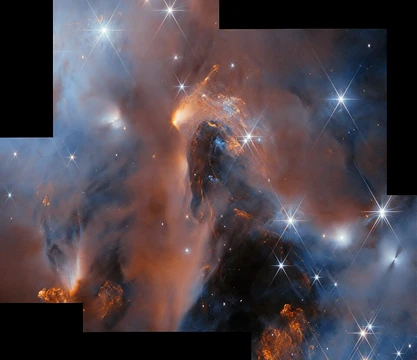
NGC 3733
Intermediate spiral galaxy with a possible active galactic nucleus.

NGC 3733, an intermediate spiral galaxy in Ursa Major, was discovered by William Herschel on 14 April 1789. It may contain an active galactic nucleus, meaning a compact central region emits energy across the electromagnetic spectrum in a way that cannot be explained by stars alone. The galaxy’s velocity relative to the cosmic microwave background gives a Hubble distance of 20.03 ± 1.41 Mpc, while nine other non-redshift measurements yield a farther mean distance of 22.583 ± 1.981 Mpc. NGC 3733 belongs to the NGC 3898 group (also designated LGG 250), which includes nine members such as NGC 3756, NGC 3794, NGC 3898, and NGC 3982. One supernova, SN 1980D, was observed in this galaxy on 17 March 1980 by Swiss astronomer Paul Wild. Initially classified as Type I, later analysis reclassified it as Type II, with a magnitude of 15.
Quick Facts
- Epoch
- J2000
- Constellation Name
- Ursa Major
- Ra
- 11 · 35 · 01.6481ned
- Dec
- +54 · 51 · 02.122ned
- Z
- 0.003949 · 0.00000200ned
- Dist Ly
- 22.583 ± 1.981 Mpcned
- Group Cluster
- NGC 3898 group (LGG 250)
- Appmag V
- 12.93ned
Facts from the source article.
Lore & Background
NGC 3733 was discovered by German-British astronomer William Herschel on 14 April 1789. Its velocity relative to the cosmic microwave background yields a Hubble distance of 20.03 ± 1.41 Mpc, while nine non-redshift measurements give a farther mean distance of 22.583 ± 1.981 Mpc. The galaxy is part of the NGC 3898 group (also known as LGG 250), which includes nine members such as NGC 3756, NGC 3794, NGC 3898, NGC 3982, and others. One supernova has been observed in NGC 3733: SN 1980D, discovered by Swiss astronomer Paul Wild on 17 March 1980. Initially classified as Type I, later analysis concluded it was more likely of Type II, with a magnitude of 15.
Reader's Guide
NGC 3733 holds significance as a member of the NGC 3898 group, a collection of nine galaxies that provides context for studying galactic interactions and evolution within a small group environment. Its possible active galactic nucleus suggests the presence of a compact, highly energetic central region, making it a candidate for studies of non-stellar energy emission across the electromagnetic spectrum. The distance measurements for NGC 3733 show a discrepancy: the Hubble distance of 20.03 Mpc contrasts with the mean of nine other measurements at 22.583 Mpc, highlighting the challenges in accurately determining extragalactic distances. The supernova SN 1980D, initially misclassified as Type I but later reclassified as Type II, adds to the galaxy's observational history and underscores the evolving understanding of supernova types. As an intermediate spiral galaxy, NGC 3733 contributes to the broader catalog of NGC objects, offering astronomers a target for research on galaxy morphology, group dynamics, and nuclear activity.
Did You Know?
- It has a possible active galactic nucleus, emitting energy beyond stellar sources.
- One supernova, SN 1980D, was observed in NGC 3733 and reclassified from Type I to Type II.
More in NGC Objects, Part 6 1-24
Spotted an error? Know more?
Reader corrections go straight into our review queue. Suggest an edit · How this site is sourced