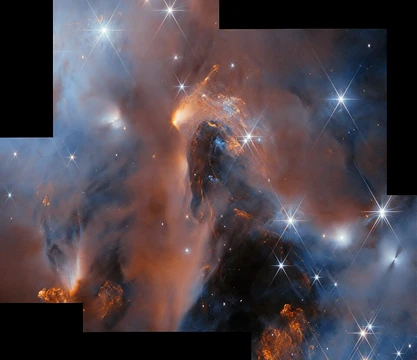
NGC 3726
Barred spiral galaxy with a small bar and three spiral arms.

NGC 3726 is a barred spiral galaxy located in the constellation Ursa Major. It lies at a distance of approximately 45 million light years from Earth and spans about 85,000 light years across. Discovered by German-British astronomer William Herschel on February 5, 1788, it is notable for its well-defined spiral arms and a small bar structure.
Quick Facts
- Epoch
- J2000
- Ra
- 11 · 33 · 21.1
- Dec
- 47 · 01 · 45
- Dist Ly
- 46.6 ± 11.2 Mly (14.3 ± 3.4 Mpc)
- Z
- 866 ± 1 km/s
- Appmag V
- 10.2
- Constellation Name
- Ursa Major
- Names
- UGC 6537, MCG +08-21-051, PGC 35676
Facts from the source article.
Lore & Background
NGC 3726 is a spiral galaxy seen with medium inclination, featuring a small bar measuring 1.38 arcseconds across. The bar ends at an inner ring with a diameter of 1.50 arcseconds, where the bluest regions of star formation are located. Three spiral arms emanate from this ring: the southern arm is the brightest, the northern arm is the best defined, and a third arm originates from the east side, moving toward the NNW before bending sharply to the southwest. The spiral arms are thick and well defined, traceable for half a revolution before branching into fragments. The overall spiral pattern is somewhat disturbed and asymmetrical, and numerous bright HII regions are present throughout the galaxy. The galaxy also possesses a massive dark matter halo.
The nucleus of NGC 3726 hosts a supermassive black hole with a mass of 3 million solar masses, determined from Ks bulge luminosity. The galaxy belongs to the NGC 3877 group, which is part of the south Ursa Major groups within the Virgo Supercluster. Other galaxies in the same group include NGC 3893, NGC 3896, NGC 3906, NGC 3928, NGC 3949, NGC 3985, and NGC 4010. NGC 3726 may also be kinematically related to the smaller galaxies NGC 3769 and NGC 3782, located at angular distances of 68 and 69 arcminutes, respectively.
Reader's Guide
NGC 3726 is significant as a well-studied barred spiral galaxy that offers insights into the structure and dynamics of spiral galaxies with moderate inclination. Its small bar and inner ring, along with three distinct spiral arms, provide a clear example of how star formation concentrates in ring structures and how spiral arms can become fragmented after half a revolution. The galaxy's disturbed and asymmetrical spiral pattern, combined with numerous bright HII regions, makes it a valuable target for studying the effects of gravitational interactions and the distribution of star-forming regions. The presence of a supermassive black hole with a mass of 3 million solar masses in its nucleus contributes to understanding the relationship between black hole mass and bulge properties. As a member of the NGC 3877 group within the Virgo Supercluster, NGC 3726 also helps astronomers map the large-scale structure of the local universe and the dynamics of galaxy groups. Its possible kinematic relationship with smaller neighboring galaxies NGC 3769 and NGC 3782 further highlights its role in studying galaxy interactions and group evolution.
Did You Know?
- NGC 3726 was discovered by William Herschel on February 5, 1788.
- The galaxy's bar is 1.38 arcseconds across and ends at an inner ring with a diameter of 1.50 arcseconds.
- The supermassive black hole at its nucleus has a mass of 3 million solar masses.
More in NGC Objects, Part 6 1-24
Spotted an error? Know more?
Reader corrections go straight into our review queue. Suggest an edit · How this site is sourced