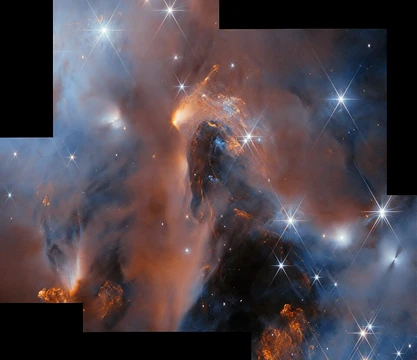
NGC 3684
A barred spiral galaxy in the Leo II Groups.

NGC 3684 is a spiral galaxy located in the constellation Leo, approximately 70 million light years from Earth. It is notable for its grand design spiral pattern, a prominent bar, and an excess of hydrogen, as well as being a member of the NGC 3686 Group within the Leo II Groups of the Virgo Supercluster.
Quick Facts
- Epoch
- J2000
- Ra
- 11 · 27 · 11.2201
- Dec
- +17 · 01 · 48.518
- Dist Ly
- 67.1 ± 14.8 Mly (20.6 ± 4.5 Mpc)
- Z
- 0.003879 ± 0.000013
- H Radial V
- 1,163 ± 4 km/s
- Appmag V
- 11.5
- Constellation Name
- Leo
- Group Cluster
- Leo II Groups
Facts from the source article.
Lore & Background
NGC 3684 features a bar embedded in an elliptical bulge. From the ends of the bar, two spiral arms emerge in a grand design pattern. The arms are smooth but contain knots, particularly along the western arm, and can be traced for about 300 degrees before fading. The galaxy has many bright H-alpha sources near its center and few HII regions in the arms, along with an excess of hydrogen. A low-surface-brightness outer spiral pattern is also present.
The galaxy is a member of the NGC 3686 Group, which also includes NGC 3681, NGC 3686, and NGC 3691. NGC 3681 lies 14 arcminutes southwest, and NGC 3686 lies 14 arcminutes northeast. A. M. Garcia additionally considers NGC 3592, NGC 3626, NGC 3655, NGC 3659, and NGC 3608 as members of the group, designated LGG 237. This group is part of the larger Leo II Groups, a cloud of galaxies within the Virgo Supercluster.
Reader's Guide
NGC 3684's significance lies in its clear grand design spiral structure and its membership in the NGC 3686 Group, a component of the Leo II Groups within the Virgo Supercluster. The galaxy's bar and two prominent spiral arms, traceable for nearly a full circle, provide a classic example of a barred spiral galaxy. The presence of many bright H-alpha sources near its center indicates active star formation in the nuclear region, while the few HII regions in the arms suggest a different distribution of star-forming activity. The galaxy's excess of hydrogen and low-surface-brightness outer spiral pattern add to its interest for studies of galactic structure and gas content. Its position within a group of galaxies, with nearby companions like NGC 3681 and NGC 3686, makes it a useful object for understanding group dynamics and interactions. The inclusion of additional galaxies by Garcia under the designation LGG 237 highlights the ongoing refinement of group membership in the local universe.
Did You Know?
- NGC 3684 was discovered by William Herschel on April 17, 1784.
- The galaxy is approximately 80,000 light years across.
- It has an excess of hydrogen and a low-surface-brightness outer spiral pattern.
- NGC 3684 is a member of the NGC 3686 Group, which is part of the Leo II Groups.
More in NGC Objects, Part 6 1-24
Spotted an error? Know more?
Reader corrections go straight into our review queue. Suggest an edit · How this site is sourced