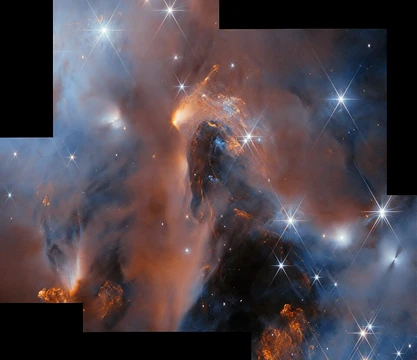
NGC 3681
A nearly face-on intermediate spiral galaxy in Leo.

NGC 3681 is an intermediate spiral galaxy located in the constellation Leo, approximately 90 million light years from Earth. Discovered by William Herschel on April 17, 1784, the galaxy spans about 80,000 light years across and is notable for its short bar, which gives the bulge an elliptical appearance, and its nearly face-on orientation at an inclination of roughly 15°.
Quick Facts
- Epoch
- J2000
- Ra
- 11 · 26 · 29.7943
- Dec
- +16 · 51 · 48.360
- Dist Ly
- 92.6 ± 8.9 Mly (28.4 ± 2.7 Mpc)
- Z
- 0.004109 ± 0.000006
- H Radial V
- 1,232 ± 2 km/s
- Appmag V
- 11.6
- Constellation Name
- Leo
- Group Cluster
- Leo II Groups
Facts from the source article.
Lore & Background
NGC 3681 is characterized as an intermediate spiral galaxy, meaning it possesses a short bar that makes the bulge appear elliptical. The galaxy's disk is smooth and of low surface brightness, with a ring formed at the inner part of the disk. It exhibits multiple flocculent spiral arms and fragments, including higher surface brightness inner arms and fainter outer arms; HII regions have been spotted in both sets of arms. In ultraviolet light, the galaxy appears more extended than in optical observations, and the inner ring is more pronounced. The galaxy also has an excess of hydrogen.
Reader's Guide
NGC 3681 is a member of the NGC 3686 Group, which also includes NGC 3684, NGC 3686, and NGC 3691. A. M. Garcia additionally considers NGC 3592, NGC 3626, NGC 3655, NGC 3659, and NGC 3608 as members of the group, which he names LGG 237. This group is part of the Leo II Groups, a large cloud of galaxies within the Virgo Supercluster. The galaxy's nearly face-on orientation and its flocculent spiral structure, along with its pronounced inner ring and hydrogen excess, make it a subject of interest for studies of spiral arm formation and interstellar medium properties.
Did You Know?
- The galaxy is seen nearly face-on, with an inclination of about 15°.
- It has an excess of hydrogen and a more extended appearance in ultraviolet than in optical light.
- NGC 3681 is a member of the NGC 3686 Group, part of the Leo II Groups in the Virgo Supercluster.
More in NGC Objects, Part 6 1-24
Spotted an error? Know more?
Reader corrections go straight into our review queue. Suggest an edit · How this site is sourced