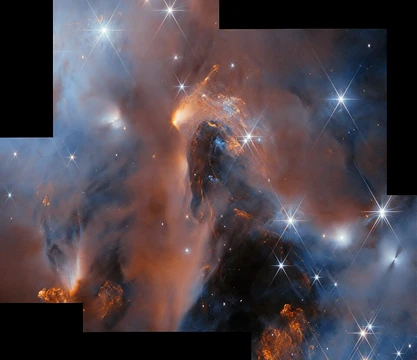
NGC 3675
Spiral galaxy in Ursa Major with a LINER nucleus.

NGC 3675 is a spiral galaxy located in the constellation Ursa Major, approximately 50 million light years from Earth. It is about 100,000 light years across and belongs to the Ursa Major Cluster, which is part of the Virgo Supercluster. Discovered by German-British astronomer William Herschel on 14 January 1788, the galaxy hosts a low-ionization nuclear emission-line region (LINER) and a supermassive black hole at its nucleus.
Quick Facts
- Epoch
- J2000
- Ra
- 11 · 26 · 08.5689
- Dec
- +43 · 35 · 09.696
- Dist Ly
- 53 ± 10 Mly (16.2 ± 3.0 Mpc)
- Z
- 0.002568
- H Radial V
- 770 ± 1 km/s
- Appmag V
- 10.0
- Constellation Name
- Ursa Major
Facts from the source article.
Lore & Background
NGC 3675 was discovered by William Herschel on 14 January 1788. It is a member of the Ursa Major Cluster, itself part of the Virgo Supercluster. The galaxy's nucleus contains a supermassive black hole with an estimated mass of 10–39 million solar masses, based on intrinsic velocity dispersion measured by the Hubble Space Telescope. The galaxy hosts a low-ionization nuclear emission-line region (LINER).
Its spiral disk is classified as type III, and a dust structure is more prominent to the east. Although infrared images suggested a strong bar, further observations have shown no indication of a bar. The galaxy features two ring structures with diameters of 1.62 and 2.42 arcminutes. The spiral arms are tightly wound and form an inner pseudoring, continuing for one revolution outside the ring; the outer arms are very patchy and filamentary.
One supernova has been observed in NGC 3675: SN 1984R, of unknown type and magnitude 13, discovered by Kaoru Ikeya on 2 December 1984.
Reader's Guide
NGC 3675 is significant as a relatively nearby spiral galaxy within the Ursa Major Cluster, offering insights into the structure and dynamics of spiral galaxies in a cluster environment. Its classification as a LINER galaxy indicates a specific type of low-ionization nuclear activity, which is of interest for understanding the processes in galactic nuclei. The presence of a supermassive black hole with a measured mass range provides a data point for studies of black hole demographics and their relation to host galaxy properties. The galaxy's morphology—including its two ring structures, tightly wound spiral arms forming an inner pseudoring, and patchy outer arms—contributes to the catalog of spiral galaxy forms. The uncertainty regarding the presence of a bar, with infrared indications not confirmed by further observations, highlights the challenges in interpreting galactic structure across different wavelengths. The single observed supernova, SN 1984R, adds to the record of transient events in this galaxy, though its type remains unknown. NGC 3675 thus serves as a case study in the diversity of spiral galaxy features and nuclear activity.
More in NGC Objects, Part 6 1-24
Spotted an error? Know more?
Reader corrections go straight into our review queue. Suggest an edit · How this site is sourced