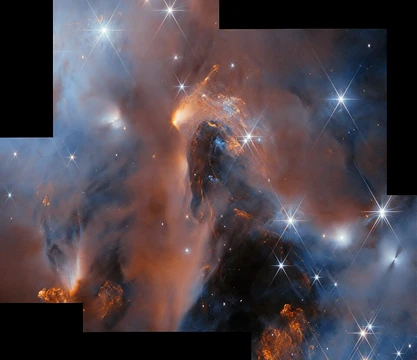
NGC 3665
A lenticular galaxy with a dust lane and low-luminosity AGN.

NGC 3665 is a lenticular galaxy in the constellation Ursa Major, approximately 85 million light-years from Earth. It is notable for its circular dust lane, active galactic nucleus, and status as the brightest member of the NGC 3665 galaxy group.
Quick Facts
- Epoch
- J2000
- Ra
- 11 · 24 · 43.7
- Dec
- +38 · 45 · 46
- Dist Ly
- 85.6 ± 22 Mly (26.3 ± 6.8 Mpc)
- Z
- 0.006901 ± 0.000017
- H Radial V
- 2,069 ± 5 km/s
- Appmag V
- 10.7
- Constellation Name
- Ursa Major
- Names
- UGC 6426, CGCG 214-004, MCG +07-24-003, PGC 35064
Facts from the source article.
Lore & Background
NGC 3665 was discovered by William Herschel on March 23, 1789. Its disk features a circular dust lane, and the galaxy contains a high molecular gas content, with a molecular gas mass estimated at 10^8.91 solar masses. A UV excess indicates a young stellar population, though the star formation rate of 1.7 solar masses per year is lower than expected from the gas reservoirs, possibly due to stabilization by the compact massive bulge.
The nucleus hosts a low-luminosity transition active galactic nucleus, powered by an accretion disk around a supermassive black hole. The black hole's mass has been measured using the rotation of molecular gas and the M–sigma relation. Radio emission is elongated perpendicular to the dust lane, with a jet of FRI morphology extending over 3 kpc at 1.4 GHz, and two jet-like structures at 5 GHz, the northwest extending 0.7 arcseconds (120 pc).
One supernova, SN 2002hl, was detected in NGC 3665. It was a type Ia supernova discovered by T. Boles on November 5, 2002, with a magnitude of 16.3, and was about one or two months past maximum light. NGC 3665 is the brightest member of the NGC 3665 group, which includes NGC 3648, NGC 3652, NGC 3658, and UGC 6433; NGC 3658 lies 15 arcminutes away.
Reader's Guide
NGC 3665 serves as a key example of a lenticular galaxy where star formation is suppressed despite abundant molecular gas, highlighting the role of bulge stability in regulating star formation. Its low-luminosity transition AGN and radio jets provide insight into the behavior of moderate black hole activity and jet morphology in early-type galaxies. The galaxy's status as the brightest member of its group makes it a reference point for studying group dynamics and galaxy interactions. The detection of a type Ia supernova, SN 2002hl, adds to its value as a site for understanding supernova properties and rates in lenticular environments. The multiwavelength observations—from UV to radio—allow a comprehensive view of its stellar populations, gas content, and nuclear activity, making NGC 3665 a well-studied object for understanding the interplay between galaxy structure, gas dynamics, and black hole feedback.
Did You Know?
- NGC 3665 has a circular dust lane in its disk.
- Its molecular gas mass is estimated at 10^8.91 solar masses.
- The supernova SN 2002hl was a type Ia event discovered about one or two months after maximum light.
- The galaxy's radio emission at 1.4 GHz shows a jet with FRI morphology extending over 3 kpc.
More in NGC Objects, Part 6 1-24
Spotted an error? Know more?
Reader corrections go straight into our review queue. Suggest an edit · How this site is sourced