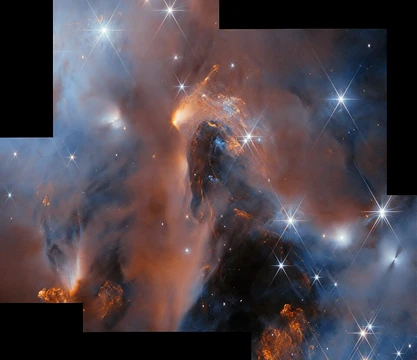
NGC 3642
A spiral galaxy with a pseudoring and a low-ionization nuclear region.

NGC 3642 is a spiral galaxy located in the constellation Ursa Major, approximately 30 million light years from Earth. It is notable for its low-ionization nuclear emission-line region and an outer pseudoring, likely formed after the accretion of a gas-rich dwarf galaxy.
Quick Facts
- Epoch
- J2000
- Ra
- 11 · 22 · 17.9
- Dec
- 59 · 04 · 28
- Dist Ly
- 27 ± 35 Mly (8.4 ± 10.7 Mpc)
- Z
- 1571 ± 3 km/s
- Appmag V
- 10.8
- Constellation Name
- Ursa Major
- Names
- UGC 6385, MCG +10-16-128, PGC 34889
Facts from the source article.
Lore & Background
NGC 3642 is a spiral galaxy lacking a bar. Its nucleus hosts a supermassive black hole with an estimated mass of 26–31 million solar masses, based on intrinsic velocity dispersion measured by the Hubble Space Telescope, or 15 million solar masses based on bulge luminosities in the near-infrared Ks-band. Around the nucleus, a one-armed spiral forms a ring, possibly funneling material inward. The nucleus is surrounded by an inner flocculent spiral, while the outer part of the galaxy forms a pseudoring extending about half a circle. The outer spiral is warped, and the main part features an ordinary differentially rotating disk. The HI gas is also warped and extends further on the western side. The galaxy belongs to the NGC 3642 group, which includes NGC 3610, NGC 3619, NGC 3669, NGC 3674, and NGC 3683. Other nearby galaxies include NGC 3440, NGC 3445, NGC 3458, NGC 3543, and NGC 3613.
Reader's Guide
NGC 3642 is significant as a nearby spiral galaxy exhibiting a low-ionization nuclear emission-line region, a feature that indicates specific nuclear activity. Its structure—including a one-armed spiral ring around the nucleus, an inner flocculent spiral, and an outer pseudoring—provides insight into galaxy evolution and accretion events. The pseudoring is thought to have formed after the accretion of a gas-rich dwarf galaxy, illustrating how minor mergers can reshape galactic morphology. The presence of a supermassive black hole with a disputed mass range (26–31 million versus 15 million solar masses) highlights ongoing uncertainties in black hole mass estimation methods. The warped outer disk and asymmetric HI gas distribution further suggest past interactions. As a member of the NGC 3642 group, it contributes to understanding group dynamics and the distribution of galaxies in the local universe.
Did You Know?
- NGC 3642 has a low-ionization nuclear emission-line region.
- The supermassive black hole mass is estimated at 26–31 million M⊙ from HST data or 15 million M⊙ from near-infrared bulge luminosities.
- The galaxy belongs to the NGC 3642 group, also known as the NGC 3610 group.
More in NGC Objects, Part 6 1-24
Spotted an error? Know more?
Reader corrections go straight into our review queue. Suggest an edit · How this site is sourced