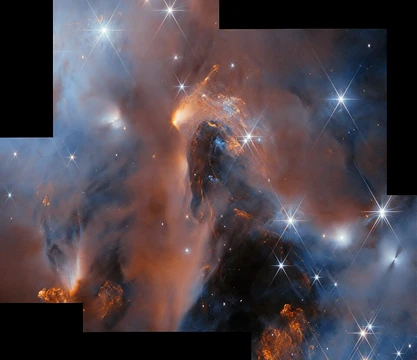
NGC 3621
A pure-disk spiral galaxy with an active nucleus and a bright supernova.

NGC 3621 is a disk-shaped spiral galaxy in the equatorial constellation Hydra, roughly 22 million light-years from Earth. German-British astronomer William Herschel first spotted it on 17 February 1790. The galaxy is relatively bright and appears clearly in moderate-sized telescopes. Its diameter spans about 216,900 light-years, and it is tilted 66° from a face-on orientation. NGC 3621 shines with a luminosity equivalent to 13 billion Suns. Classified as SA(s)d, it is an ordinary spiral with loosely wound arms and no detectable bulge. Though it seems isolated, the galaxy is part of the Leo spur. Its nucleus is active, matching a Seyfert 2 optical spectrum, which points to a low-mass supermassive black hole at the core. Based on stellar motions there, that black hole may reach three million solar masses. One supernova, SN 2024ggi, has been observed in NGC 3621. Discovered by ATLAS on 11 April 2024 as a Type II event at magnitude 18.915, it brightened to magnitude 12 by 16 April and peaked at magnitude 11.9, making it the brightest supernova of 2024. It was the closest such event to Earth since SN 2023ixf, found on 19 May 2023. Archival images from the Hubble and Spitzer space telescopes revealed the suspected progenitor, a red supergiant with an estimated mass of 12 to 15 solar masses.
Quick Facts
- Epoch
- J2000
- Constellation Name
- Hydra
- Ra
- 11 · 18 · 16.5109
- Dec
- –32 · 48 · 49.732
- Z
- 0.002403
- H Radial V
- 720 ± 0 km/s
- Dist Ly
- 21.7 million light years (6.64 Mpc)
- Mass
- 2 × 10 / 10
- Appmag V
- 9.56
Facts from the source article.
Lore & Background
NGC 3621 was discovered by German-British astronomer William Herschel on 17 February 1790. It is classified as SA(s)d, an ordinary spiral with loosely wound arms and no evidence of a bulge. The galaxy is inclined at an angle of 66° from being viewed face-on and shines with a luminosity equal to 13 billion times that of the Sun. Although it appears isolated, NGC 3621 belongs to the Leo spur.
The galaxy has an active nucleus matching a Seyfert 2 optical spectrum, suggesting a low-mass supermassive black hole at its core. Based on the motion of stars in the nucleus, this object may have a mass of up to three million times the mass of the Sun. One supernova, SN 2024ggi, was observed in NGC 3621. Discovered by ATLAS on 11 April 2024, it was a Type II supernova that brightened to magnitude 11.9, making it the brightest supernova of 2024 and the closest to Earth since SN 2023ixf. Archival Hubble and Spitzer images identified the suspected progenitor as a red supergiant with an estimated mass of 12–15 solar masses.
Reader's Guide
NGC 3621 is significant as a comparatively bright disk spiral galaxy that can be well seen in moderate-sized telescopes, offering a clear view of a pure-disc structure without a bulge. Its classification as SA(s)d and its membership in the Leo spur provide context for studying isolated spiral galaxies. The galaxy's active Seyfert 2 nucleus and the inferred presence of a low-mass supermassive black hole (up to three million solar masses) make it a valuable target for understanding black hole formation and activity in smaller galaxies. The supernova SN 2024ggi, the brightest of 2024 and the closest since 2023, drew attention to the galaxy, with archival images revealing its red supergiant progenitor. This event highlights NGC 3621 as a site for studying stellar evolution and supernova mechanisms. The galaxy's legacy lies in its role as a well-observed example of a pure-disk spiral with an active core and a recent, well-documented supernova.
Did You Know?
- NGC 3621 has no evidence of a bulge, making it a pure-disk spiral galaxy.
- The galaxy's supermassive black hole may have a mass of up to three million times the Sun.
- Supernova SN 2024ggi, discovered on 11 April 2024, was the brightest supernova of 2024.
- The progenitor of SN 2024ggi was identified as a red supergiant with a mass of 12–15 solar masses.
More in NGC Objects, Part 6 1-24
Spotted an error? Know more?
Reader corrections go straight into our review queue. Suggest an edit · How this site is sourced