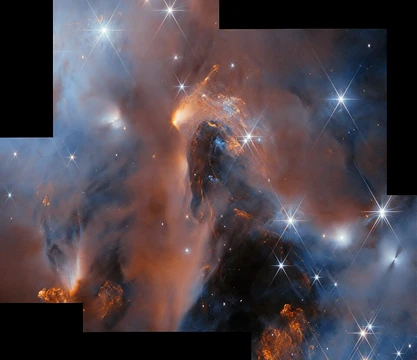
NGC 3614
Intermediate spiral galaxy with stellar streams and a faint bar.

NGC 3614 is an intermediate spiral galaxy in the constellation Ursa Major, roughly 120 million light-years from Earth. Its apparent size suggests a diameter of about 150,000 light-years. William Herschel discovered it on February 5, 1788.
The galaxy has a small, bright nucleus and hints of a faint bar, though infrared observations from the Spitzer Space Telescope show no bar. The ARRAKIS study classifies its morphology as SA(r)bc. A narrow inner ring spans 0.47 by 0.24 arcminutes. From this ring, two main, knotty, and filamentary arms emerge; after about three-quarters of a revolution, they begin to branch, forming a multiple-arm spiral pattern. Many H II regions and star-forming knots are visible along the arms, and the galaxy’s star formation rate is estimated at 0.3 solar masses per year. The galactic disk extends 5.4 arcminutes along its east–west axis and 3 arcminutes along its north–south axis.
Adam Block identified two stellar streams around the galaxy. The brighter stream starts at the northern part of the disk and stretches 4.6 arcminutes at a position angle of 314° from the nucleus, toward galaxy 2MASSX J11180157+4547453. It is uniform in brightness and lacks any discernible structure. The second stream appears linked to galaxy SDSS J111838+454721.7, with a total length of about 3.8 arcminutes at a position angle of 40°. This galaxy may be the stream’s progenitor, and both leading and trailing tidal tails are visible.
NGC 3614 seems to form a pair with NGC 3614A, located 2.6 arcminutes away; although NGC 3614A appears diffuse and patchy, it is a background galaxy. NGC 3614 also forms a group with NGC 3583 and NGC 3595.
Quick Facts
- Epoch
- J2000
- Ra
- 11 · 18 · 21.3533
- Dec
- 45 · 44 · 53.737
- Dist Ly
- 120 ± 32 Mly (36.9 ± 9.8 Mpc)
- Z
- 0.007769 ± 0.000005
- H Radial V
- 2,329 ± 1 km/s
- Appmag V
- 11.6
- Constellation Name
- Ursa Major
- Names
- UGC 6318, CGCG 242-019, MCG +08-21-015, PGC 34561
Facts from the source article.
Lore & Background
NGC 3614 has a small bright nucleus and traces of a faint bar, though no bar is detected in infrared images from the Spitzer Space Telescope; the ARRAKIS study classifies it as SA(r)bc. The galaxy features a narrow inner ring measuring 0.47 by 0.24 arcminutes. From this ring emerge two main, knotty and filamentary arms that begin branching after three-quarters of a revolution, creating a multiple spiral arm pattern. Many HII regions and star-forming knots are visible in the arms, and the star formation rate is estimated at 0.3 solar masses per year. The galactic disk extends 5.4 arcminutes along its major east–west axis and 3 arcminutes along its minor north–south axis.
Adam Block discovered two stellar streams associated with NGC 3614. The brighter stream begins at the northern part of the galactic disk and extends 4.6 arcminutes at a position angle of 314° toward the galaxy 2MASSX J11180157+4547453; it is uniform in brightness and devoid of discernable structure. The second stream appears associated with galaxy SDSS J111838+454721.7, with a total length of about 3.8 arcminutes at a position angle of 40°. That galaxy may be the progenitor of the stream, and both trailing and leading tidal tails are visible.
NGC 3614 seems to form a pair with NGC 3614A, which lies at a distance of 2.6 arcminutes and appears diffuse and patchy, but is a background galaxy. It also forms a group with NGC 3583 and NGC 3595.
Reader's Guide
NGC 3614 is notable for its complex spiral structure and the presence of two stellar streams, which provide insight into tidal interactions and galaxy evolution. The discovery of these streams by Adam Block highlights ongoing dynamical processes, with one stream possibly linked to the galaxy SDSS J111838+454721.7 as a progenitor. The galaxy's classification as SA(r)bc, despite traces of a faint bar in optical images and its absence in infrared, underscores the importance of multi-wavelength observations in understanding galactic morphology. Its star formation rate of 0.3 solar masses per year and numerous HII regions indicate active star formation, while the inner ring and branching spiral arms contribute to its distinctive appearance. As part of a small group with NGC 3583 and NGC 3595, NGC 3614 offers a case study in group interactions and the formation of tidal features. The pair with NGC 3614A, though a background object, adds to the contextual richness of the field. Overall, NGC 3614 serves as a valuable target for studies of spiral structure, star formation, and tidal streams in the local universe.
Did You Know?
- NGC 3614 was discovered by William Herschel on February 5, 1788.
- The galaxy has two stellar streams discovered by Adam Block.
More in NGC Objects, Part 6 1-24
Spotted an error? Know more?
Reader corrections go straight into our review queue. Suggest an edit · How this site is sourced