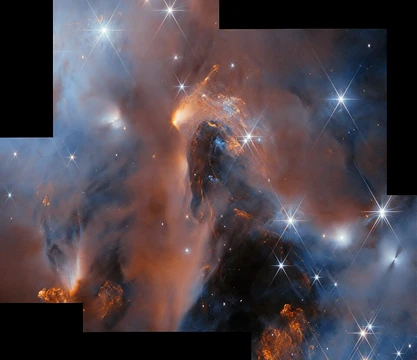
NGC 3607
Central lenticular galaxy of the Leo II Group.

NGC 3607 is a compact but relatively luminous lenticular galaxy found in the equatorial constellation Leo, roughly 2.5° south of the bright star Delta Leonis. Discovered by William Herschel on March 14, 1784, it was later described by Dreyer as very bright, large, round, with a much brighter central region, and noted as the second of three such objects. The galaxy lies about 73 million light-years away and is moving away at a radial velocity of 930 km/s. It sits southwest of NGC 3626 at a certain angular separation and anchors the center of the Leo II Group, sharing the title of brightest member with NGC 3608. It also belongs to the NGC 3607 Group, which is part of the larger Leo II Groups—a chain of galaxies and clusters stretching from the right edge of the Virgo Supercluster.
Classified as SA(s)0*, NGC 3607 is a lenticular galaxy without an inner ring structure. It is of intermediate mass, viewed at an inclination of 34°, with an ellipticity of 0.13 and its major axis aligned at a position angle of 125°. The galaxy contains an outer dusty disk, along with a second perpendicular disk that is falling inward toward the center. X-ray emission from hot gas has been detected both in the interior and surrounding the galaxy.
A system of 46 confirmed globular clusters orbits NGC 3607 within a certain effective radius, while the galaxy’s stellar component has its own effective radius. The motions of these clusters suggest an unusually low amount of dark matter—perhaps only a fraction of the total mass within five effective radii. The central black hole has a mass of M•, and the core region is kinematically distinct from the rest of the galaxy, showing an enhancement of magnesium.
Quick Facts
- Epoch
- J2000
- Constellation Name
- Leo
- Ra
- 11 · 16 · 54.657
- Dec
- +18 · 03 · 06.51
- Dist Ly
- 22.49 Mpc
- Group Cluster
- Leo II Group
- Appmag V
- 10.8
Facts from the source article.
Lore & Background
NGC 3607 was discovered on March 14, 1784 by William Herschel. Dreyer described it as 'very bright, large, round, very much brighter middle, 2nd of 3'. The galaxy is located at a distance of 73 million light years and is receding with a radial velocity of 930 km/s. It lies southwest of NGC 3626 and occupies the center of the Leo II Group of galaxies, forming one of its two brightest members – the other being NGC 3608. It is a member of the NGC 3607 Group of galaxies, which is a member of the Leo II Groups, a series of galaxies and galaxy clusters strung out from the right edge of the Virgo Supercluster.
The morphological class of NGC 3607 is SA(s)0*, matching a lenticular galaxy (SA0) with no inner ring structure (s). It is an intermediate mass galaxy being viewed at an inclination of 34°, showing an ellipticity of 0.13 with the major axis oriented along a position angle of 125°. The galaxy has an outer dusty disk with a second perpendicular disk that is falling inward toward the center. X-ray emission from hot gas has been detected in the interior and from all around the galaxy.
A system of 46 confirmed globular clusters have been identified around NGC 3607. Orbital motions of this cluster system imply an unusual poverty of dark matter. The core region of the galaxy is kinematically distinct from the remainder of the galaxy and shows an enhancement of magnesium.
Reader's Guide
NGC 3607 holds significance as the central galaxy of the Leo II Group, anchoring a collection of galaxies that extends from the edge of the Virgo Supercluster. Its classification as SA(s)0* places it among lenticular galaxies, and its observed structure—including an outer dusty disk and a second perpendicular disk falling inward—provides insight into the dynamics of disk evolution and accretion processes. The detection of X-ray emission from hot gas both in the interior and surrounding the galaxy indicates ongoing interactions with the intergalactic medium. The system of 46 confirmed globular clusters is notable for its orbital motions, which imply an unusual poverty of dark matter within five effective radii, challenging typical dark matter distributions in galaxies of similar mass. The kinematically distinct core region, combined with an enhancement of magnesium, suggests a complex formation history possibly involving mergers or accretion events. As one of the two brightest members of its group, NGC 3607 serves as a key object for studying galaxy group dynamics and the role of dark matter in lenticular systems.
More in NGC Objects, Part 6 1-24
Spotted an error? Know more?
Reader corrections go straight into our review queue. Suggest an edit · How this site is sourced