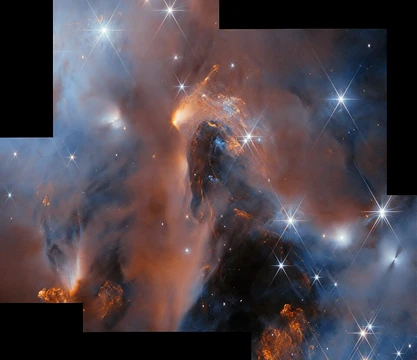
NGC 3604
Unbarred spiral galaxy with a faint elliptical ring.

NGC 3604, also cataloged as NGC 3611, is an unbarred spiral galaxy in the constellation Leo. It lies about 110 million light years from Earth and spans roughly 85,000 light years across. The galaxy is notable for its duplicate entry in the New General Catalogue, resulting from two separate observations by William Herschel.
Quick Facts
- Epoch
- J2000
- Ra
- 11 · 17 · 30.1933
- Dec
- +04 · 33 · 20.128
- Dist Ly
- 110 ± 13 Mly (33.9 ± 4.0 Mpc)
- Z
- 0.005220 ± 0.000009
- H Radial V
- 1,565 ± 3 km/s
- Appmag V
- 11.9
- Constellation Name
- Leo
- Notes
- off-center ring
- Names
- NGC 3611, UGC 6305, CGCG 039-103, MCG +01-29-026, PGC 34478
Facts from the source article.
Lore & Background
NGC 3604 was discovered by William Herschel on January 27, 1786. He observed it again on December 30, 1786, but catalogued it as a different entry, leading to its duplicate listing as NGC 3611. The galaxy has a small bright nucleus with inner spiral arms and evidence of star formation near the center. Its outer regions feature thin, smooth spiral arms with little sign of recent star formation.
The galaxy possesses a faint elliptical ring extending 189 by 121 arcseconds, which is off-center and, if circular, lies perpendicular to the galactic disk. The ring is nearly continuous with knots and consists of two shells on either side of the galaxy, connected by an incomplete blue arc. Its brightest part lies toward the northwest, in the direction of UGC 6306. The ring may result from an interaction with a satellite disk galaxy that led to its disruption.
NGC 3604 is a member of the galaxy group LGG 233, which also includes NGC 3630, NGC 3640, NGC 3641, NGC 3664, and NGC 3664A. It forms a pair with UGC 6306, located 3 arcminutes to the north, and a faint hydrogen bridge appears to connect the two galaxies.
Reader's Guide
NGC 3604's significance lies in its duplicate NGC entry, a historical curiosity from William Herschel's independent observations of the same object. The galaxy's faint elliptical ring, likely formed by an interaction with a satellite disk galaxy, provides a case study in galactic collisions and tidal disruption. The ring's off-center orientation and perpendicular alignment to the galactic disk suggest a complex dynamical history. The presence of a hydrogen bridge linking NGC 3604 to its companion UGC 6306 indicates ongoing gravitational interaction, offering insight into how galaxies exchange material. As a member of LGG 233, NGC 3604 contributes to understanding group dynamics and the effects of environment on galaxy evolution. Its central star formation contrasts with the quiescent outer arms, highlighting how interactions can trigger activity in galactic cores while leaving outer regions undisturbed.
Did You Know?
- NGC 3604 has a duplicate entry in the New General Catalogue as NGC 3611.
- The galaxy has a faint elliptical ring that is off-center and perpendicular to the galactic disk.
- A faint hydrogen bridge appears to connect NGC 3604 with its companion UGC 6306.
More in NGC Objects, Part 6 1-24
Spotted an error? Know more?
Reader corrections go straight into our review queue. Suggest an edit · How this site is sourced