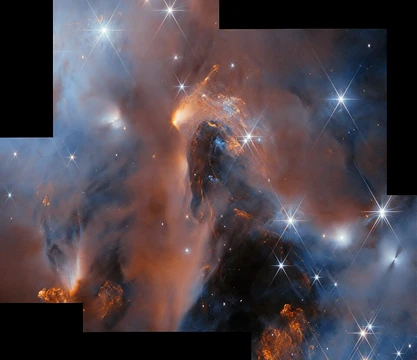
NGC 3603
Massive H II region with a dense cluster of very massive stars.

NGC 3603 sits in the Carina–Sagittarius Arm of the Milky Way, roughly 20,000 light-years from our solar system. It is a massive H II region—a cloud of glowing gas and plasma—and contains a very compact open cluster, likely a super star cluster, known as HD 97950. This region is the most massive visible H II region in the Milky Way and holds the densest concentration of very massive stars found anywhere in the galaxy.
John Herschel first spotted NGC 3603 on 14 March 1834 while in South Africa, describing it as "a very remarkable object...perhaps a globular cluster." He listed it as nebula 3334 in his 1847 *Results of Astronomical Observations made at the Cape of Good Hope*, and later as number 2354 in the 1864 *General Catalogue of Nebulae and Clusters*. J. L. E. Dreyer eventually included it in the New General Catalogue as NGC 3603.
The central cluster was originally catalogued as the star HD 97950, but it was long known to be nebulous or multiple. Its unusual emission spectrum was noted, with a spectral type of Oe in the Henry Draper Catalogue, later refined to WN5 + O when the emission was recognized as coming from a Wolf–Rayet star. Eventually, the cluster was resolved and found to contain three of the most massive and luminous stars known, along with several luminous O-class stars and many fainter ones.
Within the cluster, three prominent Wolf–Rayet stars were detected, all originally unresolved as the single star HD 97950. The brightest, HD 97950A1 (or NGC 3603-A1), is actually a pair of Wolf–Rayet stars orbiting each other every 3.77 days. The primary has an estimated mass, and its companion is slightly less massive. The star HD 97950B is a single star, more massive and luminous than either member of HD 97950A1—it is 2,880,000 times as luminous as the Sun and 132 times as massive.
Strong ultraviolet radiation and stellar winds from the central cluster have cleared away surrounding gas and dust, offering an unobscured view. In a telescope, NGC 3603 appears as a small, faint nebulosity with a yellowish tinge from interstellar absorption. In the mid-1960s, optical and radio observations revealed it to be an extremely strong thermal radio source.
Quick Facts
- Epoch
- J2000
- Ra
- 11 · 15 · 23
- Dec
- -61 · 15 · 00
- Dist Pc
- 6,900
- Appmag V
- 9.1
- Appdia
- 12.0'
- Constellation
- Carina
- Names
- Gum 38b, Collinder 244, RCW 57
Facts from the source article.
Lore & Background
NGC 3603 was observed by John Herschel on 14 March 1834 during his visit to South Africa, who remarked that it was 'a very remarkable object...perhaps a globular cluster'. Herschel catalogued it as nebula 3334 in his Results of Astronomical Observations made at the Cape of Good Hope, published in 1847. In 1864 the Royal Society published his General Catalogue of Nebulae and Clusters, where he listed it as number 2354, and it was subsequently incorporated into the New General Catalogue by J. L. E. Dreyer as NGC 3603.
The central cluster was catalogued as the star HD 97950, but has long been recognised as nebulous or multiple. It was noted for having an unusual emission spectrum, with the spectral type given as Oe in the Henry Draper Catalogue, later refined to WN5 + O as the emission was recognised as characteristic of a Wolf–Rayet star. Eventually, the cluster was resolved and found to contain three of the most massive and most luminous stars known, as well as a number of luminous O class stars and many fainter stars.
Strong ultraviolet radiation and stellar winds have cleared the gas and dust, giving an unobscured view of the cluster. Three prominent Wolf–Rayet stars have been detected within the cluster, all originally unresolved and known as the single star HD 97950. The brightest, HD 97950A1, is actually a pair of Wolf–Rayet stars that orbit each other once every 3.77 days. HD 97950B is a single star more massive and more luminous than either of the individual members of HD 97950A1, at 2,880,000 times the luminosity of the Sun and 132 times its mass.
Reader's Guide
NGC 3603 is considered a starburst region of extremely rapid star formation, comparable by some authors to the larger cluster 30 Doradus in the Large Magellanic Cloud. In the mid-1960s, optical studies combined with radio astronomical observations showed it to be an extremely strong thermal radio source. The region is visible in a telescope as a small rather insignificant nebulosity with a yellowish tinge due to interstellar absorption.
Two of the most luminous young stars known are found within NGC 3603 but outside the central cluster: WR 42e and NGC 3603 MTT 58, both with spectral type O2If*/WN6 indicating an extremely massive young star. WR 42e is a possible runaway from a three-body encounter, while MTT 58 appears still embedded within its parental cocoon and is in a possible binary with an O3If star. The star Sher 25, a B class supergiant long thought to be a member of NGC 3603, turns out to be a foreground star, but is surrounded by ejected material in an hourglass shape similar to that found for supernova 1987A, arousing interest in the future evolution of such stars.
Did You Know?
- The central cluster HD 97950 contains three of the most massive and most luminous stars known.
- HD 97950A1 is a binary pair of Wolf–Rayet stars that orbit each other every 3.77 days.
- The star Sher 25, once thought to be a member of NGC 3603, is actually a foreground star.
More in NGC Objects, Part 6 1-24
Spotted an error? Know more?
Reader corrections go straight into our review queue. Suggest an edit · How this site is sourced