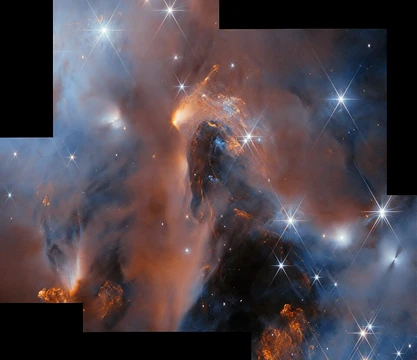
NGC 3585
A field elliptical galaxy with a red dusty core and asymmetrical outer isophotes.

NGC 3585, an elliptical or lenticular galaxy in the constellation Hydra, lies roughly 60 million light-years away. Spanning about 80,000 light-years across, it was first observed by William Herschel on December 9, 1784. At its core, a red disc region extends roughly 45 arcseconds along its semi-major axis, likely linked to diffuse dust. The galaxy hosts around 130 confirmed globular cluster candidates, with an estimated total of nearly 550—a relatively low count typical of field elliptical galaxies. A younger subpopulation of clusters may exist, inferred from the luminosity turnover of these clusters. The outer isophotes appear asymmetrical, possibly due to tidal disruption. At the center lies a supermassive black hole; its mass has been estimated in two ways: one based on the tidal disruption rate, and another at 10^8.53 ± 0.122 solar masses from very-long-baseline interferometry observations of a circumnuclear ring. Hubble Space Telescope measurements of stellar velocity dispersion at the core, using the M–sigma relation, place the black hole’s mass between 280 and 490 million solar masses. NGC 3585 is the brightest member of the loose NGC 3585 group, which also includes the spiral galaxies UGCA 226, ESO 502-G 016, and UGCA 230.
Quick Facts
- Epoch
- J2000
- Ra
- 11 · 13 · 17.1
- Dec
- -26 · 45 · 17
- Dist Ly
- 56 ± 15 Mly (17.3 ± 4.5 Mpc)
- Z
- 0.004783 ± 0.000040
- H Radial V
- 1,434 ± 12 km/s
- Appmag V
- 9.9
- Constellation Name
- Hydra
- Names
- ESO 502- G 025, AM 1110-262, MCG -04-27-004, PGC 34160
Facts from the source article.
Lore & Background
NGC 3585 was discovered by William Herschel on December 9, 1784. The galaxy features a red disc region in the core with a semi-major axis of about 45 arcseconds, probably associated with diffuse dust. Its outer isophotes are asymmetrical, possibly due to tidal disruption. The galaxy hosts nearly 130 globular cluster candidates, with the total number estimated to be nearly 550, a low count typical for field elliptical galaxies. Based on the luminosity turnover of the globular clusters, a subpopulation of younger clusters is suspected. At its center lies a supermassive black hole; its mass has been estimated using multiple methods: based on the tidal disruption rate, and as 10^8.53 ± 0.122 solar masses from very-long-baseline interferometry observations of the circumnuclear ring. Hubble Space Telescope observations of stellar velocity dispersion at the core yield a mass between 280 and 490 million solar masses via the M–sigma relation.
Reader's Guide
NGC 3585 is significant as the brightest member of the NGC 3585 group, a loose collection of galaxies that includes the spiral galaxies UGCA 226, ESO 502-G 016, and UGCA 230. Its status as a field elliptical galaxy—one not located in a dense cluster—makes its relatively low globular cluster count (estimated at nearly 550) typical for such environments. The suspected subpopulation of younger globular clusters suggests a possible recent merger or star formation event. The asymmetrical outer isophotes hint at past tidal interactions, possibly with other group members. The multiple mass estimates for its central supermassive black hole, derived from tidal disruption rates, very-long-baseline interferometry, and the M–sigma relation, provide a valuable case study for comparing black hole measurement techniques. The galaxy's red dusty core region adds to its interest as an object with both structural and dynamical complexity.
Did You Know?
- NGC 3585 is located about 60 million light-years from Earth in the constellation Hydra.
- Its central supermassive black hole mass is estimated between 280 and 490 million solar masses using the M–sigma relation.
- The outer isophotes of NGC 3585 are asymmetrical, possibly due to tidal disruption.
More in NGC Objects, Part 6 1-24
Spotted an error? Know more?
Reader corrections go straight into our review queue. Suggest an edit · How this site is sourced