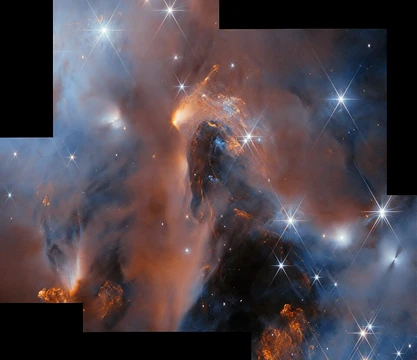
NGC 3576
Bright emission nebula and star-forming region in Carina.

NGC 3576, sometimes called the Statue of Liberty Nebula, is a bright emission nebula and a site of active star formation located in the southern constellation Carina. It sits near the galactic plane, within the Carina arm of the Milky Way, and spans roughly 100 light-years across. The nebula lies close to the Eta Carinae nebula and forms the western part of the larger complex RCW 57. At its core is a giant molecular cloud where stars are being born, with a luminous H II region expanding outward into that cloud, likely triggering additional star formation. In infrared light, this H II region ranks among the brightest in the entire galaxy. Most of the ionization comes from two O-type stars—HD 97319 and HD 97484—and two B-type stars, HD 97499 and CPD–60°2641. Many of the brightest stars here remain wrapped in the gas and dust of their birth cocoons, and a majority show an infrared excess due to surrounding circumstellar disks. Star formation appears to be moving from northeast to southwest, with the youngest stars found in the southwest. Deep within the molecular cloud lies a very young cluster of massive stars, containing 130 identified members. Distance estimates for NGC 3576 range from 2.4 to 3.0 kiloparsecs.
Quick Facts
- Epoch
- J2000.0
- Ra
- 11 · 11 · 53.2
- Dec
- −61 · 18 · 26
- Dist Ly
- 2.4 kpc to 3.0 kpc
- Dist Pc
- 2,400 to 3,000
- Constellation
- Carina
- Names
- GAL 291.30-00.7, RCW 57A, BRAN 348A, GUM 38a
Facts from the source article.
Lore & Background
NGC 3576 was discovered by John Frederick William Herschel on 16 March 1834. It lies near the galactic plane along the Carina arm of the Milky Way, close to the Eta Carinae nebula, and forms the western section of RCW 57. The complex consists of a giant, star-forming molecular cloud with a luminous H II region positioned just outside. This H II region is expanding into the molecular cloud and appears to be triggering further star formation. Most of the ionization is believed to be due to two O-type stars, HD 97319 and HD 97484, and two B-type stars, HD 97499 and CPD–60°2641.
Many of the brightest stars in this formation remain enshrouded in their natal cocoons of gas and dust, and a majority display an infrared excess from surrounding circumstellar disks. Star formation appears to be progressing from the northeast to the southwest, with the youngest stars located in the southwest. A very young cluster of massive stars with 130 identified members is embedded deep within the molecular cloud. Distance estimates for this complex range from 2.4 kpc to 3.0 kpc.
Reader's Guide
NGC 3576 holds significance as a prominent star-forming region in the Carina arm of the Milky Way. Its status as one of the brightest H II regions in the galaxy in the infrared makes it a key target for studying massive star formation and the interaction between young stars and their natal environment. The expansion of the H II region into the molecular cloud, and the apparent triggering of further star formation, provides insight into the sequential processes that shape stellar nurseries. The presence of a very young cluster of 130 massive stars, many still enshrouded in gas and dust with circumstellar disks, offers a laboratory for examining the early stages of stellar evolution and the role of infrared excess in identifying young stellar objects. The directional progression of star formation from northeast to southwest further illustrates how star formation propagates through a molecular cloud. The nebula's location near the Eta Carinae nebula and its association with RCW 57 place it within a larger complex of star formation, contributing to the understanding of galactic structure and stellar birth in the southern sky.
Did You Know?
- NGC 3576 is also known as the Statue of Liberty Nebula.
- The nebula is approximately 100 light years across.
- A very young cluster of 130 massive stars is embedded deep within its molecular cloud.
More in NGC Objects, Part 6 1-24
Spotted an error? Know more?
Reader corrections go straight into our review queue. Suggest an edit · How this site is sourced