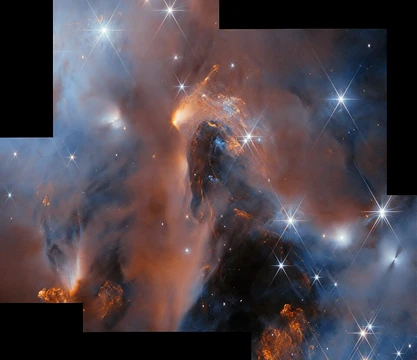
NGC 3557
Brightest elliptical galaxy in the NGC 3557 Group.

NGC 3557 is a large elliptical galaxy located in the constellation Centaurus. It is notable as the brightest and largest member of the NGC 3557 Group (also known as LGG 229), which includes at least eleven galaxies. The galaxy is classified both as a Seyfert I Galaxy and as a LINER galaxy, indicating an active nucleus with high-ionization emission lines and broad lines of weakly ionized atoms.
Quick Facts
- Constellation Name
- Centaurus
- Epoch
- J2000
- Ra
- 11 · 09 · 57.6396
- Dec
- -37 · 32 · 21.037
- Dist Ly
- 50.12 ± 3.53 Mpc
- Z
- 0.010270
- H Radial V
- 3079 ± 6 km/s
- Appmag V
- 10.4
Facts from the source article.
Lore & Background
NGC 3557 was discovered by British astronomer John Herschel on 21 April 1835. It is a large elliptical galaxy whose distance measurements show a discrepancy: the Hubble distance based on its cosmic microwave background velocity is about 50.12 Mpc, while 20 non-redshift measurements yield a mean distance of roughly 32.9 Mpc. The galaxy hosts an active nucleus classified as a Seyfert I Galaxy by SIMBAD, meaning it has a quasar-like core with very high surface brightness and strong, high-ionization emission lines, yet the host galaxy remains clearly detectable. Additionally, NED lists it as a LINER galaxy, characterized by an emission spectrum with broad lines of weakly ionized atoms. NGC 3557 is the dominant member of the NGC 3557 Group (LGG 229), which contains at least eleven galaxies including NGC 3568.
Reader's Guide
NGC 3557 holds significance as the largest and brightest galaxy in its namesake group, making it a key object for studying galaxy group dynamics and evolution. Its dual classification as both a Seyfert I and a LINER galaxy highlights the complexity of its active galactic nucleus, offering insights into the transition or coexistence of different nuclear activity types. The discrepancy between its Hubble distance and the mean of 20 non-redshift measurements underscores ongoing challenges in extragalactic distance determination. The discovery of a Type Ia supernova, SN 2023bpx, in February 2023 adds to its value as a site for supernova studies and distance calibration. As a prominent member of the Centaurus region, NGC 3557 continues to be a target for observational astronomy, contributing to our understanding of elliptical galaxies, active nuclei, and group-scale structures.
Did You Know?
- NGC 3557 was discovered by John Herschel on 21 April 1835.
- It is classified as both a Seyfert I Galaxy and a LINER galaxy.
- One supernova, SN 2023bpx (Type Ia, mag. 17), was observed in NGC 3557 on 12 February 2023.
More in NGC Objects, Part 6 1-24
Spotted an error? Know more?
Reader corrections go straight into our review queue. Suggest an edit · How this site is sourced