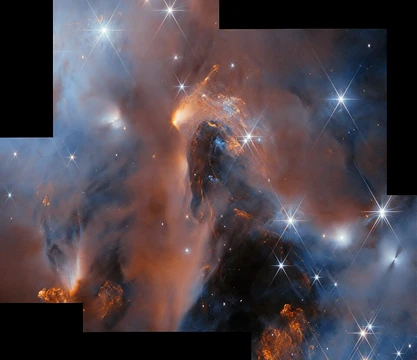
NGC 3521
A flocculent spiral galaxy with a massive bulge and a weak bar.

NGC 3521, often called the Bubble Galaxy, is a flocculent intermediate spiral galaxy located in the constellation Leo. It was discovered by German-British astronomer William Herschel on 22 February 1784. Its velocity relative to the cosmic microwave background is 1,167 ± 26 km/s, which yields a Hubble distance of 17.21 ± 1.26 Mpc, though 26 non-redshift measurements place it much closer at 11.395 ± 0.56 Mpc.
The galaxy has a morphological classification of SAB(rs)bc, meaning it is a spiral with a faint bar (SAB), a weak inner ring (rs), and moderately loose spiral arms (bc). The bar is hard to spot because of its low ellipticity and the galaxy’s high inclination of 72.7° to our line of sight. Its relatively bright bulge is nearly three-quarters the size of the bar, suggesting the bulge is quite massive. The nucleus is classified as an HII LINER, containing an H II region at the core and forming a low-ionization nuclear emission-line region.
Structurally, NGC 3521 resembles the Milky Way, and its supermassive black hole has a similar mass—about 7 million solar masses.
One supernova has been observed in this galaxy: SN2024aecx (Type Ic, magnitude 14.543), discovered by ATLAS on 16 December 2024. Initially classified as Type IIb, spectroscopy later showed it closely resembles SN 1994I.
Quick Facts
- Epoch
- J2000
- Ra
- 11 · 05 · 48.581ned
- Dec
- –00 · 02 · 09.11ned
- Constellation Name
- Leo
- Z
- 0.002672
- H Radial V
- 801 km/s
- Dist Ly
- 11.395 ± 0.56 Mpcned
- Appmag V
- 11.0
- Notes
- HII LINER
Facts from the source article.
Reader's Guide
NGC 3521 is notable for its structural resemblance to the Milky Way and for hosting a supermassive black hole of about 7 million solar masses, similar to that of the Milky Way. Its flocculent, patchy spiral arms and weak bar make it a key object for studying intermediate spiral morphology. The distance to NGC 3521 is disputed: its Hubble distance (derived from cosmic microwave background velocity) is 17.21 ± 1.26 Mpc, while 26 non‑redshift measurements yield a much closer mean distance of 11.395 ± 0.56 Mpc. This discrepancy highlights the challenges in extragalactic distance determination. The galaxy’s HII LINER nucleus and the 2024 supernova (SN 2024aecx) provide ongoing opportunities for studying nuclear activity and stellar explosions in a Milky‑Way‑like environment. Its popular nickname, the Bubble Galaxy, reflects its soft, bubbly appearance in images.
Did You Know?
- NGC 3521 is also called the Bubble Galaxy.
- It was discovered by William Herschel on 22 February 1784.
- Its supermassive black hole has a mass of about 7 million solar masses, similar to the Milky Way's.
- The only observed supernova in NGC 3521, SN 2024aecx, was originally misclassified as Type IIb.
More in NGC Objects, Part 6 1-24
Spotted an error? Know more?
Reader corrections go straight into our review queue. Suggest an edit · How this site is sourced