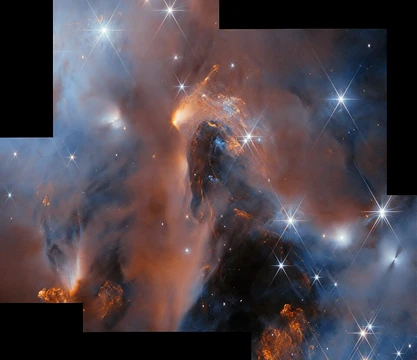
NGC 3512
An intermediate spiral galaxy in Leo with a LINER nucleus.

NGC 3512 is an intermediate spiral galaxy located in the constellation Leo. It is notable as a LINER galaxy, meaning its nucleus exhibits an emission spectrum with broad lines of weakly ionized atoms. The galaxy is a member of the NGC 3504 Group, which is part of the larger Leo II Groups, a chain of galaxies and clusters extending from the western edge of the Virgo Supercluster.
Quick Facts
- Epoch
- J2000
- Constellation Name
- Leo
- Ra
- 11 · 04 · 02.9449ned
- Dec
- +28 · 02 · 12.888ned
- Z
- 0.004580 · 0.00000200ned
- Dist Ly
- 34.800 ± 3.434 Mpcned-distance
- Group Cluster
- NGC 3504 group (LGG 227)
- Appmag V
- 12.98ned
Facts from the source article.
Lore & Background
NGC 3512 was discovered by German-British astronomer William Herschel on 11 April 1785. Its distance is uncertain: its velocity relative to the cosmic microwave background yields a Hubble distance of 24.73 ± 1.76 Mpc, while four non-redshift measurements give a farther mean distance of 34.800 ± 3.434 Mpc. The galaxy is classified as a LINER, indicating a nucleus with broad emission lines from weakly ionized atoms. It belongs to the NGC 3504 Group (also designated LGG 227), which includes eight other galaxies such as NGC 3414, NGC 3504, and UGC 5958. This group is part of the Leo II Groups, a string of galaxies and clusters on the western edge of the Virgo Supercluster. The group was also referenced by Abraham Mahtessian in a 1998 research paper. One supernova, SN 2001fv, was observed in NGC 3512: a Type II event of magnitude 16.4, discovered by British amateur astronomer Mark Armstrong on 3 November 2001.
Reader's Guide
NGC 3512 holds significance as a member of the NGC 3504 Group, which is embedded within the Leo II Groups, a structure that traces the western boundary of the Virgo Supercluster. Its classification as a LINER galaxy places it among those with active galactic nuclei that emit characteristic low-ionization spectral lines, offering insights into the processes governing such nuclei. The distance discrepancy between Hubble-based and non-redshift measurements highlights the challenges in accurately determining the galaxy's location, a common issue in extragalactic astronomy. The discovery of SN 2001fv, a Type II supernova, adds to the observational record of stellar explosions within this galaxy. The group's inclusion in Abraham Mahtessian's 1998 research underscores its role in studies of galaxy clustering and large-scale structure. Overall, NGC 3512 contributes to understanding galaxy evolution, group dynamics, and the cosmic web in the Leo region.
Did You Know?
- NGC 3512 is a LINER galaxy, meaning its nucleus shows broad emission lines from weakly ionized atoms.
- One supernova, SN 2001fv (Type II, magnitude 16.4), was discovered in NGC 3512 on 3 November 2001 by Mark Armstrong.
- The galaxy's distance is uncertain, with Hubble distance at 24.73 Mpc and a mean non-redshift distance of 34.80 Mpc.
Frequently Asked Questions
What is NGC 3512?
NGC 3512 is an intermediate spiral galaxy visible in the constellation Leo. It was first recorded by William Herschel on 11 April 1785.
What makes NGC 3512's nucleus unusual?
It is classified as a LINER galaxy, meaning its core produces broad emission lines from weakly ionized atoms rather than the stronger ionization signatures seen in Seyfert or starburst nuclei.
Which galaxy group does NGC 3512 belong to?
It is a member of the NGC 3504 Group, which in turn sits within the larger Leo II Groups—a chain of clusters and associations stretching out from the western rim of the Virgo Supercluster.
How far away is NGC 3512?
Distance estimates differ by method: the Hubble-flow calculation gives roughly 24.7 Mpc, while the average of four non-redshift measurements places it closer to 34.8 Mpc.
Why is NGC 3512 interesting to deep-sky observers?
Its LINER classification makes it a useful natural laboratory for studying low-excitation nuclear activity, and its membership in the NGC 3504 Group ties it into a well-mapped local galaxy cluster.
More in NGC Objects, Part 6 1-24
Spotted an error? Know more?
Reader corrections go straight into our review queue. Suggest an edit · How this site is sourced