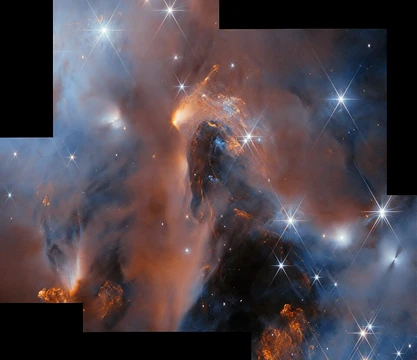
NGC 3511
A high-inclination spiral galaxy with patchy arms and a central black hole.

NGC 3511 is an intermediate spiral galaxy in the constellation Crater, approximately 41 million light-years from Earth. It is notable for its high inclination, patchy spiral arms, and a supermassive black hole at its center, and it forms a pair with NGC 3513.
Quick Facts
- Epoch
- J2000
- Ra
- 11 · 03 · 23.8090
- Dec
- -23 · 05 · 11.555
- Dist Ly
- 12.563 ± 0.339 Mpcned
- Z
- 0.003699 ± 0.000010
- H Radial V
- 1,109 ± 3 km/s
- Appmag V
- 10.8
- Constellation Name
- Crater
- Notes
- Extended HIPASS source
Facts from the source article.
Lore & Background
NGC 3511 was discovered by William Herschel on December 21, 1786, and lies two degrees west of Beta Crateris. The galaxy is seen at a high inclination of about 70°, and its spiral structure consists of two very diffuse, thick, and patchy arms that emanate from a weak, elliptical bulge, along with additional spiral arm fragments. Dark dust lanes are visible across the spiral pattern. At its center lies a supermassive black hole with an estimated mass of 1.3–6.2 million solar masses, derived from the pitch angle of the spiral arms. Originally classified as a type I Seyfert galaxy, it was later reclassified as an HII region galaxy because it exhibits only narrow emission lines. The Infrared Spectrograph on the Spitzer Space Telescope detected polycyclic aromatic hydrocarbon (PAH) emission from the galaxy. NGC 3511 forms a pair with NGC 3513, located 10.5 arcminutes away, and together with ESO 502-024 they constitute the NGC 3511 group.
Reader's Guide
NGC 3511 is significant as a nearby intermediate spiral galaxy that offers insights into spiral arm structure and dust lane dynamics at high inclination. Its reclassification from a Seyfert galaxy to an HII region galaxy highlights the importance of spectroscopic observations in refining galaxy classifications. The detection of polycyclic aromatic hydrocarbon emission by the Spitzer Space Telescope indicates ongoing star formation and the presence of organic molecules in the interstellar medium. The galaxy's supermassive black hole mass estimate, derived from spiral arm pitch angle, provides a valuable data point for calibrating black hole scaling relations. As part of a small group with NGC 3513 and ESO 502-024, NGC 3511 contributes to the study of galaxy interactions and group dynamics. Its pairing with NGC 3513, separated by only 10.5 arcminutes, makes it a useful target for understanding tidal effects and group evolution. The galaxy's legacy lies in its role as a well-observed example of a moderate-mass spiral with complex arm morphology and a central black hole, aiding comparative studies with similar galaxies such as NGC 4088 and NGC 2427.
Frequently Asked Questions
Who is NGC 3511?
NGC 3511 is an intermediate spiral galaxy located in the constellation Crater, roughly 41 million light-years from Earth. William Herschel first recorded it on December 21, 1786, and it spans approximately 107,000 light-years in apparent diameter.
What are NGC 3511's powers/role?
The galaxy stands out for its steeply tilted disc, irregular patchy spiral arms, and a supermassive black hole anchoring its core. It also forms a close galactic pair with its neighbor NGC 3513, making the duo a favored target for studying interacting systems.
Why is NGC 3511 important?
Its combination of a central supermassive black hole, high inclination angle, and tight pairing with NGC 3513 makes it a useful natural laboratory for studying spiral-galaxy dynamics and tidal interactions. It also carries the historical weight of being catalogued by Herschel nearly 240 years ago.
Where can I find NGC 3511?
Aim your telescope toward the small southern-sky constellation Crater to locate the galaxy. At its apparent width of roughly 107,000 light-years, it presents a challenging but rewarding deep-sky target, especially for observers who enjoy resolving patchy spiral structure.
More in NGC Objects, Part 6 1-24
Spotted an error? Know more?
Reader corrections go straight into our review queue. Suggest an edit · How this site is sourced