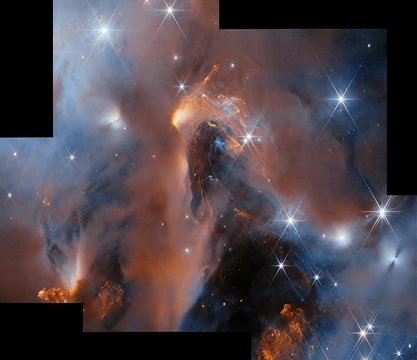
NGC 3318
Barred spiral Seyfert II galaxy in Vela with three supernovae.

NGC 3318 is a barred spiral galaxy located in the constellation Vela. It is notable as a Seyfert II galaxy, possessing a quasar-like nucleus with high surface brightness and strong, high-ionisation emission lines, while its host galaxy remains clearly detectable. The galaxy is the namesake of the NGC 3318 group (also known as LGG 199), which contains at least nine member galaxies.
Quick Facts
- Epoch
- J2000
- Constellation Name
- Vela
- Ra
- 10 · 37 · 15.5036
- Dec
- -41 · 37 · 38.859ned
- Z
- 0.009255 · 0.000021ned
- Dist Ly
- 37.550 ± 0.735 Mpcned
- Group Cluster
- NGC 3318 group (LGG 199)
- Appmag V
- 12.19ned
Facts from the source article.
Lore & Background
NGC 3318 was discovered by British astronomer John Herschel on 2 March 1835. Its velocity with respect to the cosmic microwave background corresponds to a Hubble distance of 45.38 ± 3.19 Mpc, though 20 non-redshift measurements yield a closer mean distance of 37.550 ± 0.735 Mpc. The galaxy is classified as a Seyfert II galaxy, meaning its nucleus exhibits quasar-like properties with very high surface brightness and strong, high-ionisation emission lines, yet the host galaxy remains clearly visible. NGC 3318 is the central member of the NGC 3318 group (LGG 199), which includes at least nine galaxies: NGC 3250, NGC 3250E, NGC 3250B, NGC 3318B, ESO 317-17, ESO 317-19, ESO 317-21, and ESO 317-23. Three supernovae have been observed in NGC 3318: SN2000cl (Type IIn, magnitude 14.8), discovered by French amateur astronomer Robin Chassagne on 26 May 2000; SN2017ahn (Type II, magnitude 18.0896), discovered by the Distance Less Than 40 Mpc Survey (DLT40) on 8 February 2017; and SN2020aze (Type II, magnitude 17.1224), discovered by DLT40 on 26 January 2020.
Reader's Guide
NGC 3318 holds significance as a Seyfert II galaxy, offering astronomers a clear view of both an active galactic nucleus and its host galaxy, which aids in understanding the relationship between supermassive black hole activity and galaxy evolution. The discrepancy between its Hubble distance (45.38 ± 3.19 Mpc) and the mean distance from 20 non-redshift measurements (37.550 ± 0.735 Mpc) highlights ongoing challenges in cosmic distance measurement, underscoring the importance of multiple methods. As the namesake of the NGC 3318 group (LGG 199), it serves as a reference point for studying galaxy interactions and group dynamics within a small cluster of at least nine galaxies. The three recorded supernovae—SN2000cl, SN2017ahn, and SN2020aze—provide valuable data on stellar explosions, particularly the Type IIn and Type II categories, and demonstrate the contributions of both amateur and survey-based discoveries. The galaxy's discovery by John Herschel in 1835 places it within the rich history of 19th-century astronomical cataloguing, while its modern observations continue to inform research on active galaxies and supernova physics.
Did You Know?
- NGC 3318 is a barred spiral galaxy in the constellation Vela.
- It is a Seyfert II galaxy with a quasar-like nucleus but a clearly detectable host galaxy.
More in NGC Objects, Part 5 1-24
Spotted an error? Know more?
Reader corrections go straight into our review queue. Suggest an edit · How this site is sourced