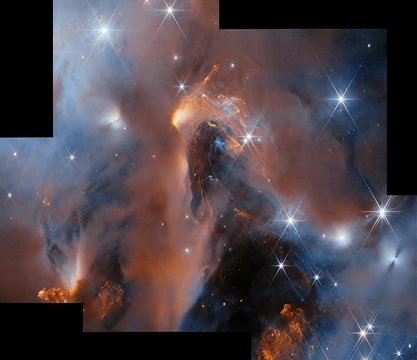
NGC 3003
A disturbed barred spiral galaxy in Leo Minor.

NGC 3003 is a nearly edge-on barred spiral galaxy in the constellation of Leo Minor. It was discovered by German-British astronomer William Herschel on December 7, 1785. The galaxy is notable for its disturbed morphology, possibly due to interaction with NGC 3021, and for hosting a supernova and a luminous blue variable.
Quick Facts
- Epoch
- J2000
- Constellation Name
- Leo Minor
- Ra
- 09 · 48 · 35.580
- Dec
- +33 · 25 · 17.83
- Z
- 0.004930
- Dist Ly
- 19.50 Mpc
- Appmag V
- 11.78
- Appmag B
- 12.25
Facts from the source article.
Lore & Background
NGC 3003 has a morphological classification of SBbc, indicating a barred spiral with moderate to loosely wound spiral arms. The galaxy's shape suggests it has been disturbed, possibly by NGC 3021, though the projected separation between the two is not specified. NGC 3003 displays high luminosity in the hydrogen-alpha line, showing a bright nucleus and many prominent H II regions. Twenty-five independent star-forming regions have been identified, including the nuclear region. There is a bright and compact region to the southwest, which may be the remains of a dwarf galaxy or an intense H II region.
One supernova and one luminous blue variable have been observed in NGC 3003. SN 1961F (Type II, magnitude 13.1) was discovered by Paul Wild on 21 February 1961. AT 2020jev (Type LBV, magnitude 20.33) was discovered by Pan-STARRS on 4 May 2020.
Reader's Guide
NGC 3003 is significant as a nearby barred spiral galaxy that exhibits signs of gravitational disturbance, likely from an interaction with NGC 3021. Its high hydrogen-alpha luminosity and numerous H II regions make it a valuable target for studying star formation processes in a disturbed galactic environment. The presence of a bright, compact southwestern region—possibly a remnant dwarf galaxy or an intense H II region—adds to its interest. The galaxy has also contributed to the study of stellar transients, having hosted a Type II supernova (SN 1961F) and a luminous blue variable (AT 2020jev), the latter discovered by Pan-STARRS. These events provide insights into the life cycles of massive stars and the dynamics of star-forming galaxies. NGC 3003 remains a subject of ongoing observation, particularly for its star-forming regions and the nature of its southwestern feature.
Did You Know?
- NGC 3003 was discovered by William Herschel on December 7, 1785.
- The galaxy hosted SN 1961F, a Type II supernova discovered by Paul Wild on 21 February 1961.
- AT 2020jev, a luminous blue variable, was discovered in NGC 3003 by Pan-STARRS on 4 May 2020.
Frequently Asked Questions
What is NGC 3003?
NGC 3003 is a barred spiral galaxy classified as SBbc, viewed at a nearly edge-on angle from Earth. It sits roughly 19.5 megaparsecs away and has an apparent visual magnitude of about 11.78, placing it well beyond naked-eye visibility.
Where in the sky can I find NGC 3003?
It resides in the constellation Leo Minor, a small and faint asterism located just north of Leo. Its recessional velocity of around 1,474 km/s reflects the expansion of space carrying it away from us.
Who discovered NGC 3003 and when?
German-British astronomer William Herschel first catalogued the galaxy on December 7, 1785, during his sweeping surveys of deep-sky objects. It has carried his name in the New General Catalogue ever since.
Why does NGC 3003 have a disturbed shape?
Its morphology appears warped and irregular, and astronomers suspect a gravitational encounter with the nearby companion galaxy NGC 3021 is the likely culprit. Such interactions can tug on a galaxy's disk and gas, producing the lopsided features we observe.
What notable transient events have occurred in NGC 3003?
The galaxy has been the site of at least one supernova explosion and also hosts a luminous blue variable star. These energetic episodes make it a useful target for studying massive stellar evolution in a barred spiral environment.
More in NGC Objects, Part 5 1-24
Spotted an error? Know more?
Reader corrections go straight into our review queue. Suggest an edit · How this site is sourced