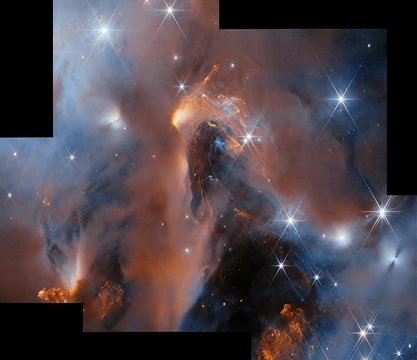
NGC 3021
A spiral galaxy used to refine the Hubble constant.

NGC 3021 is a spiral galaxy located in the northern constellation of Leo Minor, approximately 93 million light-years from Earth. It is notable for containing many Cepheid variable stars, which have been used to measure galactic distances and to help refine the measurement of the Hubble constant.
Quick Facts
- Epoch
- J2000
- Constellation Name
- Leo Minor
- Ra
- 09 · 50 · 57.146
- Dec
- +33 · 33 · 12.94
- Z
- 0.005120 · 0.000009
- Dist Ly
- 28.44 Mpc
- Appmag V
- 10.88
- Appmag B
- 12.54
- Absmag V
- −21.25
- Notes
- Starburst galaxy
Facts from the source article.
Lore & Background
NGC 3021 was discovered by German-British astronomer William Herschel on December 7, 1785. Its morphological classification is SA(rs)bc, indicating a spiral galaxy with no central bar, an incomplete inner ring structure, and moderate to loosely wound spiral arms. The galaxy is receding with a heliocentric radial velocity and lies about 93 million light-years from Earth.
Two supernovae have been observed in NGC 3021. SN 1995al, a Type Ia supernova with magnitude 13, was discovered by S. Pesci and P. Mazza in Milan, Italy, on November 1, 1995. G. M. Hurst in England confirmed the finding, estimating the magnitude at 13.2. The supernova was offset west and south of the galactic nucleus, and its spectrum was found to be similar to SN 1981b near maximum. SN 2023bvj, a Type II supernova with magnitude 17.287, was discovered by ATLAS on February 18, 2023.
Reader's Guide
NGC 3021 holds particular significance in extragalactic astronomy due to its population of Cepheid variable stars. These stars serve as standard candles for measuring cosmic distances, and observations of NGC 3021 have contributed to refining the Hubble constant, a fundamental parameter describing the expansion rate of the universe. The galaxy's well-studied Cepheids have helped calibrate the distance scale used for more remote galaxies. Additionally, the occurrence of two supernovae within NGC 3021—SN 1995al (Type Ia) and SN 2023bvj (Type II)—provides further data for understanding stellar evolution and explosion mechanisms. Type Ia supernovae, in particular, are also used as distance indicators, making NGC 3021 a valuable object for cross-checking distance measurements. The galaxy's clear spiral structure and lack of a central bar (SA classification) make it a useful example of a pure spiral morphology for comparative studies of galaxy formation and dynamics.
Did You Know?
- NGC 3021 was discovered by William Herschel on December 7, 1785.
- It contains many Cepheid variable stars used to measure galactic distances.
Frequently Asked Questions
What is NGC 3021?
NGC 3021 is a spiral galaxy sitting about 93 million light-years away in the northern constellation Leo Minor. It was first recorded by William Herschel on December 7, 1785, during his wide-ranging surveys of the sky.
What morphological type is NGC 3021?
It is classified as an SA(rs)bc spiral, which means it possesses a central bar, a ring-like structure, and relatively open spiral arms without a prominent dust lane pattern.
Who discovered NGC 3021 and when?
William Herschel identified the galaxy on December 7, 1785, as part of his systematic cataloguing of faint deep-sky objects in the northern hemisphere.
Why is NGC 3021 significant for measuring the Hubble constant?
The galaxy contains a large population of Cepheid variable stars that serve as reliable distance candles. By measuring those Cepheids, astronomers have been able to cross-check and refine the value of the Hubble constant, tightening the estimate of the universe's expansion rate.
Is NGC 3021 approaching or receding from Earth?
Its heliocentric radial velocity shows the galaxy is moving away from the Solar System, consistent with the overall cosmic expansion observed in distant objects.
More in NGC Objects, Part 5 1-24
Spotted an error? Know more?
Reader corrections go straight into our review queue. Suggest an edit · How this site is sourced